Summary
Three major policy debates in the Iowa Legislature reveal competing priorities as the state faces budget pressure and policy shifts.
Lawmakers approved a sweeping “MAHA” health bill combining SNAP restrictions, school nutrition changes, and over-the-counter ivermectin access.
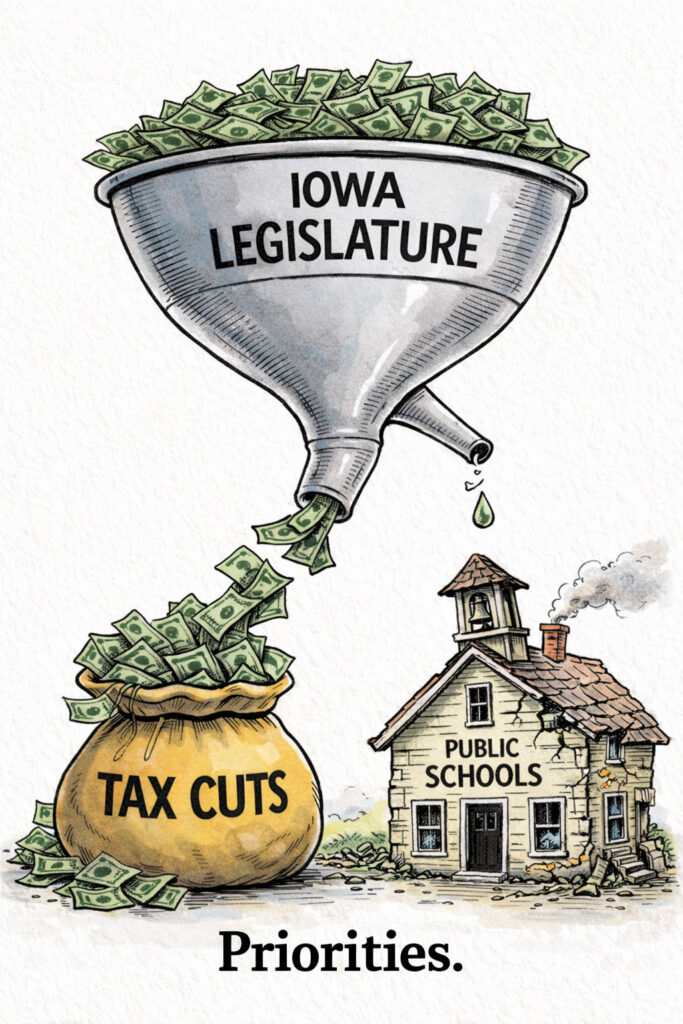
Meanwhile, Senate leaders are considering a temporary tax increase on health insurers to fill a Medicaid funding gap, while business and education leaders are warning that proposed changes to Iowa’s long-standing 260E workforce training program could harm economic growth.
Together, the issues illustrate the challenge of balancing fiscal constraints, public health policy, and workforce development priorities in Iowa.
Iowa House Passes Reynolds’ “MAHA” Bill with SNAP Limits and Ivermectin Provision
The Iowa House has approved a sweeping health-related bill championed by Gov. Kim Reynolds that combines restrictions on Supplemental Nutrition Assistance Program (SNAP) purchases with several new school health policies and a provision allowing the anti-parasitic drug ivermectin to be sold over the counter.
The bill, House File 2676, passed the chamber by a 65–30 vote and now moves to the Iowa Senate. One Republican joined Democrats in opposition. The measure is framed as aligning with the “Make America Healthy Again” (MAHA) movement associated with U.S. Health and Human Services Secretary Robert F. Kennedy Jr.
Among its provisions, the bill requires Iowa to annually seek a federal waiver to prohibit SNAP recipients from purchasing certain foods considered unhealthy, including soda and candy. It also would ban several artificial dyes and additives from school meals, mandate minimum weekly physical activity for students, limit digital learning time for younger students, and require school nutrition programs to emphasize Iowa-produced proteins such as pork and dairy.
A controversial provision would allow ivermectin to be sold over the counter without a prescription. Supporters argue the move expands consumer access and has precedent in several states, while critics, including physician-legislators, warn that misuse of the drug can lead to serious health complications.
Our Take
This legislation blends legitimate public health concerns with politically driven symbolism. Efforts to encourage healthier food options and increased physical activity for students are broadly supported goals. However, packaging these policies with highly contentious provisions like over-the-counter ivermectin access risks undermining serious health policy discussions.
The SNAP restrictions also raise complex economic questions for Iowa. Many of the processed foods targeted by the legislation contain corn-based sweeteners such as high fructose corn syrup, meaning the policy could indirectly affect Iowa’s largest agricultural sector. If the goal is improved nutrition, policymakers should carefully weigh the economic and public health implications rather than rely on ideologically branded legislation.
Iowa Senators Consider $123 Million Insurance Tax Increase to Address Medicaid Shortfall
Iowa Senate Republicans are advancing legislation that would temporarily raise taxes on health insurance companies to offset a growing funding gap in the state’s Medicaid program.
The proposal would increase the state’s tax on health maintenance organizations from 0.925% to 3.5% through September 2026, generating an estimated $123 million in additional revenue. After that period, the rate would fall back to 0.95%.
State officials say the temporary increase would allow Iowa to draw additional federal matching funds before a federal policy change limits similar provider tax increases. The bill passed the Senate Appropriations Committee on a party-line vote and now moves forward for further consideration.
Insurance industry representatives strongly oppose the measure, warning that the increase could amount to a 238% tax hike and may ultimately raise premiums for Iowa consumers. Lawmakers supporting the bill say the state faces rising Medicaid costs and must act quickly before the federal deadline for submitting the tax changes to the Centers for Medicare and Medicaid Services.
Our Take
The debate reflects a deeper structural problem of rising Medicaid costs combined with tax and budget policies that have narrowed the state’s fiscal flexibility. Rather than addressing the root causes of the Medicaid shortfall, lawmakers are attempting a short-term financial maneuver to capture additional federal matching funds.
While the proposal may temporarily stabilize Medicaid funding, shifting costs onto insurers could ultimately raise premiums for Iowa families. A sustainable solution will require a broader and deeper examination of health care spending, coverage policies, and long-term budget priorities.
Business Leaders Warn Changes to Workforce Training Program Could Hurt Iowa Employers
Business and higher education leaders are pushing back against a proposal that would eliminate the primary funding mechanism for Iowa’s long-standing Industrial New Jobs Training (260E) program.
The program allows community colleges to issue bonds that finance training for employees at expanding or relocating companies, with the bonds repaid through withholding taxes on wages from those newly created jobs. It has been used for more than four decades to support workforce development and economic growth in Iowa.
Under proposed legislation, the withholding mechanism would be eliminated, effectively removing the program’s current funding structure. State economic development officials say changes to Iowa’s income tax system and other fiscal factors have made the existing model financially difficult to sustain.
Business leaders argue the program has been a key tool for retaining talent and helping Iowa companies compete nationally. Several speakers told lawmakers the program has helped keep skilled workers in the state and enabled businesses to expand.
Our Take
The controversy surrounding the 260E program highlights a growing tension between tax policy and workforce development. Iowa leaders routinely emphasize the importance of workforce training as a cornerstone of economic competitiveness, yet proposed budget changes threaten one of the state’s most successful job training tools.
If the program’s funding structure is no longer sustainable, reform may be necessary. But eliminating the funding mechanism without a clear replacement risks weakening the very workforce development pipeline Iowa leaders say they want to strengthen.