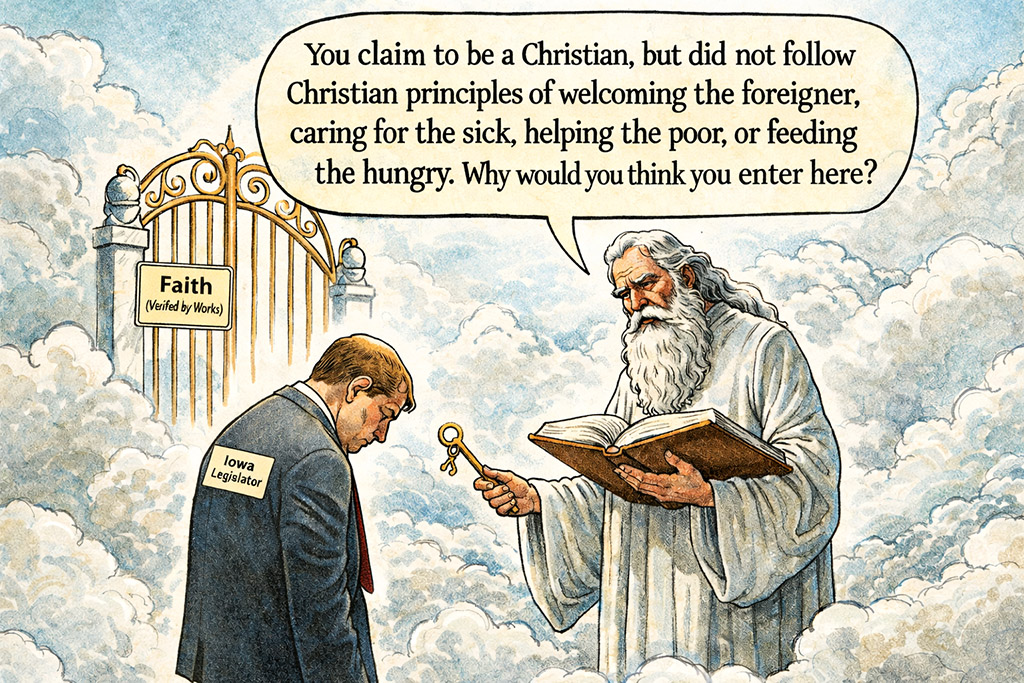
Iowa House Advances Anti-Trans and Anti-Accountability Bills in One More Culture-War Offensive
Iowa Hate
The Iowa House on Wednesday passed two deeply controversial bills that opponents say would harm already vulnerable communities while doing nothing to address the state’s actual problems. One measure, House File 2557, creates broad protections for parents who refuse to affirm a child’s gender identity and explicitly shields certain actions from being considered child abuse or endangerment. The bill says parents cannot be penalized in abuse investigations, foster parent licensing, adoption, or custody proceedings for trying to raise a child according to their sex assigned at birth. It also protects parents who refuse gender-affirming care, refuse to use a child’s chosen name or pronouns, or seek mental health treatment intended to make a child live “consistent with the child’s sex.”
Critics argued the bill effectively opens the door to conversion therapy under another name. Democrats and advocates warned that because conversion therapy is rejected by major medical organizations and not supported by accepted standards of care, the children affected by this bill may be pushed toward unregulated, unlicensed, and potentially abusive interventions. Rep. Aime Wichtendahl called the measure one designed to “shield abusers,” while Rep. Angelina Ramirez described how a child she worked with could have remained trapped in a humiliating and abusive home environment if such a law had been in effect. Republicans insisted the bill simply protects parental rights and prevents the state from treating non-affirmation of gender identity as abuse. The measure passed 65–31.
The House also passed House File 2711, which removes numerous affirmative action requirements from Iowa law, including reporting and planning obligations for state agencies, the judicial branch, the Board of Regents, community colleges, school districts, and area education agencies. Supporters said the bill promotes merit and a “colorblind” society. Opponents countered that it strips away the state’s ability to detect patterns of discrimination, could jeopardize compliance with some federal funding requirements, and removes important bias-awareness training for law enforcement. Although the bill was amended to preserve de-escalation training, Democrats said lawmakers were still dismantling practical tools that help identify inequity before it escalates into lawsuits, settlements, or entrenched institutional harm. That bill passed 64–29.
Taken together, the two bills offer a clear picture of where Iowa House leadership is choosing to spend its political energy: not on housing costs, health care access, workforce shortages, rural decline, public education stress, or economic insecurity, but on symbolic and punitive legislation aimed at marginalized people and the systems intended to monitor unequal treatment. One bill narrows protections for children who may already be at risk inside their own homes. The other weakens the state’s ability to measure whether discrimination is happening at all.
Our Take
Let’s be blunt: this is not serious governing. It is ideological theater dressed up as public policy.
The anti-trans bill is especially grotesque because it tries to solve a largely invented Iowa crisis by carving out legal cover for conduct that can plainly become humiliating, coercive, and psychologically abusive. The sales pitch is parental rights. The practical effect is state-sanctioned permission to deny a child affirming care, deny basic dignity, and then argue that any resulting harm does not count. When lawmakers write exemptions into child welfare law for behavior aimed at forcing identity conformity, they are not defending children. They are protecting adults from scrutiny.
The affirmative action bill is cut from the same cloth: claim to eliminate discrimination while removing the mechanisms used to track it. That is not neutrality. That is strategic blindness. If you eliminate reporting, oversight, and training, you do not create fairness; you create plausible deniability. The state cannot correct what it refuses to measure, and that is precisely the point. A legislature serious about equal treatment would want better data, better accountability, and better safeguards. Instead, Iowa House Republicans keep returning to the same political formula: inflame cultural resentment, target disfavored groups, call it common sense, and move on while real state problems go unsolved.
What makes this especially ugly is the mismatch between the cruelty of the policy and the triviality of the legislative imagination behind it. Iowa does not need lawmakers inventing new ways to humiliate transgender youth or pretending discrimination disappears when reporting requirements do. It needs adults willing to govern. Instead, too much of the session is being wasted on legislation whose primary achievement is to make vulnerable people less safe and everyone else more distracted.