Iowa’s First Funnel Reveals the Legislature’s Priorities: Control, Culture War, and Corporate Favor
The first legislative funnel did not merely narrow the list of bills still alive in the Iowa Legislature. It clarified the governing philosophy driving the session. Of the thousands of proposals introduced, the bills that survived show a legislature focused less on affordability, water quality, housing, health care access, or rural stabilization, and more on centralizing authority, policing identity, weakening local autonomy, and rewarding favored interests.
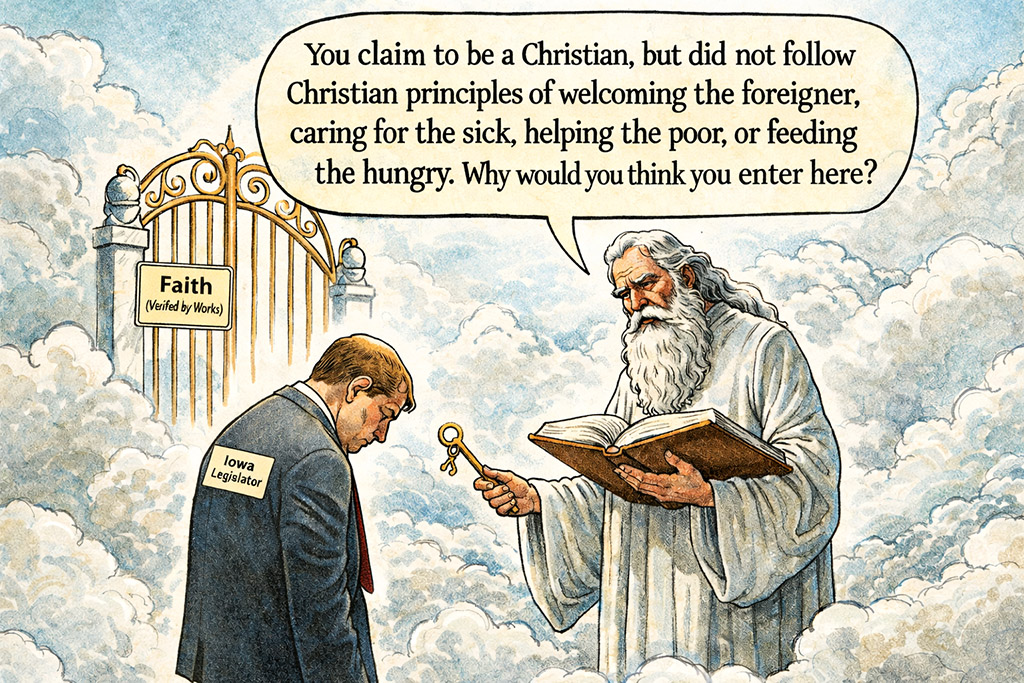
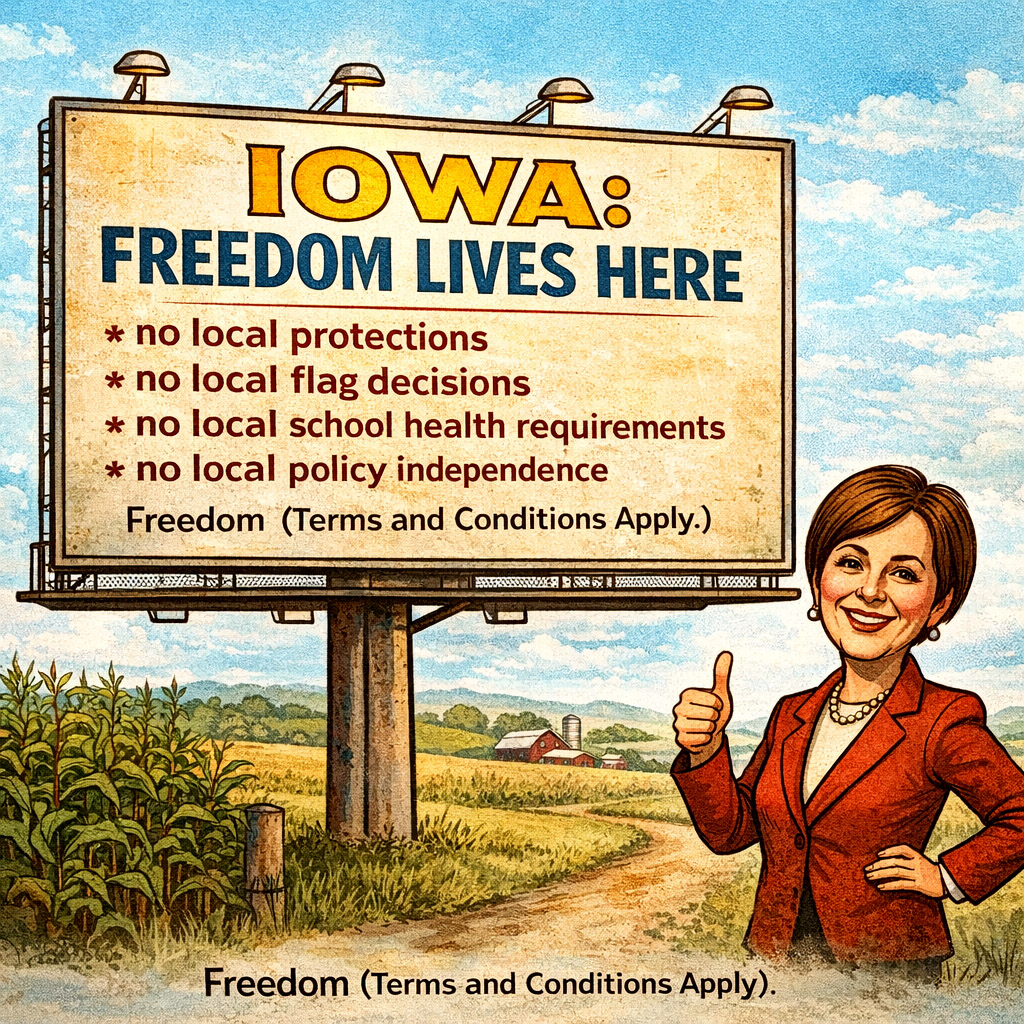
Across education, state government, law enforcement, and civil rights, the dominant theme is control. Surviving bills would restrict local libraries, expand Iowa’s “Don’t Say Gay” law, weaken affirmative action requirements, ban local transgender civil rights protections, shield anti-LGBTQ conversion efforts from child-abuse scrutiny, tighten immigration-related verification rules, and restrict public assistance eligibility. Other surviving measures would increase state oversight of rules, force local compliance with gubernatorial flag proclamations, limit local ID programs, and keep regent university presidential searches more secretive. In criminal justice, lawmakers kept alive proposals to raise bail, expand DNA collection upon arrest, and impose harsher sentencing structures.
At the same time, business and institutional favoritism is clearly visible. Bills survived to expand incentives for a possible Chicago Bears stadium, offer targeted corporate incentive tools to recruit a Corteva seed headquarters, and protect farmers from greenhouse-gas-related lawsuits. Even where there are legitimate issues in play — such as towing reform, mental health care stay limits, and eminent domain — those practical proposals must compete for oxygen with a pile of performative legislation aimed at symbolic enemies rather than real Iowa needs.
Some proposals died, including the total abortion ban, annexing Illinois counties, waiving no-fault divorce, reviving VEISHEA, direct EV sales, and birth control expansion. That matters. It suggests leadership is not simply endorsing every fringe idea thrown into the hopper. But what survived is still revealing: this is not a Legislature drifting aimlessly. It is choosing a direction — and that direction is not centered on solving the everyday problems Iowans actually live with.
Our Take
Let’s call this what it is, a session dominated by invented crises, ideological sorting, and selective “small government” hypocrisy.
If lawmakers were seriously focused on the needs of Iowans, the funnel would be full of proposals aggressively addressing affordability, stagnant wages, housing costs, child care shortages, rural hospital strain, water pollution, public school underfunding, and workforce retention. Instead, a remarkable share of the surviving bills are aimed at telling libraries what books to manage, telling schools what ideas they cannot discuss, telling local governments what protections they cannot offer, telling struggling families how long they must live in Iowa before qualifying for assistance, and telling marginalized people that they are once again the Legislature’s preferred political target.
This is not problem-solving. Much of it is problem invention. There is no broad public emergency caused by local library card partnerships, local transgender protections, community ID programs, or anti-bias training. These are not the issues keeping most Iowa families up at night. These are imported ideological priorities, national culture-war scripts translated into Iowa bill numbers. The Legislature is not responding to a groundswell of daily pain from these issues; it is manufacturing a sense of threat where none meaningfully exists and then claiming credit for fighting it.
Where there are real beneficiaries, they are often not ordinary Iowans. Bills favoring charter school expansion, corporate headquarters incentives, a possible NFL stadium, and protections from greenhouse-gas liability all reflect a familiar pattern where public power goes upward, toward institutions and interests with influence, while “accountability” and restriction are directed downward, toward workers, families, students, immigrants, transgender people, and local communities. That is not neutral governance. It is ideology combined with selective favoritism.
The deeper pattern is structural. This session is about who gets to decide. State over local. Legislature over agencies. Ideology over expertise. Cultural signaling over material problem-solving. Even the bills that appear procedural — rule approval, local ID bans, university search secrecy, public assistance verification — fit the same architecture: centralize authority, narrow discretion, weaken independent institutions, and force alignment with the majority’s political worldview.
Below is a sharper breakdown of the surviving bills and what they appear to be doing.
Funnel Overview: What Survived, and What It Suggests
Bills that address real needs, at least in part
These are the survivors that appear connected to actual public problems, even if the policy details may still be debated.
Subacute mental health care changes
Removing the rigid 10-day cap on subacute mental health care is aimed at a real operational problem in continuity of care. This appears to be a genuine attempt to align discharge timing with patient need rather than insurer convenience.
Towing and abandoned vehicle reform
This responds to longstanding complaints about predatory towing, notice failures, and excessive fees. This is real consumer protection work.
County veterans affairs overhaul
If implemented carefully, improving processing and service coordination for veterans addresses a genuine need. The caution is whether “performance-based” funding becomes a pretext for centralization without service gains.
Community colleges offering bachelor’s degrees
This responds to workforce and access needs, particularly in high-demand fields. Reasonable people can debate duplication or mission creep, but it is tied to a real labor market challenge.
State government continuing funding if budgets stall
This addresses the practical problem of shutdown disruption, though critics are right to ask whether it weakens accountability and budgeting discipline.
Farm bill / rural veterinarian / local food provisions
These appear rooted in practical agricultural and rural needs, though they are relatively modest.
Higher penalties for extreme speeding
There is a real public safety problem here, though care should be taken that enforcement remains proportionate and not merely punitive.
Bills that follow national culture-war and ideological scripts
These are the measures that most clearly fit the pattern of inventing a solution to a problem that either does not exist in Iowa in meaningful form or has been inflated for political theater.
Library restrictions / school-library separation / city control over libraries
This is classic moral panic legislation. There is no statewide emergency requiring political takeover of library governance. This is a culture-war campaign masquerading as child protection.
Expansion of “Don’t Say Gay” to all grades
This is not about educational excellence. It is about policing identity and public speech. It follows a national ideological template and addresses no pressing Iowa classroom crisis.
Ending school vaccination requirements
This is ideological anti-public-health legislation. Iowa does not need weaker disease-prevention standards; it needs stable public health and functioning schools.
Conversion therapy / child abuse carveout bill
This is among the ugliest bills still alive. It effectively creates legal cover for coercive anti-trans parenting behavior while pretending to defend families. It is a solution in search of a fabricated abuse-by-affirmation crisis.
Ban on local civil rights protections for transgender Iowans
This is not about uniformity. It is about erasing protections where local communities chose to provide them. It serves ideology, not public need.
Banning local ID programs
Community ID programs are practical local tools. Treating them as a statewide threat is ideological overreach.
School employee immigration vetting / broader immigration enforcement bills
These fit the national immigration politics playbook more than any urgent Iowa administrative breakdown. Verification can be reasonable in some contexts, but the package clearly signals symbolic politics aimed at a broader national base.
Lowering flags by gubernatorial proclamation
This is pure grievance politics elevated into statute.
School reporting on antisemitism
Antisemitism is real and serious, but lawmakers increasingly use this area selectively — often sincerely in some cases, but also sometimes as a political wedge while ignoring other forms of targeted hostility. The implementation matters.
Geoengineering ban
This has the feel of conspiracy-adjacent legislation chasing a problem that is not meaningfully driving harm in Iowa.
Bills motivated more by business interests than broad public benefit
These are the bills where the public justification may exist, but the primary energy appears driven by institutional or commercial interests, not everyday Iowa needs.
Chicago Bears stadium incentives
This is the kind of political fantasyland legislation that should embarrass serious lawmakers. Iowa does not need to subsidize an NFL stadium recruitment pitch while real infrastructure, housing, and public services strain.
Corteva headquarters incentive bill
Economic development tools can be defensible, but this is still a reminder that lawmakers can move quickly for a well-positioned corporation while everyday affordability struggles wait in line.
Charter school funding parity / access provisions
This may be framed as student opportunity, but it also advances a broader effort to shift resources and legitimacy away from traditional public schools. It reflects ideological privatization as much as educational need.
Banning lawsuits over agricultural greenhouse gas emissions
This is a protection bill for business interests, full stop. It is designed to preempt accountability rather than solve a pressing public problem.
Regent presidential search confidentiality
Presented as a recruitment measure, but it weakens public transparency in public institutions.
Bills that centralize authority and weaken local or institutional independence
This may be the biggest structural theme of the session.
Legislative approval of major administrative rules
Marketed as accountability, but it is fundamentally about subordinating agency implementation to legislative control.
Affirmative action repeal / replacing minority-business emphasis with Iowa-based businesses
This is not eliminating discrimination; it is reducing the state’s ability to see and address it, while redefining the beneficiary class in politically convenient ways.
Historical Society consolidation in Des Moines
Efficiency may be the argument, but the effect is reduced regional access and continued centralization.
Eliminating townships
Could be defensible in administrative terms, but it is another step toward consolidating governance upward.
Lawmakers’ per diem reform (or study)
Potentially valid, but even this is being softened into further process rather than real change.
What died. And what that tells us
A few notable bills died. A total abortion ban, no-fault divorce waiver, annexation of Illinois counties, direct EV sales, bottle bill expansion to non-carbonated drinks, birth control expansion, state healthcare exchange groundwork, stand-alone ivermectin OTC bill, and a VEISHEA study.
This does suggest some boundary-setting. The majority is not moving every maximalist proposal. But it also suggests they are choosing to preserve the bills that best combine ideological signaling with durable structural effect. In other words, they are not abandoning extremism so much as refining it.
Bottom line
The first funnel shows an Iowa Legislature that is not chiefly animated by solving the material problems of Iowans. It is animated by centralizing control, disciplining institutions, importing national ideological campaigns, rewarding favored business or political interests, and targeting vulnerable groups for symbolic and legal rollback.
That is the throughline. The real question for the rest of the session is not whether some useful bills remain alive. A few do. The question is whether Iowa’s lawmakers can stop legislating against imagined enemies long enough to govern for the people who live here.