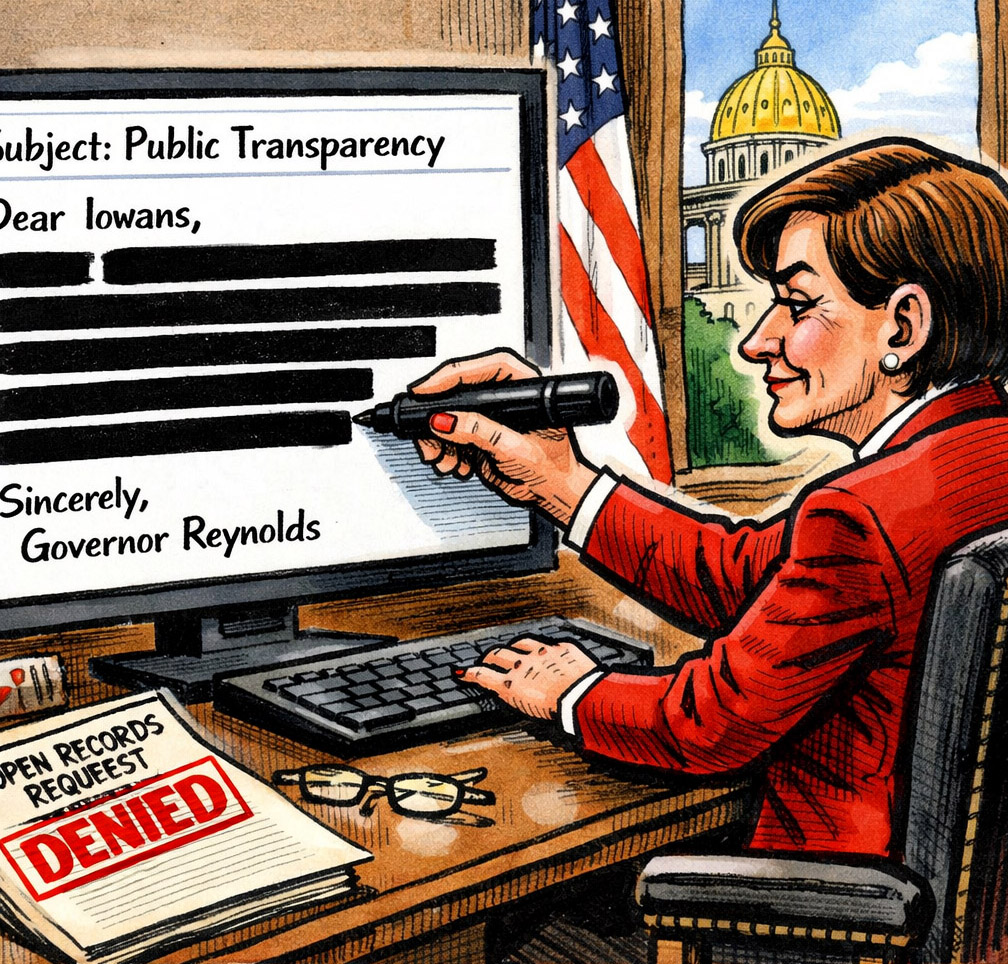
“Write Nothing You Wouldn’t Want Iowans to Read”: A Simple Rule Iowa Government Seems to Be Forgetting
When I was a child, writing thank-you notes to relatives across Iowa, my mother had a simple rule before she read it and sealed the envelope. “Don’t write anything you wouldn’t want your mother to read.”
It wasn’t about control. It was about judgment, accountability, and the understanding that words, once written, have consequences.
It is a lesson that applies far beyond childhood. It is, in fact, a principle that should sit at the very foundation of public service.
From Kitchen Tables to the Statehouse
Today, that same basic expectation to write with the assumption of public visibility is being tested in Iowa government.
Gov. Kim Reynolds is currently fighting the release of four internal emails requested by the Des Moines Register, asserting they are protected under “executive privilege.” A Polk County judge has, for now, allowed those emails to remain hidden while the court considers whether such a privilege exists under Iowa law.
That question alone should give Iowans pause. Because unlike at the federal level, where executive privilege is narrowly defined and frequently challenged, Iowa law does not clearly establish such a protection. The state’s open records framework has long leaned in the opposite direction: toward disclosure, not concealment.
The Question Isn’t Just Legal, It’s Cultural
Yes, the courts will decide whether executive privilege can be claimed here. But the deeper issue is cultural. Why is there such resistance to releasing four emails?
We do not know what is in them. And that is precisely the point.
When elected officials go to court to prevent disclosure rather than simply releasing routine communications, it invites speculation. Would the emails be politically damaging? Embarrassing? Contradictory to public statements? Or simply revealing how decisions are actually made behind the scenes?
Maybe none of those is true. But when transparency is resisted, trust does not hold steady, it erodes.
Transparency Is Not Optional
Public records laws are not a nuisance. They are not a technicality. They are a core mechanism of democratic accountability.
They exist for a simple reason. Government officials work for the public. Their records, in most cases, belong to the public. That includes emails.
Especially emails. Because in modern governance, email is where decisions are shaped, narratives are crafted, and strategies are formed.
To suggest that such communications should be broadly shielded under a doctrine not clearly recognized in Iowa law is to move the state away from transparency and toward selective visibility.
What Happens If This Standard Holds
If the court ultimately sides with the governor and establishes executive privilege in this context, the implications are significant. Future administrations could withhold internal communications more easily, and the burden shifts from government disclosure to public challenge. In short, transparency becomes conditional, not assumed.
And once that shift happens, it rarely reverses itself.
The Simple Standard Still Applies
The lesson from that kitchen table still applies. If you wouldn’t want it to be read by the public, don’t write it. That is not an unrealistic expectation. It is the baseline for public accountability.
No one is suggesting that every conversation must be public in real time. But when the work is done and when decisions are made, there must be a presumption that the public can see how and why.
That is how trust is built. And that is how it is lost.
Final Thought
This case may turn on legal definitions of whether Iowa recognizes executive privilege. But the larger question is simpler. Should transparency in Iowa be the rule, or the exception?
Four emails may not seem like much. But what is decided here will determine whether future Iowans see more, or less, of how their government works. And that is not a small matter.
Breaking With Trump, or Just His Poll Numbers?
Candidates show some dissent over the Iran war, as Grassley and Ernst vote against limiting Trump’s war powersIowa Republican candidates are changing their positions on the Iran war as Election Day approaches. That is news. Calling it a “break with Trump” may be...
Has the UI Center Lost Its Academic Legitimacy?
How Much Academic Legitimacy Does Iowa's Center for Intellectual Freedom Have Left?Eleven scholars recruited to help establish the Center have resigned. Their departure raises a bigger question about what made this politically created institution academic in the first...
Trump Lost His Lawsuit. But Did the Lawsuit Fail?
An Iowa judge threw out Donald Trump’s lawsuit against Gannett and pollster J. Ann Selzer. But after nearly two years of litigation, the case raises a larger question about what it means to “win.”President Donald Trump lost his lawsuit against Gannett (owner of the...
As Iowans Suffer, Grassley Turns His Focus to Transgender Sports
Iowa already prohibits transgender girls from competing in girls' sports. With farmers struggling with diesel prices and families confronting inflation and housing costs, why is Chuck Grassley making the issue a national priority now?Should we be concerned about his...
Would a Ban of Diesel Exports Actually Lower Prices? Likely Not.
It’s More Complicated Than Grassley BelievesSen. Chuck Grassley says the U.S. should stop exporting diesel to bring down prices for farmers and truckers. The oil industry says that could backfire. Its explanation deserves a closer look.Iowa farmers are heading into...
Iowa Corn Growers Ask for Diesel Price Relief as Harvest Begins
Iowa Corn Growers Association asks for diesel relief as harvest kicks offBy Cami KoonsIowa Capital Dispatch As Iowa farmers begin harvesting their crops, corn growers in the state are asking Iowa congressional delegates to help lower the cost of diesel fuel, which has...
Mortgage Rates Hit 7% as War Increases Housing Market Pressure
Higher energy prices, persistent inflation, and rising borrowing costs are making an already difficult housing market even harder for buyers.The New York Times reports that mortgage rates have climbed above 7% for the first time since January 2025, another economic...