From Project 2025 to Iowa’s Policy Climate
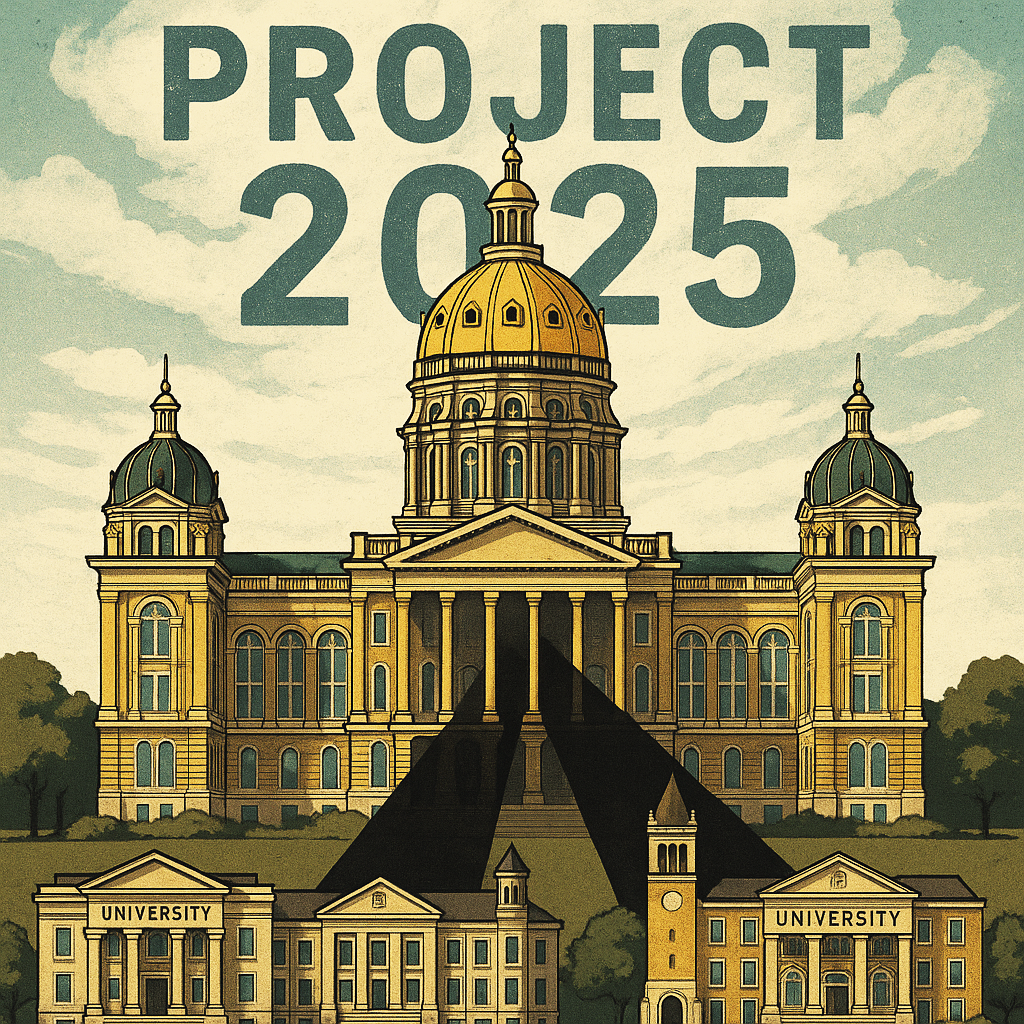
Project 2025 doesn’t just outline policy – it defines a worldview. Central to that worldview is the idea that “woke ideology” and “DEI bureaucracies” have corrupted government, education, and corporate culture by prioritizing diversity and social awareness over “merit” and “patriotism.” The document’s authors position wokeness as a form of moral decay and DEI as institutionalized discrimination against conservative or Christian viewpoints.
In Iowa, this rhetoric has become both talking point and playbook. The governor and state legislature have mirrored that framing almost verbatim — portraying DEI programs at public universities as “political indoctrination” rather than educational enrichment. In doing so, they’ve adopted Project 2025’s moral language: a crusade against cultural subversion disguised as a policy correction.
Application in Iowa: Policy and Obedience
Policy Imitation, Not Innovation
The Iowa bans on DEI offices, mandatory diversity statements, and “woke” training requirements didn’t originate from local need or data; they were modeled on a national template championed by Project 2025-aligned think tanks such as the Heritage Foundation and the Claremont Institute. The language of “removing divisive ideologies” and “restoring neutrality” is lifted almost word-for-word from those national proposals.
Subservience of State Universities
The University of Iowa, Iowa State, and UNI quickly complied with new restrictions – dismantling DEI programs, disbanding offices, and rewriting mission statements – often with minimal resistance.
This rapid capitulation underscores the political vulnerability of public universities dependent on state appropriations and board oversight. What once were centers of independent inquiry have been repositioned as extensions of executive ideology, echoing Project 2025’s goal of bringing public institutions “under presidential authority and moral discipline.”
Rhetorical Triumph Over Reality
The bans have not eliminated bias or division — they’ve simply redefined the moral vocabulary of Iowa’s public institutions. Terms like “equity” and “inclusion” have been replaced with “respect” and “excellence,” while the underlying power dynamic remains untouched.
This shift reflects Project 2025’s success at recoding political language itself – turning social awareness into sin and conformity into virtue.
Conclusion
In dismantling DEI, Iowa’s leaders did not merely eliminate programs; they signaled allegiance to a larger national movement that seeks to remake education in its own image.
By echoing the language of Project 2025, the state has turned classrooms into ideological battlegrounds and universities into laboratories for political obedience.
The cost is not only academic freedom, but also the civic promise of education itself – to question power rather than serve it.