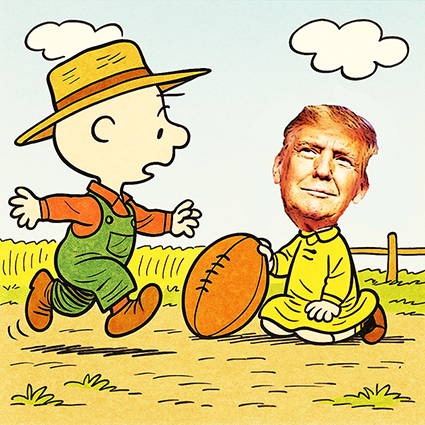
Farmer Brown – Déjà vu all over again
Rounds of Tariffs Have Decimated Iowa Soybean Export Markets
For Iowa’s soybean farmers, the numbers tell a story that politics refuses to admit. Once the backbone of America’s agricultural exports, soybeans from Iowa now struggle to find buyers abroad.
After the 2018 tariffs were imposed, China – once the state’s largest customer – began to buy soybeans from Brazil and Argentina, whose fields are nourished not only with tropical rain but with the consequences of American trade policy. Tariffs, once sold as leverage for fairer deals, have instead gutted long-term markets, leaving farmers with full bins, empty promises, and bailout checks where steady income used to be.
It’s easy to frame Project 2025’s ideological battles as distant – culture-war abstractions from Washington. But for Iowa, the fallout is tangible. The same brand of nationalist economic policy that demonized “globalism” now isolates the very producers who feed the world. In farm country, “America First” has become “Iowa Last.”
The Economic Fallout: Empty Markets, Full Bins
When the trade war began in 2018, Iowa’s soybean exports to China collapsed almost overnight. What was once a $14 billion global market for U.S. farmers has now been structurally rewired – and not in Iowa’s favor.
In 2017, China bought more than a third of all U.S. soybeans; by 2025, that share has fallen below 10 percent. Brazil and Argentina, aided by lower production costs and long-term supply contracts, now dominate the Chinese market.
For Iowa farmers, the damage is deeper than a single season’s loss. Export relationships are built on consistency, and China’s buyers no longer see the U.S. as a reliable supplier. Meanwhile, rising fertilizer and input costs – much of them driven by the same tariffs – have squeezed margins to the breaking point.
Bailout checks keep operations afloat, but they don’t replace trust, nor do they secure new customers. As one Grundy County grower recently put it, “I don’t want a handout. I want a handshake.”
The Political Cycle: Faith, Loyalty, and the Price of Policy
Iowa farmers have long been loyal to the promise that strong leadership would protect rural America. In 2018 they were told tariffs were a short-term sacrifice for long-term gain.
Seven years later, the same promises are being repackaged, even as markets remain fractured. The pattern is painfully familiar: a populist narrative of national pride masking an economic strategy that leaves producers stranded.
During each election cycle, rural voters hear that Washington elites and foreign competitors are the problem. Yet, the policies that were supposed to defend them have instead deepened dependence – not on markets, but on subsidies.
The real casualty isn’t just soybeans; it’s the independence that once defined Iowa agriculture.
What Comes Next: Reclaiming Pragmatism
The solution won’t come from another tariff, bailout, or campaign slogan. It will come from rebuilding relationships – trade diplomacy that values stability over spectacle, and leadership that listens more than it lectures. Iowa’s farmers, historically among America’s most pragmatic producers, are uniquely positioned to lead that call.
Re-opening markets will require steady negotiations with China and diversification into Southeast Asia, Europe, and Africa. But equally important is restoring credibility. Global buyers must once again believe that America – and Iowa – can deliver without politics getting in the way.
If Iowa’s farmers can demand that kind of realism from their leaders, they may yet turn this painful chapter into a turning point – one that replaces grievance with growth, and restores the promise that hard work, not ideology, should decide the price of a bushel.
The Latest
Recently the Trump administration gave $20 billion to the government of Argentina in order to support the electoral campaign of the Argentinian president, a Trump ally. This allowed Argentina to reduce their export tariffs, and as a result their lower soybean prices led to an increase of Argentinian soybean exports to China. And U.S. soybean producers continue to be locked out of the Chinese market.
Not long after that, Trump became upset with China because it refused to lower the export prices of its rare earth minerals. As a result, the president threatened to raise U.S. tariffs on China goods by 100%, to a high of 130-145%. And the stress on US-China relations has increased. This personal animosity is in no way responsible way to conduct trade; in large part because it continues to ignore the needs of US bean growers.
The White House had planned a bailout for U.S. soybean farmers, but Trump recently announced that he has placed the payments on hold until Congress passes a continuing budget resoultion. A cheap political pressure attempt that prolonged the suffering of US producers.
These are unfortunate examples of the president, who got soybean farmers into this mess, again, has once again followed his personal whims without considering the plight of U.S. farmers.
Closing: The Heartland’s Reckoning
Iowa’s farmers have weathered droughts, floods, and volatile markets, but this moment feels different. It’s not nature they’re battling – it’s policy. Decades of work to build trust with global buyers have been undone by decisions made far from the fields, in conference rooms where trade is treated as a weapon instead of a bridge.
Yet, amid the frustration, there’s also resolve. Across Iowa’s co-ops and small towns, farmers still rise before dawn, still tend to their crops with faith that the world will need what they grow.
What they’re asking for now isn’t charity or politics – it’s honesty, partnership, and a government that values stability over slogans. The future of Iowa agriculture will depend not on who shouts loudest, but on who listens the closest.
By the Numbers — The Collapse of the U.S.–China Soybean Trade
2017 – Before the Trade War
- China bought 36% of all U.S. soybeans, making it Iowa’s single largest export destination.
- The U.S. held roughly 34% of global soybean exports.
- U.S. soybean exports totaled $14.2 billion to China.
2018 – Tariffs Take Effect
- U.S.–China tariffs hit agricultural goods directly; soybean exports fell 75% within a year.
- Brazil became China’s top supplier almost overnight, shipping three times more soybeans than the U.S. that season.
2020–2022 – Bailouts and Brief Recoveries
- The federal government issued over $28 billion in farm bailout payments to offset losses.
- Some Chinese purchases resumed under the “Phase One” trade deal — but at lower volumes and unstable frequency.
2023–2025 – The Structural Shift
- China now sources over 80% of its soybeans from Brazil and Argentina.
- U.S. global market share has dropped to less than 10%.
- Iowa soybean prices remain 10–15% below pre-tariff trend levels, even amid global inflation.
- Meanwhile, Brazil’s soybean production hit a record 170 million metric tons in 2025, up nearly 40% from 2018.
Takeaway
Iowa farmers didn’t lose their competitiveness — they lost their biggest customer.
Rebuilding that trust will take diplomacy, not another subsidy.