
Iowa Lawmakers Push Project 2025 and Christian Nationalism Control
As Iowa lawmakers urge the Board of Regents to adopt Donald Trump’s “Compact for Academic Excellence,” critics warn that the plan threatens academic freedom and mirrors the goals of Project 2025 and Christian Nationalism – cornerstones of Iowa’s emerging Golden Triad.
Introduction
The Trump administration’s proposed “Compact for Academic Excellence” has been met with swift and nearly unanimous resistance from America’s leading universities.
Institutions such as the University of Pennsylvania, USC, MIT, and Brown have all rejected the deal, which promises preferential access to federal funds in exchange for strict oversight of university finances, admissions, hiring, and speech.
In statements to faculty and alumni, university leaders warned that the compact represents an unprecedented intrusion into academic freedom – an attempt to turn America’s universities into ideological instruments rather than engines of discovery.
Faculty senates at multiple institutions passed resolutions condemning the compact for violating the constitutional protection of academic liberty and undermining evidence-based research.
Despite that backlash, the Trump administration has doubled down. Officials have declared that institutions unwilling to sign the compact “shouldn’t count on any federal support,” framing the proposal as a crusade to restore “merit” and eliminate so-called “divisive” diversity, equity, and inclusion programs.
The compact also mandates a five-year tuition freeze, a cap on international students, and the requirement that universities define sex solely as “male” and “female.” Critics argue these provisions reflect not reform but ideological control, aligning education policy with political messaging rather than the public good.
From Washington to Iowa: The Push for Compliance
While the rest of the nation’s top universities are rejecting the compact, two Iowa legislators, first-term Republicans Rep. Taylor Collins and Sen. Lynn Evans, are pressing the Iowa Board of Regents to sign on. Their letter to the board, urging quick adoption, frames Iowa as a potential “leader in higher education reform.” Yet the reform they propose mirrors not the best academic practices, but the core tenets of Project 2025, the Heritage Foundation’s sweeping conservative agenda to reengineer the federal government around loyalty and ideological uniformity.
Under the compact, Iowa’s universities would be required to overhaul governance, admissions, and hiring practices to ensure “no single ideology dominates.” While framed as neutrality, the effect would be to silence perspectives deemed “woke” or “progressive”, including research on race, gender, or climate change. The compact would also compel Iowa’s universities to define “male” and “female” biologically, limit international students, and freeze tuition – effectively substituting federal political directives for institutional autonomy.
This is not merely a policy proposal; it is a test of independence. The Iowa Board of Regents, which oversees the University of Iowa, Iowa State University, and the University of Northern Iowa, now faces a defining question: Will it defend academic freedom, or surrender it for short-term financial incentives from Washington?
The Golden Triad at Work
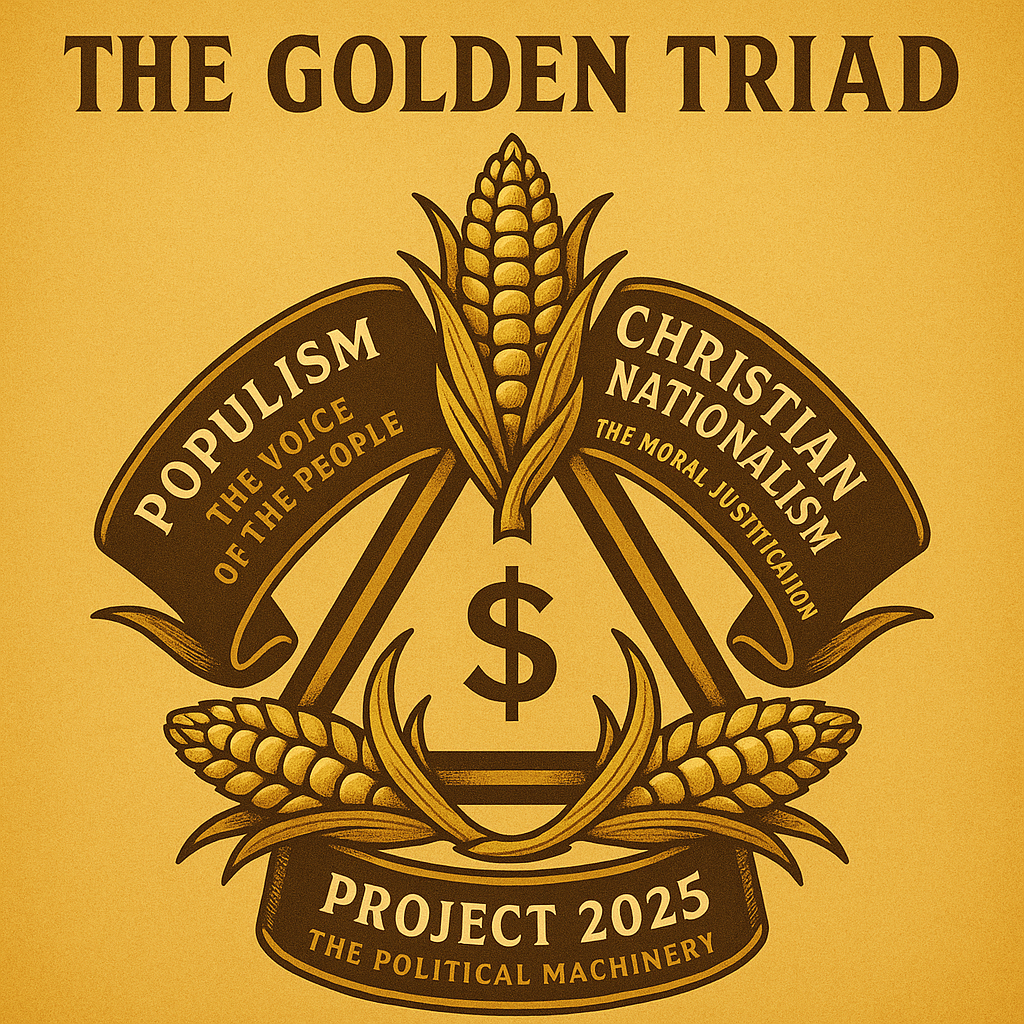
The push from Collins and Evans reveals the growing influence of what Iowa411 has described as the Golden Triad – the alliance of Populism, Christian Nationalism, and Project 2025. Each branch feeds the other: populism supplies the anger, Christian nationalism provides the moral cover, and Project 2025 delivers the political machinery.
Within this framework, the compact functions as both a loyalty test and a control mechanism. Populist rhetoric portrays universities as elitist and corrupt; Christian nationalist dogma demands conformity to “traditional” moral values; and Project 2025 turns that resentment into policy by reengineering public institutions to serve ideological ends. In Iowa, this convergence threatens to turn centers of learning into state-supervised echo chambers, where truth and evidence must first pass a political test.
Academic Freedom or Ideological Captivity?
Iowa has long prided itself on its public universities – world-class research institutions that have advanced medicine, agriculture, and social science. Yet the compact’s directives could erode that legacy by binding Iowa’s universities to federal dictates that punish dissent.
The irony is striking: a political movement that preaches “small government” now seeks federal control over what can be taught, studied, and spoken. For Iowa’s students and educators, this moment is a crossroads. Signing Trump’s compact may promise funding, but the cost would be autonomy, innovation, and the open exchange of ideas that have defined Iowa higher education for more than a century.
The Golden Triad’s reach is deep, but it is not inevitable. The courage of Iowa’s educators, students, and citizens will determine whether the state remains a beacon of independent thought – or becomes another instrument in a campaign to silence it.
Project 2025 and Iowa’s Universities
What Is Project 2025?
A coordinated blueprint created by The Heritage Foundation and over 100 conservative groups to reshape federal government and culture. It outlines how a second Trump administration could replace career officials with loyalists, restrict civil rights, and impose Christian Nationalist values across public life – including education. Read more.
Why It Matters to Iowa Higher Education
- Federal Leverage. The “Compact for Excellence” mirrors Project 2025’s goal of tying federal funding to ideological compliance.
- Academic Censorship. It calls for “institutional neutrality,” a euphemism for suppressing DEI, gender studies, and social-justice discourse.
- Gender Definition Mandate. Enforces biological essentialism, a direct echo of Christian Nationalist theology rather than science.
- International Limits. Capping student visas curbs Iowa’s global research ties — especially in agriculture and health sciences.
What Experts Say
“It’s not reform. It’s control.” – Dr. Melissa Arendt, Education Policy Scholar
“The Compact would turn the Department of Justice into an ideological enforcer.” – American Association of University Professors
The Iowa Connection
Lawmakers Taylor Collins and Lynn Evans have urged the Board of Regents to join the Compact. Their language mirrors Triad messaging – “common sense,” “neutrality,” “woke universities” – but the subtext is political capture.
Bottom Line
The Compact isn’t about tuition or efficiency. It’s about transforming Iowa’s universities from centers of inquiry into instruments of conformity.