
Iowa House advances bills reshaping university curriculum, governance and DEI policies
The Iowa House has approved a package of bills that would significantly reshape how the state’s public universities design their core curriculum, conduct presidential searches, and regulate diversity-related programs.
One of the most debated measures, House File 2361, would require Iowa’s public universities to include courses in American history and government in their general education requirements. The legislation also directs the Iowa Board of Regents to review all core curricula by the end of the year and requires civic education centers at the University of Iowa, Iowa State University, and the University of Northern Iowa to oversee lecture series and annual reporting to the legislature.
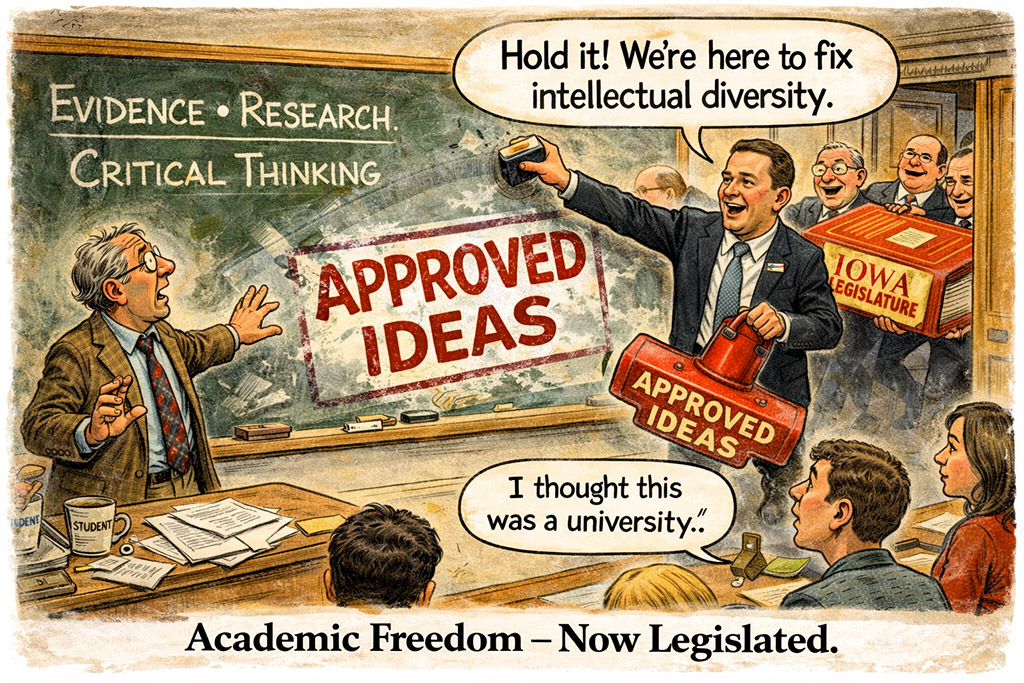
Supporters say the changes are needed to address what they describe as a lack of intellectual diversity on college campuses. Rep. Taylor Collins (R–Mediapolis) said the proposal continues efforts by the legislature to strengthen civic education and reform university curricula.
Critics argue the legislation inserts the state directly into decisions traditionally made by universities and faculty. Rep. Adam Zabner (D–Iowa City) questioned whether lawmakers would continue expanding government control over higher education curriculum in future sessions. The bill passed the House 58–33.
Another measure, House File 2487, expands the state’s restrictions on diversity, equity and inclusion programs at universities. The legislation allows the Iowa attorney general to investigate potential violations of state policy related to DEI activities at universities and community colleges. Institutions could be required to reimburse the attorney general’s office for investigation costs.
Supporters say the measure prevents ideological programming in public institutions. Opponents argue it risks politicizing academic oversight and adding enforcement responsibilities to the attorney general’s office that universities currently manage internally.
The House also passed legislation affecting university governance. House File 2245 would require the Iowa Board of Regents to use presidential search committees and restrict the board to selecting candidates recommended by those committees. Supporters said the change ensures a more structured search process following recent controversies surrounding university leadership searches.
In addition, lawmakers approved a tuition policy bill that would allow students to opt into a tuition guarantee program, locking in tuition rates for the duration of their undergraduate education in exchange for an upfront fee. The measure also limits tuition increases to the three-year rolling average of the Higher Education Price Index.
Finally, lawmakers approved legislation requiring more transparency about student loan interest rates in financial aid offers.
Several of the measures now move to the Iowa Senate for further consideration.
Our Take
The debate over these bills reflects a growing national struggle over the role of politics in higher education.
Universities traditionally operate on the principle of academic independence. This means that curriculum development, intellectual inquiry, and course design emerge from scholarly research and faculty expertise rather than political direction.
When legislatures begin dictating curriculum structures or ideological boundaries, critics argue it risks transforming universities from centers of scholarship into arenas of political enforcement.
Supporters frame these proposals as efforts to promote civic education and broaden intellectual diversity. But the mechanism used here, legislative mandates and investigative authority over academic content, raises concerns that the state is moving toward greater control over intellectual life on campus.
The long-term implications extend beyond Iowa’s universities. Research institutions compete nationally and internationally for faculty, students, and research funding. Policies perceived as political interference in academic inquiry can affect how universities are viewed by scholars, graduate students, and national academic organizations.
Higher education thrives on debate, critical inquiry, and evidence-based scholarship. Those qualities tend to grow best when ideas emerge through open academic processes—not when they are directed by statute.
As these bills move to the Senate, Iowans may want to consider not only what should be taught in universities, but who should decide.
Read more about the political takeover in Iowa’s education system.