Deleted post highlights a disconnect between political messaging and deeply held beliefs
A now-deleted social media post by President Donald Trump is drawing sharp criticism. Not just from political opponents, but from within his own base.
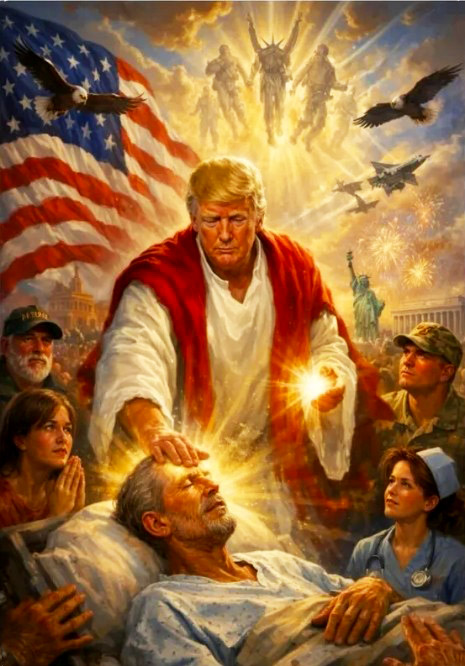
The post featured an AI-generated image depicting Trump in the role of Jesus Christ, performing a healing gesture over a man in a bed while surrounded by followers, patriotic symbols, and divine imagery.
The image was quickly removed following widespread backlash. The White House has not provided a formal explanation.
The Image Itself: Not Subtle
Seeing the image clarifies why the reaction was immediate. It portrays Trump wearing robe-like garments, performing a healing act associated with Christ surrounded by reverent onlookers and framed by heavenly light and symbolic figures above.
This is not vague metaphor. It is a direct visual comparison to Jesus Christ.
Backlash From an Unexpected Direction
Criticism came from across the political spectrum. But what stands out is the response from conservative commentators, religious writers and pro-Trump influencers. Many described the image as blasphemous, reprehensible, not a good joke, and saying that faith is not a prop.
Some called for the meme’s immediate removal (which happened), a public apology, and greater humility from Trump. That level of internal criticism is significant.
Why This Crossed a Line
For many Americans, especially in Iowa, faith is not political branding. It is deeply personal. In Christianity, Jesus Christ is not a symbol of leadership, not a metaphor for national strength, and not a role to be paralleled. He is central to belief itself.
That’s why even supporters who often defend political messaging found this difficult to accept.
The More Important Question: What Was Assumed?
The most revealing aspect of this episode may not be the image itself, but the assumption behind posting it. Because to share something like this suggests a belief that the audience would accept, excuse, or even embrace the comparison. That assumption did not hold, and the reaction made that clear.
A New Explanation. And More Questions.
This morning during a press interview President Donald Trump confirmed he created the post but claimed that the image was meant to depict him as a doctor “healing the people” as a doctor. That explanation raises immediate questions, because the image itself does not resemble a medical setting. And other than a medical professional looking up at him the graphic is not in a clinical environment, there are no medical tools or context, and no visual cues associated with a physician.
Instead, it shows a robed figure with a glowing, hands-on healing gesture with followers in poses of reverence. This is light and imagery commonly associated with a religious depiction of Christ. In other words, the visual language is not medical, it is spiritual.
When Explanation Doesn’t Match the Image
This exemplifies a continually widening credibility gap. Not because people are looking to be offended, but because the explanation does not match what viewers clearly see. And when that happens, interpretation fills the void, trust becomes harder to maintain, and the original controversy is reinforced, not resolved
“Surprised” by the Backlash?
During the same presser President Trump also said that he was surprised by the reaction to the post. That claim raises an equally important question, of “Who was the message intended for and how was it expected to be received?”
Because the response to the blasphemous meme was not limited to political opponents. It included conservative commentators, religious voices, and supporters who typically defend his messaging.
A Gap Between Message and Audience
Taken together, the sequence is telling. An image with strong religious symbolism is posted, it is removed after unexpected backlash it was later described as “medical” in intent. That points to a disconnect, not just in messaging, but in audience awareness.
Why That Matters
In politics, especially at the national level, messaging is rarely accidental, symbolism is rarely neutral, and audience reaction is rarely unpredictable. So when a message uses powerful religious imagery and generates immediate backlash, even among allies, and is followed by claims of surprise, it suggests a misreading of where the boundaries are.
Iowa411 Perspective
This is not just about a serious offense. It is about judgment and awareness. In a state like Iowa, where faith plays a central role in community life and religious identity is deeply held, messaging that crosses into sacred ground carries real consequences. And this episode suggests something important. A misreading of the audience, especially on issues of faith.
The Bottom Line
The meme has been removed but will never be gone. The image and the reaction remain. And what it reveals is not just controversy, but a disconnect between political messaging and the values of the people it reaches.
Conclusion
There are many ways to communicate strength, leadership, and vision. But when messaging crosses into deeply held beliefs the response is no longer just political. It becomes personal. And in this case, even allies made it clear that there are limits, and this crossed one.
Trump’s Jesus Meme. Definitely not a doctor.