Editorial: Treasury Is Making It Easier to Hide Who Is Behind American Companies
An Iowa411 Iowa Values Editorial
“It is the deliberate removal of a transparency safeguard created specifically to make financial crime harder to hide.”
Bessent Touts Policy that Makes It Easier to Conceal Crime
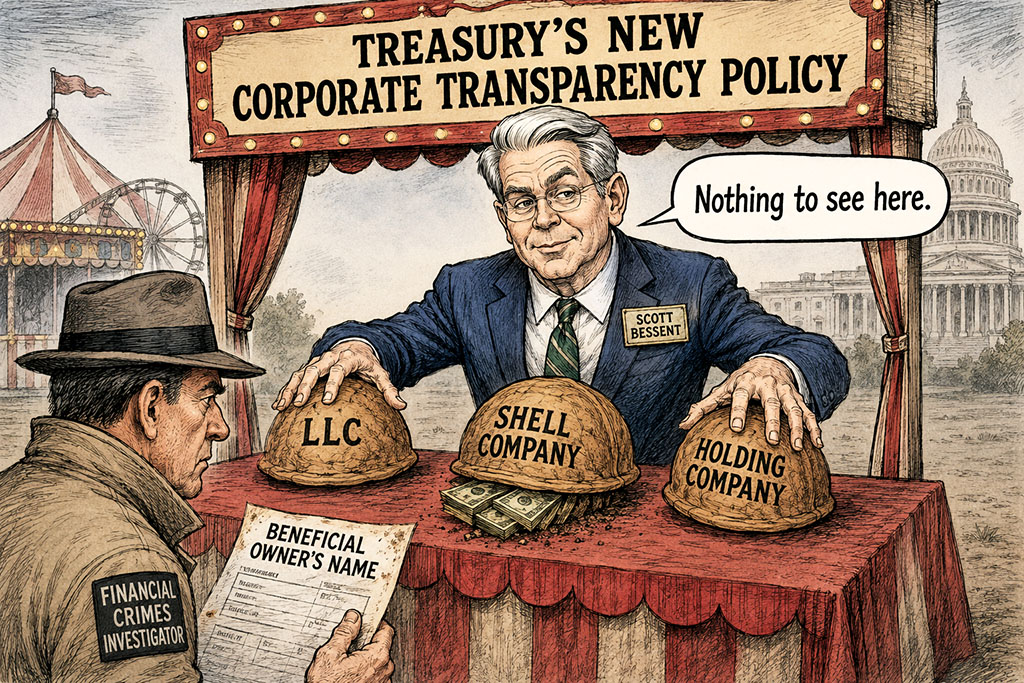
Treasury Secretary Scott Bessent has a simple sales pitch for eliminating beneficial-ownership reporting for American companies: it will save millions of law-abiding business owners from unnecessary paperwork without compromising national security.
The first part is easy to understand. Nobody wants to saddle a small Iowa business with another federal form. But that isn’t all Treasury has done.
The administration has effectively eliminated beneficial-ownership reporting for all companies created in the United States, not simply small family businesses. In doing so, it has also removed a transparency requirement specifically created to make it harder for criminals to hide behind anonymous American companies.
That is a much bigger story than paperwork.
Why Congress required ownership reporting
Congress passed the Corporate Transparency Act on a bipartisan basis in 2021 to address a remarkably simple problem. At that time, the government often didn’t know who owned or controlled a company, which created an obvious opportunity for criminals.
Someone can establish a company, have that company own another company, move money through different accounts and transactions, and make it increasingly difficult to determine who is ultimately behind it.
These aren’t necessarily businesses with factories, employees and storefronts. Some exist primarily on paper. Such shell companies can have legitimate purposes. But anonymous companies can also be useful for hiding money from fraud, corruption, drug trafficking, money laundering, sanctions evasion, and other crimes.
The Corporate Transparency Act attempted to shine some light into that darkness. Many companies were required to report their beneficial owners, the actual people who ultimately own or control them, to the Treasury Department’s Financial Crimes Enforcement Network, or FinCEN.
This was not a public database where anyone could look up their neighbor’s business interests. Access to the information was restricted for specified law-enforcement, national-security and financial-compliance purposes.
The concept was straightforward. If investigators encounter a suspicious company, they should have a way to determine who is behind it.
There was a real small-business problem
The reporting requirement wasn’t perfect. Millions of perfectly legitimate businesses suddenly faced another federal filing requirement. Small business groups raised reasonable concerns about paperwork, compliance costs, penalties and privacy.
Those concerns deserved attention. Treasury could have simplified the reporting process. Congress could have created more carefully targeted exemptions. Regulators could have looked for ways to use information businesses already provide government agencies.
There were many ways to reduce the burden on ordinary businesses while preserving transparency where it mattered most. Instead, the administration took a sledgehammer to the requirement. Domestic companies are now exempt from beneficial-ownership reporting.
And that means something important has changed. The government isn’t simply collecting less paperwork. It is collecting less information about who controls American companies.
Criminal companies also get the exemption
This is part of Bessent’s argument that Iowans should understand. A legitimate family business gets relief from the reporting requirement, but so does a domestic shell company created to conceal its ownership.
A company that moves criminal proceeds gets the exemption. A company established as part of an intentionally complicated ownership structure gets the exemption. A U.S. company being used by people outside the United States can get the exemption.
The government has not drawn the line between low-risk companies and potentially dangerous ones. It has largely drawn the line based on where the company was created. That makes little sense if the objective is preventing financial crime.
An LLC registered in an American state is an American company. That tells us very little about who is behind it. And discovering who is behind it was the entire point of beneficial-ownership reporting.
This isn’t just a hypothetical concern
The administration says it can eliminate this reporting without compromising national security. The nonpartisan Government Accountability Office has already identified a problem.
In May, GAO reported that Treasury’s exemptions had created gaps in beneficial-ownership information and recommended that Treasury determine how it will address the risks created by those gaps. GAO also has documented the larger problem that shell and front companies can conceal people’s identities and help launder illicit proceeds.
That makes Bessent’s assurance much less reassuring. The government created a system to identify the people behind opaque companies, and now it has largely stopped requiring American companies to participate in that system.
Of course that reduces paperwork. It also reduces transparency.
The foreign-company argument doesn’t solve the problem
Treasury still requires certain foreign companies doing business in the United States to report beneficial ownership. But criminals aren’t required to organize their businesses in ways that make life convenient for American investigators.
A foreign bad actor can potentially operate through an American-created company. The company may be American, but the money may not be. And the people controlling it may not be.
And their intentions certainly aren’t guaranteed to be legitimate simply because someone filed incorporation papers in the United States.
That’s why the relevant question isn’t where the company was created. It is to ask who is behind it.
This makes it easier to conceal financial crime
It would be unfair to claim that Treasury eliminated the requirement for the purpose of helping criminals. We don’t have evidence establishing that motive. But we don’t need to speculate about motive to examine consequences.
A policy does not have to be intended to help criminals to make criminals’ jobs easier. If someone wants to hide criminal money behind an American company, ownership anonymity is useful. If investigators want to follow that money, knowing who ultimately owns or controls the company is useful.
Treasury has chosen to stop requiring virtually all domestic companies to provide that information through the Corporate Transparency Act reporting system. That is not merely deregulation. It is the deliberate removal of a transparency safeguard created specifically to make financial crime harder to hide.
Protect small businesses. Not anonymous shell companies
There was a reasonable policy argument to be made about protecting small businesses from unnecessary federal paperwork. But that argument does not justify granting the same opacity to every American-created company.
We don’t have to choose between forcing the local plumbing company through unnecessary bureaucracy and allowing an anonymous shell company moving millions of dollars to conceal who controls it.
Good regulation distinguishes between the two. Treasury instead chose an exemption so broad that companies with the greatest reason to conceal their ownership receive the same relief as businesses with nothing to hide.
Secretary Bessent told Iowans that Treasury is protecting law-abiding small business owners. He should also explain who else Treasury’s decision protects. Because when government deliberately stops asking who is behind the company, the people who benefit most may be precisely those who don’t want us to know.
Iowa Values at Stake
Honesty
A legitimate company should be able to identify the people who own or control it. Corporate structures should not become disguises for people seeking to conceal criminal conduct.
Accountability
People who use companies to move money, enter contracts or conduct business should remain accountable for what those companies do.
Fairness
A local Iowa business should not be treated as though it presents the same risk as a deliberately opaque shell company. Good policy distinguishes between responsible businesses and structures created to hide ownership.
Rule of Law
Law-enforcement agencies need reasonable tools to investigate fraud, money laundering, corruption, trafficking and sanctions evasion. Removing information investigators may need makes enforcement more difficult.
Responsible Government
Government should reduce unnecessary paperwork through careful reform. Eliminating an entire safeguard because parts of it are burdensome is not careful governance.
Stewardship of Taxpayer Resources
Anonymous ownership can make it harder to recover stolen public funds, detect fraud and determine who profited from illegal activity. Protecting public money requires the ability to follow it.
Transparency
Government cannot hold companies accountable when it deliberately avoids learning who controls them. Transparency is especially important when corporate structures can be used to separate people from responsibility.
Community Responsibility
Most Iowa businesses operate openly, contribute to their communities and follow the law. Their legitimate concerns should not be used as political cover for policies that also protect anonymous actors with something to hide.
Common Sense
Protecting small businesses and investigating suspicious shell companies are not mutually exclusive goals. Iowa common sense calls for reducing needless burdens while preserving safeguards where genuine risks exist.
At a Glance
What changed?
The Treasury Department has eliminated beneficial-ownership reporting for companies created in the United States and will delete ownership information previously submitted by U.S. persons.
What is a beneficial owner?
The actual person who ultimately owns or exercises substantial control over a company.
Why was reporting required?
Congress created the reporting system to help authorized investigators identify the people behind otherwise anonymous companies used in money laundering, fraud, corruption, trafficking and sanctions evasion.
Was the information public?
No. Access was restricted to specified law-enforcement, national-security and financial-compliance purposes.
What problem did the requirement create?
Millions of legitimate small businesses faced additional paperwork, compliance costs, privacy concerns and potentially serious penalties.
What did Treasury do?
Instead of narrowing or simplifying the requirement for low-risk businesses, Treasury broadly exempted domestic companies.
Who benefits?
Legitimate small businesses receive regulatory relief. But so do anonymous American shell companies and complicated ownership structures intended to conceal who controls them.
Why does it matter?
Investigators will have less information available when attempting to follow suspicious money and identify the people behind American companies.
The central question
Could Treasury have protected ordinary small businesses without restoring anonymity to companies that may be used to conceal financial crime?