
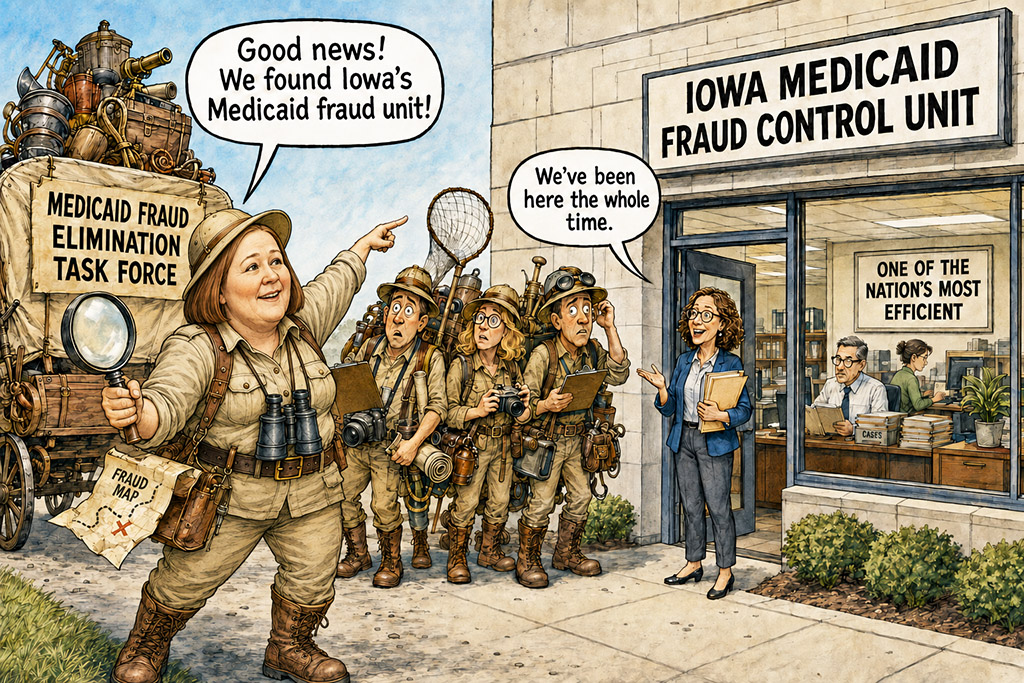
After Exhaustive Search, Task Force Discovers that Iowa Already Has a Medicaid Fraud Unit
Satire
Iowa Attorney General Brenna Bird’s Medicaid Fraud Elimination Task Force has made a remarkable discovery: Iowa already has a Medicaid Fraud Control Unit. Even more surprisingly, the unit is apparently very good at its job.
At the task force’s second meeting, representatives reported that Iowa operates one of the country’s most effective and efficient Medicaid fraud units. Unfortunately, it is trying to oversee an $8.7 billion Medicaid program with limited staff, outdated tools and only one auditor analyst available to mine the data.
This was unexpected news to almost everyone except the people who have spent years working with the unit. Former state officials Kevin Techau and Dean Lerner had already explained that Iowa possesses the legal authority, professional expertise and government partnerships needed to fight Medicaid fraud. They suggested adequately staffing the existing unit, improving its analytical technology and making greater use of the Iowa False Claims Act.
But simply listening to experienced professionals would have deprived state leaders of the opportunity to form workgroups, conduct livestreamed meetings and announce that they are searching for ways to improve something they recently discovered was already working. Bird explained that even though Iowa’s fraud unit is highly efficient, “you can take something that’s good and still make it better.”
This principle could theoretically be applied to almost any part of state government. Iowa could take something good, provide it with appropriate staffing and modern technology, and make it better without first creating a politically branded task force. But where is the excitement in that?
The task force must now continue meeting through October, when it will issue recommendations that may include hiring more investigators, improving data analysis, expanding public reporting and enforcing laws Iowa already has. In the meantime, Iowa411 has obtained absolutely no evidence that the task force is considering the following initiatives. We nevertheless offer them in the spirit of helping the attorney general find something, anything, to investigate.
Top Task Force Investigations
Operation Popsicle Stick
Investigators will conduct a statewide inventory of tongue depressors in physician offices, hospitals and clinics.
The objective is to determine whether providers have billed Medicaid for premium medical lumber while purchasing ordinary wooden craft sticks. Each depressor will be measured, photographed and tested to ensure it has not previously been used for a frozen confection. Broken sticks must be retained for seven years.
The Cotton Ball Accountability Program
Participating clinics will weigh their cotton balls at the beginning and end of every business day.
Any unexplained reduction in cotton inventory will be reported to the newly proposed Office of Suspicious Fluff. Providers unable to reconcile their cotton-ball balances may be required to submit a corrective action plan.
Waiting-Room Eligibility Patrols
Trained investigators will visit medical waiting rooms to identify Medicaid patients who appear insufficiently sick.
Warning signs may include completing a crossword puzzle, laughing at a television program, declining to cough or demonstrating excessive interest in a six-month-old copy of People magazine. Anyone observed enjoying the aquarium may be questioned about whether viewing the fish constituted an undocumented therapeutic service.
The Medical Glove Chain of Custody
Healthcare providers will be required to account for every disposable glove purchased with Medicaid funds.
Clinics must certify that gloves were used exclusively for authorized medical activities and not for washing dishes, cleaning the break-room refrigerator, gardening or making balloon animals. Investigators will pay particular attention to providers who consistently use more left gloves than right gloves.
The Missing “Aah” Database
Doctors billing Medicaid for throat examinations must preserve evidence that the patient actually said “aah.”
Responses such as “uh,” “eh” or “Do I really have to?” will be flagged for additional review. Claims involving children who refused to open their mouths may be placed on hold until the child turns 18 and can provide a sworn statement.
The Lollipop Integrity Program
Pediatric clinics must demonstrate that every lollipop was awarded for medically necessary bravery.
Children who did not cry, kick, scream or hide beneath the examination table may be required to return their lollipops. Flavor upgrades could require prior authorization.
Sugar-free lollipops will be reviewed separately by the Department of Inspections, Appeals and Confectionery Licensing.
Examination-Table Paper Surveillance
Clinics will be asked to explain every missing inch of examination-table paper.
Unusual tearing patterns could indicate waste, fraud, abuse or an unusually restless patient who may have been ineligible for benefits. Providers will be encouraged to install electronic paper-verification systems, except in rural areas where internet dead spots may prevent real-time confirmation that the paper was crinkled.
The One-Analyst Productivity Initiative
Rather than immediately hiring additional personnel, Iowa’s lone Medicaid fraud auditor analyst could be provided with a second computer monitor and an inspirational poster reading:
THERE IS ALWAYS ROOM FOR IMPROVEMENT.
If data mining remains difficult, the task force may authorize a larger shovel.
Fraud Tip Co-Branding
State officials have suggested that Iowa could improve public awareness by coordinating fraud-reporting information across agencies.
This could involve a common logo, a coordinated color palette and a more proactive typeface. After several months of deliberation, the task force may recommend placing a button that says “Report Fraud” on a website. This would represent a substantial technological advance over expecting citizens to locate the existing fraud-reporting system themselves.
The Task Force Discovers Funding
There is, of course, a serious issue beyond satire.
Iowa’s Medicaid Fraud Control Unit appears to be performing well despite staffing and technological limitations. The federal government pays 75% of the unit’s operating costs, making additional state investment an unusually good bargain. Iowa also has a False Claims Act that can be used to recover taxpayer money.
The obvious response is to fund the existing investigators, improve their tools, strengthen data analysis and enforce the laws already on the books. The task force may eventually recommend precisely that. If so, it will have spent four months discovering that experienced fraud investigators could accomplish more if Iowa gave them the resources to accomplish more.
The exercise could create another political complication. Iowa Republicans transferred Medicaid management to private insurance companies a decade ago. If the task force seriously examines payment integrity, referrals, administrative expenses and fraud detection, it may eventually have to ask whether those companies are adequately protecting public money.
Bird began this campaign by looking for evidence that patients and healthcare providers were cheating Iowa Medicaid. If she continues looking carefully, she may wind up examining the private companies Iowa pays to manage it. After months of meetings, workgroups, press coverage and tongue-depressor reconciliation reports, the task force may even identify one possible source of unnecessary Medicaid-related spending:
The task force.
Satire appears throughout Iowa411 and is clearly labeled when used. For our reporting, analysis, and investigative work, visit our News and Editorial sections.

Image Gallery: Trump’s Tarp Program
Image Gallery of Trump’s National Tarp Program Cover-ups: Nothing to See HereOur image gallery of...
Trump Administration Announces Expansion of Tarp Program
Trump’s National Tarp Program: If You Can’t Fix It, Cover ItSuccessful Kennedy Center pilot to be...
The “Give Us Another Chance” Tour Comes to Iowa
JD Vance to Voters – Please Give Us Another Chance Vice President J.D. Vance is coming to western...
Trumpapalooza Starts Today – Will Iowa Republicans Present?
Iowa411 SatireTrumpapalooza: Suggested Speaking Topics for Iowa Republicans The Republican Party’s...
Vandals Strike the National Mall – AGAIN!
Investigators Question July 4 Crews About Mysterious Grass Vandals Satire President Donald Trump...