Land, Presence, and the First Story
Iowa did not begin with settlement. Long before it became a state, before farms, towns, and borders, the land that is now called Iowa was home to Indigenous nations who understood it not as property, but as place.
Rivers, prairies, forests, and seasons were not resources to be extracted. They were part of a living system; one that shaped movement, culture, and identity. The story of Iowa begins here.
A Land of Nations
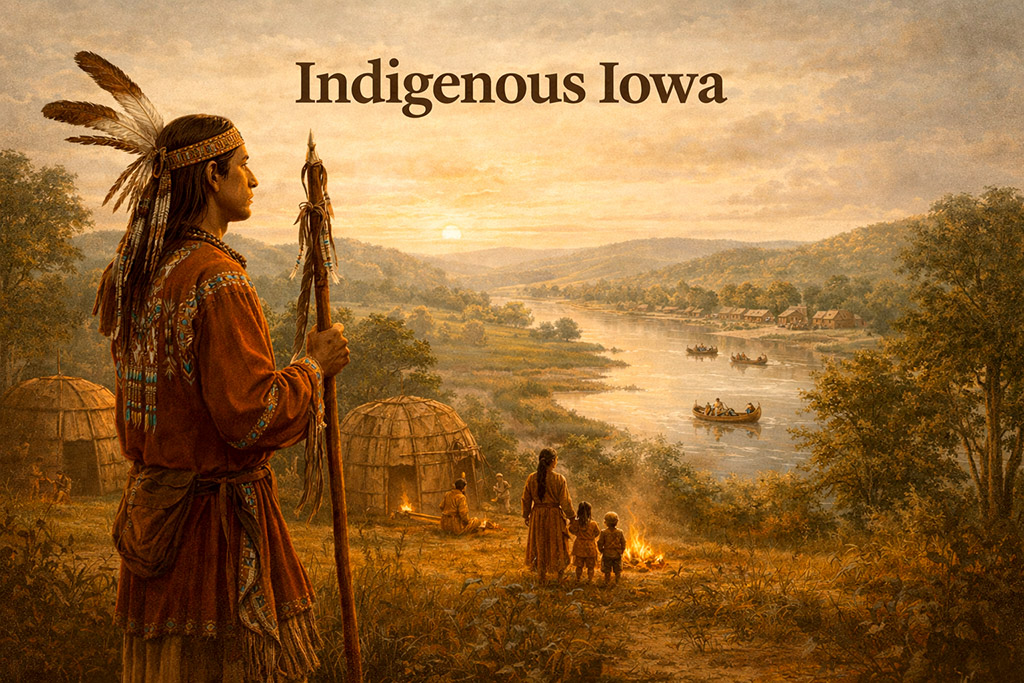
For thousands of years, the region was inhabited by Native peoples, including the ancestors of tribes such as the Meskwaki (Fox), Sauk, Ioway (Báxoje), and others. Their presence was not static.
Communities moved with the seasons, hunting, planting, gathering, and trading across a landscape that was deeply understood and carefully navigated. Knowledge of the land was not written in documents, it was lived, taught, and passed down through generations. The land provided, but it also required respect.
Relationship with the Land
Indigenous life in Iowa was defined by balance. Agriculture, especially crops like corn, beans, and squash, was combined with hunting and fishing. Rivers served as pathways, and prairies supported both wildlife and community life. This relationship was not based on control; It was based on continuity.
The land was not something to be owned outright, but something to be sustained.
Displacement and Loss
That relationship changed rapidly in the 19th century. As American expansion moved westward, pressure on Indigenous lands increased. Treaties, often made under unequal conditions, led to the cession of vast areas of land. Conflict followed, including the Black Hawk War of 1832, which marked a turning point in the removal of Native peoples from the region.
By the mid-1800s, most tribes had been forced west of the Mississippi River as the land that had defined their lives was taken.
The Meskwaki Return
One story in Iowa’s history stands apart. The Meskwaki (Sac & Fox of the Mississippi in Iowa) found a way back. Beginning in the 1850s, Meskwaki people began purchasing land in Iowa. Legally buying property rather than receiving it through federal reservation policy. Over time, they established what is now the Meskwaki Settlement in Tama County.
It remains the only federally recognized Indian settlement in Iowa. Their presence is not symbolic, it is continuous.
A Different Understanding of History
Indigenous Iowa is not only a story of the past. It is a story of presence.
Too often, Native history is treated as something that ended with removal or settlement. But Indigenous communities did not disappear. They adapted, endured, and continue to live, work, and shape Iowa today. Their history is not separate from Iowa’s story. It is foundational to it.
The First Story
Before fields were planted, before towns were built, before the state was defined, there was land, and there were people who knew it intimately. That story does not end. It continues, often quietly, sometimes overlooked, but always present.
To understand Iowa fully is to recognize that its history does not begin with settlement. It begins with those who were already here.
Return to The Iowa Story