
Iowans Must Demand Greater Transparency for Massive Data Centers
An Iowa411 Editorial
Iowans Must Question the Details of Proposed Data Centers
Artificial intelligence is transforming the global economy, and Iowa is well-positioned to benefit. With abundant land, relatively low energy costs, and a central location, the state has become increasingly attractive for the construction of large-scale data centers that support AI, cloud computing, and digital infrastructure.
The question is not whether Iowa should welcome these investments. The question is whether Iowa should ask more questions before approving them.
Texas recently took a significant step in that direction. After years of rapid data center expansion and growing concerns about the strain on electricity, water resources, and public infrastructure, Gov. Greg Abbott directed state agencies to conduct audits of proposed projects before approving new developments. The move reflects a growing recognition that facilities consuming enormous amounts of public resources deserve an equally significant level of public scrutiny.
Iowa should consider adopting a similar approach. This is not an argument against data centers, nor is it an argument against artificial intelligence or economic development.
It is an argument for transparency, accountability, and informed decision-making.
Bigger Than a Building
Today’s AI data centers are unlike traditional industrial facilities. Some require as much electricity as small cities, and many consume millions of gallons of water for cooling each day. Others require substantial investments in transmission lines, substations, roads, fiber infrastructure, and utility upgrades.
When projects reach this scale, they become more than private business decisions. They become matters of public policy.
Citizens deserve to understand not only the promised economic benefits, but also the long-term costs and obligations that accompany them.
Economic Development Requires Public Accountability
Iowa has a proud history of supporting economic development. Tax incentives, infrastructure improvements, and public-private partnerships have helped attract manufacturers, renewable energy projects, and technology companies that have strengthened the state’s economy.
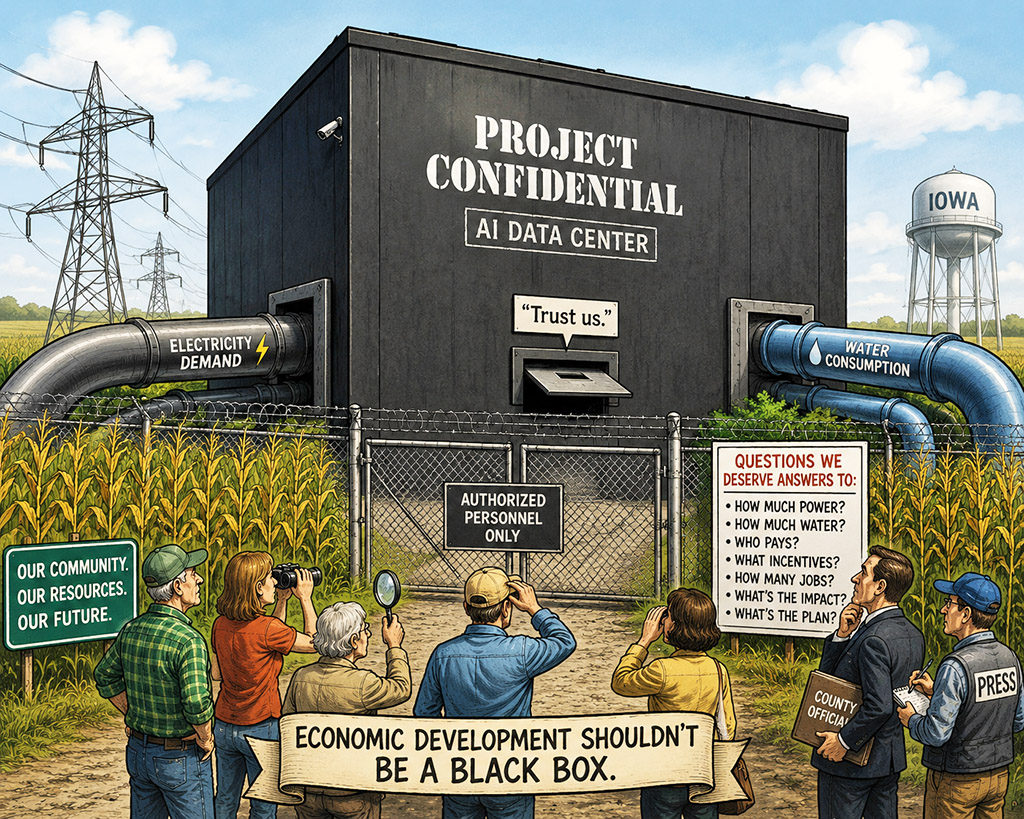
But public investment should always be accompanied by public accountability. Before approving large data center projects, Iowa policymakers should ask straightforward questions about the amount of electricity the facility will use, what new infrastructure will be required and who will pay for it, how much water will the project use, how many permanent jobs will be created, what public incentives are being offered and requested, and how will the project benefit local communities after the project is complete.
These are not anti-business questions, they are good-government questions.
Transparency Builds Public Trust
One of the recurring frustrations surrounding major development projects is that many details remain confidential until agreements have already been negotiated.
Companies often cite proprietary business information, and governments point to economic development confidentiality.
Some confidentiality is understandable. Businesses should not be required to disclose legitimate trade secrets or competitive information. But confidentiality should not become a blanket justification for withholding information that directly affects taxpayers, utility customers, and local communities.
If public dollars, public infrastructure, or public resources are involved, the public deserves meaningful information before, not after, major decisions are made.
Transparency does not discourage investment; it builds confidence that decisions are being made fairly and responsibly.
Looking Beyond Construction
Data centers are frequently promoted based on construction jobs and billions of dollars in capital investment. Those are important economic benefits, but they are only part of the story.
Communities should also understand long-term impacts, including permanent employment, electrical demand, water consumption, environmental stewardship, infrastructure maintenance, local tax revenues after incentive agreements expire, and ongoing community benefits.
These factors determine whether a project remains a long-term asset for Iowa or becomes a long-term public obligation.
An Opportunity for Iowa Leadership
Rather than waiting for controversy, Iowa has an opportunity to establish a thoughtful, transparent framework for evaluating projects of exceptional size and public significance.
The state could require a standardized public impact assessment for large data centers and similar developments that addresses energy demand, water use, infrastructure needs, economic projections, environmental impacts, and the use of public incentives.
Such a process would not delay responsible development. It would strengthen it.
Companies willing to make long-term investments should have confidence in presenting the facts behind those investments. Communities should have confidence that decisions are based on complete and accurate information.
And policymakers should have confidence that public resources are being managed responsibly.
Artificial intelligence will undoubtedly shape Iowa’s future. The question is not whether we should embrace that future, it is whether we will do so with the transparency, accountability, and public trust that Iowans have every right to expect.
Our Take
Iowa has welcomed major economic development projects for decades, and many have brought lasting benefits to communities across the state.
Data centers may represent the next chapter in that story, but their unprecedented demands on electricity, water, infrastructure, and public incentives call for an equally unprecedented level of transparency.
Responsible economic development is not measured by how quickly projects are approved, it is measured by whether citizens have the information needed to evaluate costs, benefits, and long-term impacts.
The best investment climate is one built on public trust, informed decision-making, and accountability to the people whose communities are being transformed.
Judge Strikes Down Trump’s Anti-DEI Teacher Grant Policy
Court says Education Department failed to adequately explain why it canceled more than $600 million in teacher-training grants The Trump administration can change federal education policy. But it still has to explain what it is doing and follow the law. That is the...
The “Give Us Another Chance” Tour Comes to Iowa
JD Vance to Voters – Please Give Us Another Chance Vice President J.D. Vance is coming to western Iowa Friday with a message for voters that may require a little work from the marketing department. “Give us another chance.” No, really. That was part of the vice...
Trumpapalooza Starts Today – Will Iowa Republicans Present?
Iowa411 SatireTrumpapalooza: Suggested Speaking Topics for Iowa Republicans The Republican Party’s first-ever national midterm convention, also known as “Trumpapalooza” because of its unswerving focus on President Trump, opens today in Dallas. The two-day production...
Diesel Prices Hit An All-Time High, Again
Record Diesel Prices Will Reach Far Beyond the Pump in IowaAn Iowa411 News BriefDiesel has set national records on consecutive days, increasing costs for Iowa agriculture, transportation, businesses, public services, and eventually, consumers.Record Diesel Prices...
Vandals Strike the National Mall – AGAIN!
Investigators Question July 4 Crews About Mysterious Grass Vandals Satire President Donald Trump has identified what he claims to be another act of vandalism on the National Mall. And this time, the victim is grass. Trump posted a photograph showing large patches of...
AG Bird’s Medicaid Fraud Task Force Reports Big Progress
After Exhaustive Search, Task Force Discovers that Iowa Already Has a Medicaid Fraud Unit Satire Iowa Attorney General Brenna Bird’s Medicaid Fraud Elimination Task Force has made a remarkable discovery: Iowa already has a Medicaid Fraud Control Unit. Even more...
Experts: Iowa Already Has the Tools to Fight Medicaid Fraud
Former Iowa Officials: Iowa Already Has the Tools to Fight Medicaid FraudReynolds, Bird Failed to Use Existing State Resources Two former Iowa officials with extensive experience investigating health care fraud argue that Gov. Kim Reynolds and Attorney General Brenna...