
The Cost of Outsourcing Accountability: Medicaid, Private Insurers, and Iowa Values
An Iowa411 Iowa Values Editorial
The Cost of Outsourcing Accountability
KFF Health News recently examined one of the defining policy questions in Iowa’s 2026 governor’s race: Should Iowa continue using private insurance companies to administer Medicaid, or should the state return the program to direct public management? The article focuses on the candidates’ competing visions. But it also raises a broader question that extends well beyond healthcare.
The debate is not simply about Medicaid. It is about accountability.
Public-private partnerships
Private companies perform countless services for government. They build roads, maintain computer systems, provide engineering services, process claims, and administer public programs. There is nothing inherently wrong with public-private partnerships. In many cases, they produce innovation, efficiency, and expertise that government alone may not provide.
The question is not whether private companies should make a profit. The question is what happens when the service being managed is not a highway or a software system, but healthcare for hundreds of thousands of vulnerable Iowans.
Medicaid’s commitment to Iowans
That changes the conversation. Medicaid is more than another government contract. It is a public commitment to children, seniors, people with disabilities, and low-income families who depend on timely access to healthcare.
Private insurers have legal obligations under their contracts with the state and must comply with extensive federal and state regulations. Those requirements are important safeguards.
But they are not the same as public accountability. Corporate leaders have fiduciary responsibilities to the companies they manage. Their organizations must remain financially sustainable. Those are legitimate business responsibilities.
Responsibilities of government and private contractors
Government has a different responsibility. Its obligation is to the public. That distinction matters because every system creates incentives.
A managed care organization has incentives to improve efficiency, coordinate care, prevent unnecessary hospitalizations, and negotiate lower healthcare costs. Those goals can benefit both taxpayers and patients.
Why oversight matters
But critics also argue that the same financial incentives can encourage narrower provider networks, more prior authorization requirements, delayed approvals, or denied claims. Whether those concerns exist in any case should be evaluated through evidence, audits, and performance data, not assumptions.
That is precisely why oversight matters.
One of the most important questions raised by the KFF story is not whether private management is inherently good or bad. It is whether Iowa has built a system capable of measuring success honestly and responding effectively when problems occur.
Beyond oversight to accountability
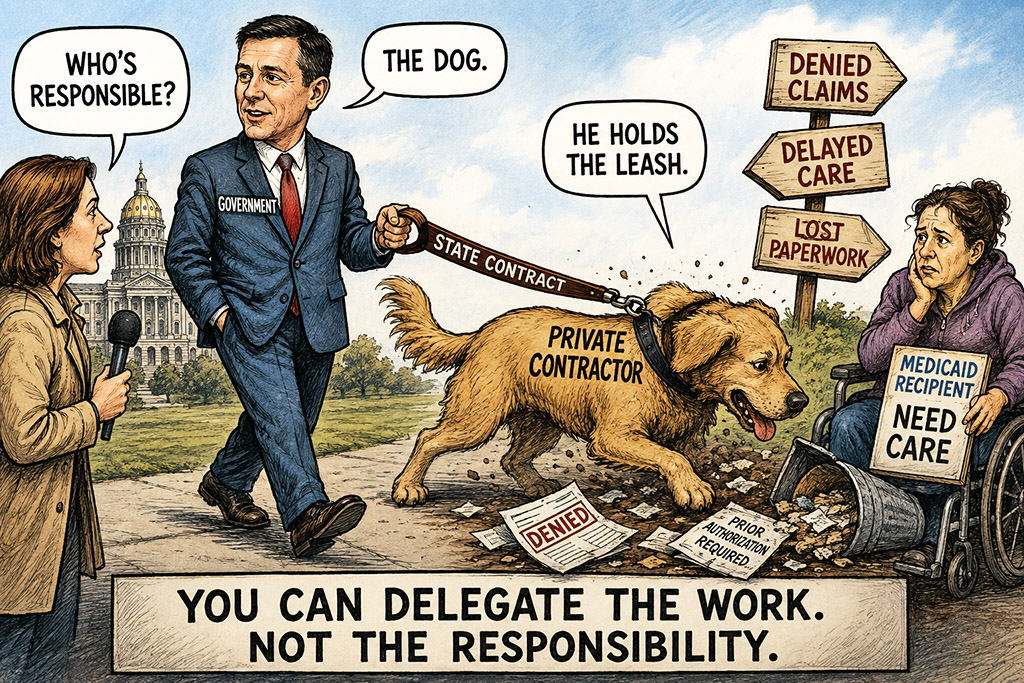
When a private company administers Medicaid, who is ultimately accountable if patients experience unnecessary delays in care? Who answers when providers struggle with reimbursements? Who explains rising administrative costs? Who ensures that patient data is protected and used only for appropriate purposes?
And most importantly, who answers to the public? The answer cannot simply be “the insurance company,” because citizens do not elect insurance executives. They elect governors, legislators, and other public officials.
Government cannot contract away responsibility and accountability
Government may contract for services, but it cannot contract away responsibility.
That principle extends far beyond Medicaid. Whenever government delegates a public responsibility, whether it involves healthcare, prisons, foster care, transportation, or information technology, it also assumes an obligation to oversee that work aggressively, measure outcomes objectively, and intervene when the public interest is no longer being served.
Outsourcing administration should never become outsourcing accountability.
The 2026 governor’s race offers Iowans two different visions for managing Medicaid. Voters will decide which approach they prefer. Regardless of that outcome, one principle should remain constant.
What Iowa taxpayers deserve from private Medicaid insurers
If private management continues, Iowa taxpayers deserve rigorous audits, transparent performance measures, enforceable contracts, and public reporting that demonstrates whether patients are receiving the care they were promised.
If the state resumes direct administration, Iowans should expect the same level of transparency, measurable outcomes, and accountability from government itself.
The management model may change, but the responsibility never does. Public trust depends on knowing that someone, not just a contract, is ultimately accountable for serving the people of Iowa.
Iowa Values in Focus
Accountability
Government remains responsible for public programs, even when private companies administer them.
Human Dignity
Every Medicaid recipient deserves timely, respectful, and appropriate access to healthcare.
Stewardship
Public funds should be managed efficiently, transparently, and in the best interests of both taxpayers and beneficiaries.
Truth and Transparency
Performance should be measured through objective evidence, independent audits, and open public reporting.
Ethical Leadership
Leaders should evaluate programs based on outcomes rather than ideology and be willing to make changes when the evidence warrants it.
At a Glance
What happened?
A KFF Health News investigation highlights Medicaid as a major issue in Iowa’s 2026 governor’s race, with Rob Sand proposing to return Medicaid administration to the state and Zach Lahn supporting Iowa’s current private managed-care model.
Why does it matter?
More than 700,000 Iowans rely on Medicaid or the Iowa Health and Wellness Plan for healthcare. How the program is administered affects access to physicians, hospitals, prescriptions, and other essential medical services.
What’s the debate?
The central question is not simply whether private companies should administer Medicaid, but whether the current managed-care system provides sufficient accountability, transparency, and protection for patients and taxpayers.
What is an MCO?
A Managed Care Organization (MCO) is a private insurance company that contracts with the state to administer Medicaid benefits, coordinate care, process claims, and manage healthcare costs.
Why is accountability important?
While administration can be contracted to private organizations, responsibility for the Medicaid program ultimately remains with the State of Iowa and the elected officials who oversee it.
The Iowa Values Question
Can government outsource public services without outsourcing accountability?