Save Our Bacon Act Sparks Debate Over Animal Welfare, Interstate Commerce, and States’ Rights
Animal Welfare and Interstate Commerce Collide in Save Our Bacon Act Debate
A federal bill backed by Iowa lawmakers is reigniting a national debate over animal welfare, interstate commerce, and the limits of state authority.
The “Save Our Bacon Act,” introduced by U.S. Rep. Ashley Hinson and supported by Iowa’s congressional delegation, would prohibit states from imposing livestock production standards on products raised outside their borders.
Supporters say the bill protects farmers from a growing patchwork of state regulations, while opponents argue it would override voter-approved animal welfare laws and weaken states’ ability to regulate products sold within their own markets.
California’s Prop. 12
The legislation is largely a response to California’s Proposition 12 and a similar Massachusetts law. California voters approved Proposition 12 in 2018, establishing minimum space requirements for breeding pigs, egg-laying hens, and veal calves whose products are sold in California, regardless of where the animals are raised.
Supporters of the Save Our Bacon Act argue that California’s law effectively allows one state to dictate production practices nationwide because producers seeking access to California’s large consumer market must comply with its standards. “California politicians have no business regulating Iowa agriculture,” Iowa Attorney General Brenna Bird said in support of the legislation.
Agricultural organizations including the Iowa Farm Bureau, Iowa Pork Producers Association, National Pork Producers Council, and many elected officials contend that Proposition 12 increases production costs, creates uncertainty, and places disproportionate burdens on small and mid-sized producers. According to supporters, compliance can require significant facility investments and contribute to higher food prices.
Opponents’ viewpoint
Opponents view the issue differently. Animal welfare organizations, consumer advocacy groups, legal scholars, and some farmers argue that California voters have the right to determine which products may be sold within their state. They contend that Proposition 12 does not regulate Iowa farms directly but instead establishes standards for products entering California’s marketplace.
Critics of the Save Our Bacon Act also argue that the bill could have consequences beyond animal welfare. A legislative analysis published by Harvard Law School’s Brooks McCormick Jr. Animal Law & Policy Program concluded that the legislation could potentially affect hundreds of state and local livestock-related laws and regulations involving public health, food safety, animal disease prevention, and consumer protections. The analysis also warned that the legislation could create legal uncertainty and generate significant litigation.
An unusual policy conflict
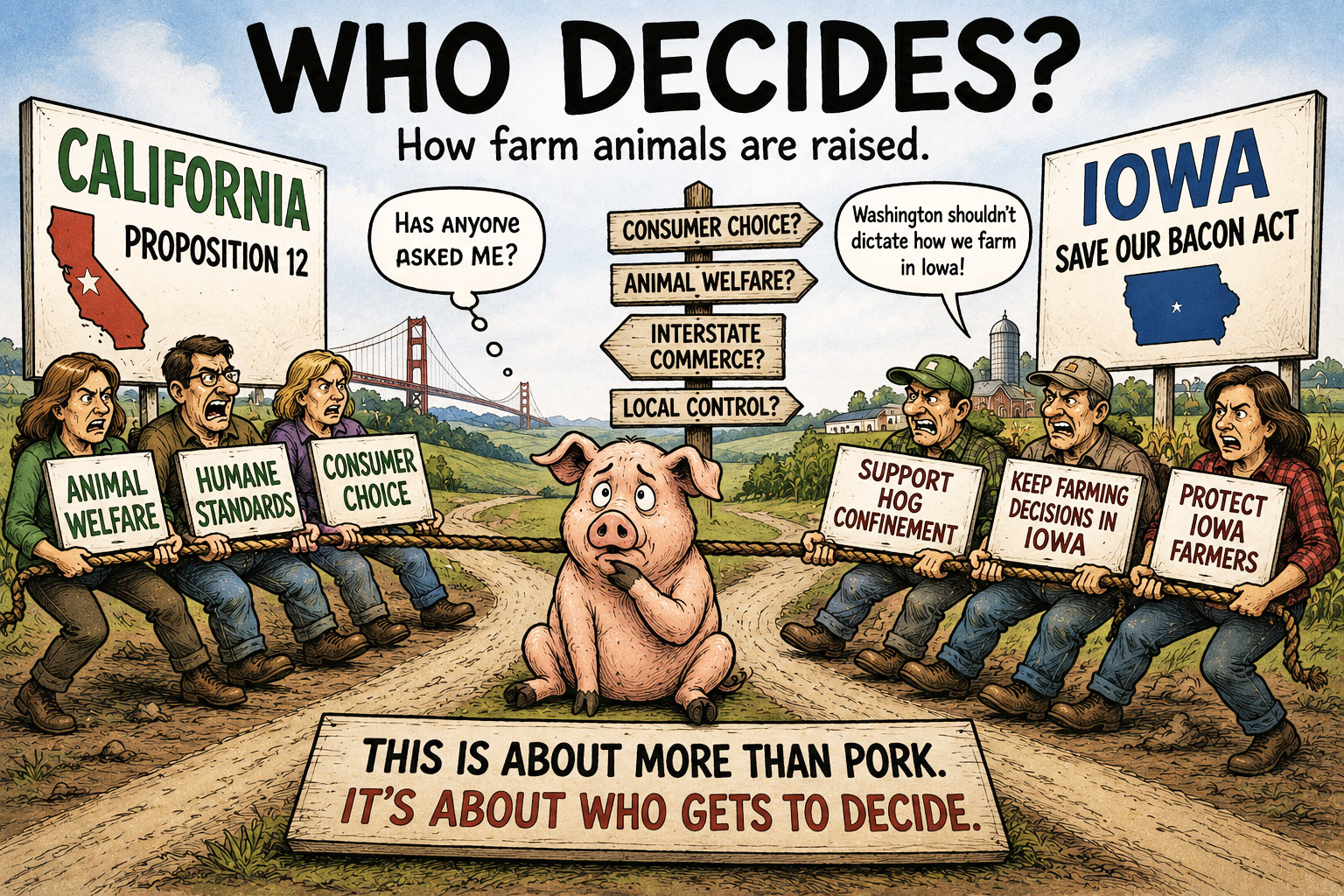
The debate highlights an unusual political conflict. Supporters frame the bill as a defense of interstate commerce and protection against regulatory overreach from states such as California and Massachusetts. Opponents argue the legislation would itself represent federal overreach by overriding laws adopted by individual states and their voters.
The issue has also become politically charged. Hinson recently criticized Democratic Senate candidate Josh Turek for opposing the legislation, characterizing supporters of Proposition 12 as “radical” activists. However, opposition to the bill includes a diverse coalition of animal welfare organizations, consumer advocates, legal scholars, public health advocates, and some agricultural interests.
Core debate
At its core, the debate extends beyond pork production. The central question is whether states should be allowed to establish standards for products sold within their borders when those standards influence production practices elsewhere. The answer could shape future disputes involving agriculture, consumer protections, environmental regulations, and other areas where state policies intersect with national markets.
The stakes for Iowa
For Iowa, where pork production plays a major role in the state’s economy, the stakes are significant. For consumers and voters nationwide, the debate raises broader questions about animal welfare, consumer choice, federalism, and who gets to set the rules in a national marketplace.
As Congress continues to consider the legislation as part of the broader Farm Bill debate, the conflict over the Save Our Bacon Act is likely to remain one of the most closely watched agricultural policy battles in the country.
Related
Iowa Legislators at Odds Over the Iran War
Hinson Calls for End to Iran War as Grassley and Ernst Vote to Continue ItIowa Republican Rep. Ashley Hinson is now calling for an “immediate end” to the nearly seven-month Iran war, even as Iowa Republican Sens. Chuck Grassley and Joni Ernst voted Thursday against a...
Breaking With Trump, or Just His Poll Numbers?
Candidates show some dissent over the Iran war, as Grassley and Ernst vote against limiting Trump’s war powersIowa Republican candidates are changing their positions on the Iran war as Election Day approaches. That is news. Calling it a “break with Trump” may be...
Has the UI Center Lost Its Academic Legitimacy?
How Much Academic Legitimacy Does Iowa's Center for Intellectual Freedom Have Left?Eleven scholars recruited to help establish the Center have resigned. Their departure raises a bigger question about what made this politically created institution academic in the first...
Trump Lost His Lawsuit. But Did the Lawsuit Fail?
An Iowa judge threw out Donald Trump’s lawsuit against Gannett and pollster J. Ann Selzer. But after nearly two years of litigation, the case raises a larger question about what it means to “win.”President Donald Trump lost his lawsuit against Gannett (owner of the...
As Iowans Suffer, Grassley Turns His Focus to Transgender Sports
Iowa already prohibits transgender girls from competing in girls' sports. With farmers struggling with diesel prices and families confronting inflation and housing costs, why is Chuck Grassley making the issue a national priority now?Should we be concerned about his...