Collapse, Community, and the Fight to Hold On
The Great Depression did not arrive in Iowa with a single moment of impact. It came gradually, then all at once.
What began as falling crop prices in the late 1920s deepened into a statewide crisis that touched nearly every farm, every town, and every family. By the early 1930s, the systems that had sustained Iowa’s way of life, markets, banks, and land values, were no longer holding.
This was not simply an economic downturn. It was a test of whether Iowa could endure.
When Agriculture Collapsed
Iowa entered the Depression already vulnerable. Throughout the 1920s, farmers had expanded production, often taking on debt to buy land and equipment. When global demand weakened and prices began to fall, that expansion became a liability.
After 1929, prices dropped sharply. Corn and hog prices fell below the cost of production, farm income collapsed, and debt remained fixed.
The math no longer worked. And for many farmers, there was no way out.
Foreclosure and Displacement
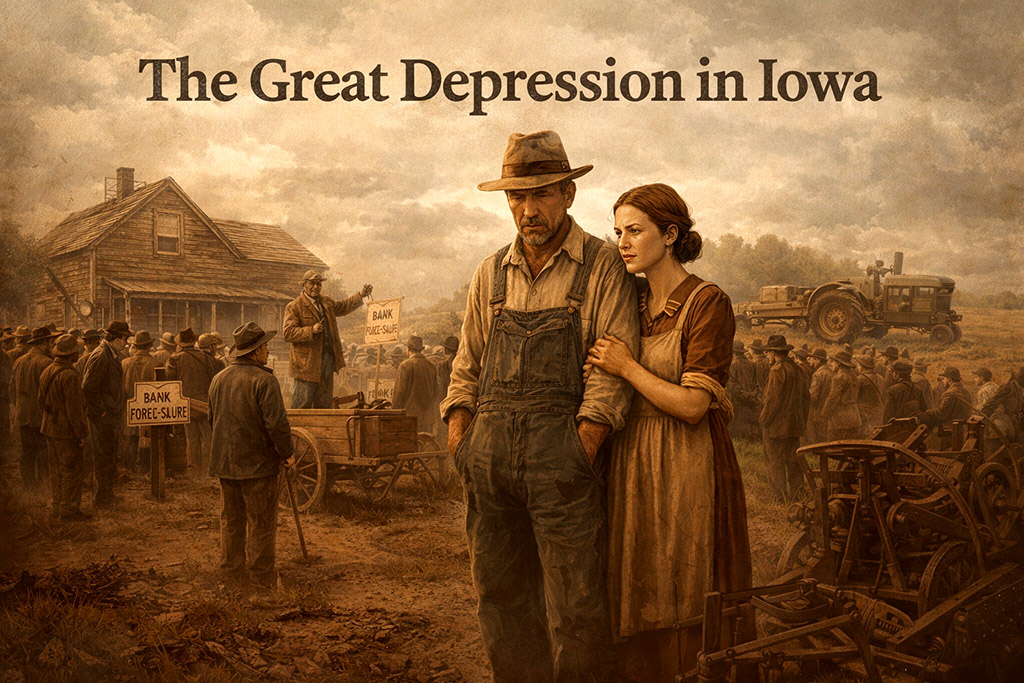
As incomes and access to credit disappeared, banks began to foreclose. Farms that had been built over decades, sometimes passed down through generations, were seized and sold. Families were forced off land they had cleared, planted, and depended on for survival.
The impact was immediate and visible. This was not a distant financial crisis. It was happening at the end of the driveway, at the edge of the field, at the front door.
The Rise of Penny Auctions
In response, Iowans created their own form of resistance. Neighbors gathered at foreclosure auctions. Not to compete, but to protect.
They bid pennies on equipment, livestock, and household goods, effectively preventing outside buyers from purchasing them. Once the auction ended, the items were quietly returned to the original family.
These “penny auctions” were not legal in the strict sense. But they reflected something deeper; a shared understanding that survival mattered more than process.
Protest and Pressure
As conditions worsened, frustration turned outward. Farmers organized, roads were blocked, and goods were withheld from market in an attempt to force higher prices. Confrontations with authorities occurred in some areas, as desperation collided with enforcement.
The crisis was no longer just economic. It had become social, and political.
The Role of the Land
At the same time, the land itself offered no guarantees. Weather remained unpredictable and yields fluctuated. While Iowa was not at the epicenter of the Dust Bowl, the broader environmental pressures affecting the Midwest still added to the strain.
For farmers who depended on both market stability and natural conditions, the combination was devastating.
Life During the Depression
Daily life narrowed during the Depression. Families cut expenses wherever possible, food was preserved and stretched, and clothing was repaired and reused. Cash was scarce and bartering became more common. Children contributed at a younger age as expectations shifted. The future, once assumed, became uncertain.
The Iowa Perspective
The Great Depression revealed something fundamental about Iowa. Resilience was not an abstract idea, it was daily practice.
Communities adapted when systems failed. Informal support networks emerged where formal ones broke down. Survival depended not just on individual effort, but on collective response.
There was no guarantee that things would improve. Only the decision to continue.
Then and Now
The Depression did not end cleanly, and its lessons did not disappear. Questions that defined that era still echo today. How much risk should be tied to land and markets? What happens when financial systems fail local communities? Where is the line between independence and collective responsibility?
The context has changed, but the underlying tensions remain.
Lasting Impact on Iowa
The effects of the Great Depression shaped Iowa for decades. It influenced how farmers approached debt and expansion, and reshaped attitudes toward banks, markets, and government policy. It reinforced a cautious, measured approach to growth, and a deep awareness of how quickly conditions can change.
It also strengthened something less visible, but equally important, the role of community.
The Story Within the Story
The Great Depression in Iowa is not only a story of collapse. It is a story of response.
Of what happens when systems fail, and what people do in their place. Of how communities hold together when the structures around them fall apart.
It is a reminder that while economies can break, something else can endure. And in Iowa, it did.
Return to The Iowa Story