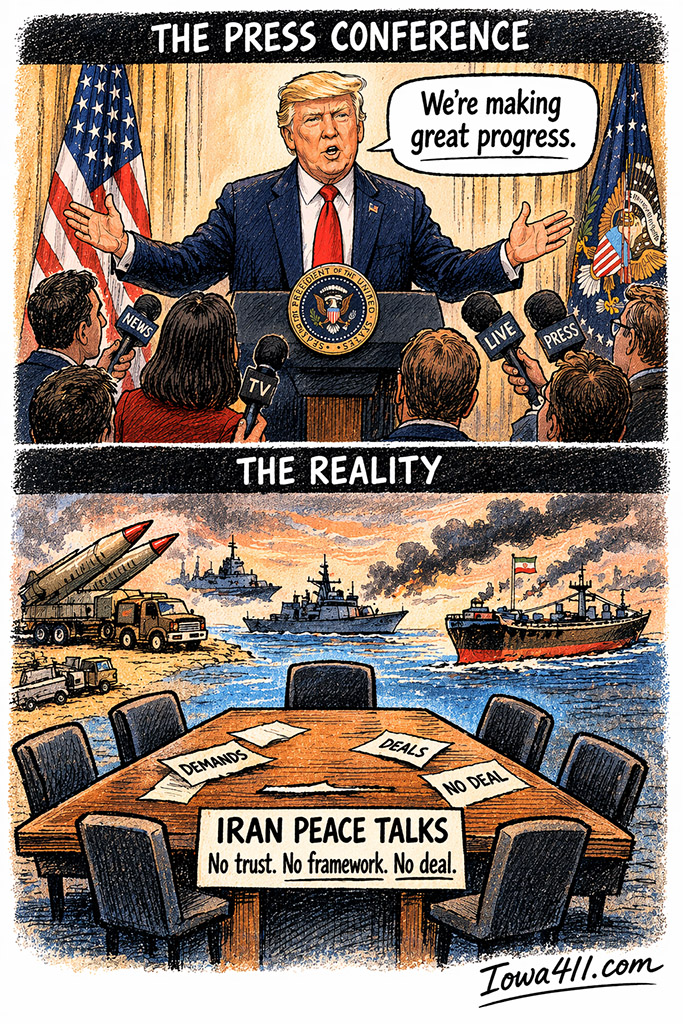
More Unverifiable Iran War Claims
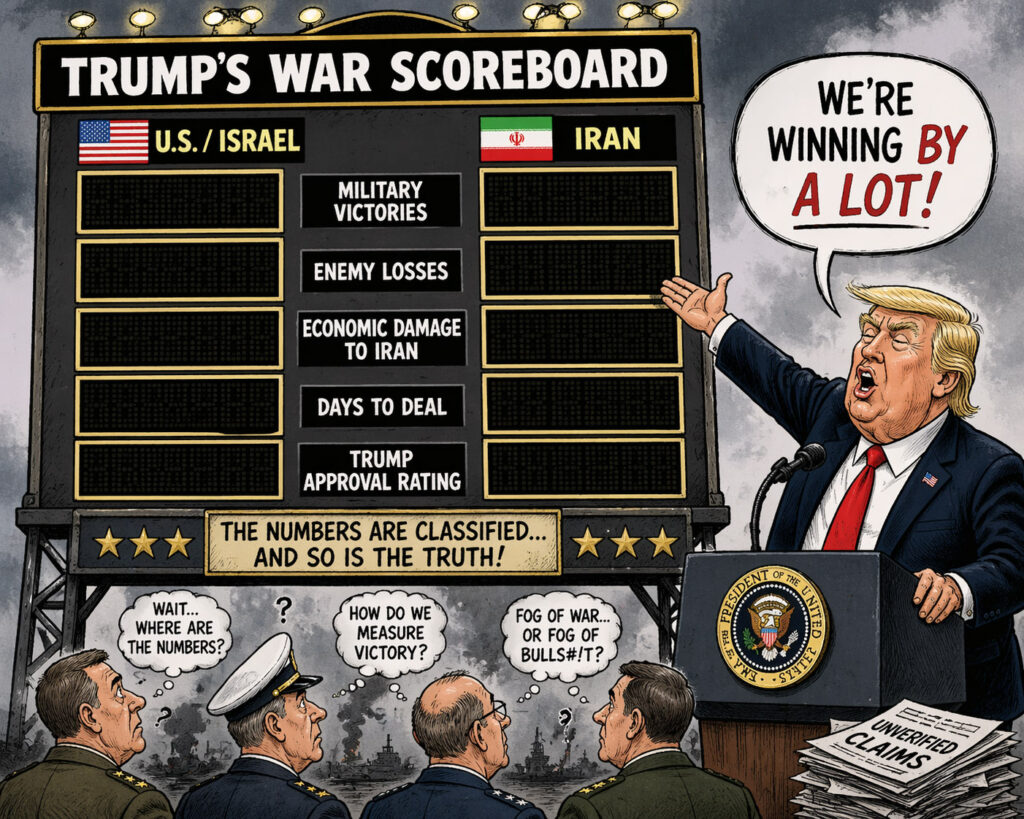
More claims without substantiation, facts, or details.
Winning “By A LOT”: The War Only Trump Can See
There is a familiar pattern in modern American politics. When facts become inconvenient, they are replaced. Not with better facts, but with louder declarations.
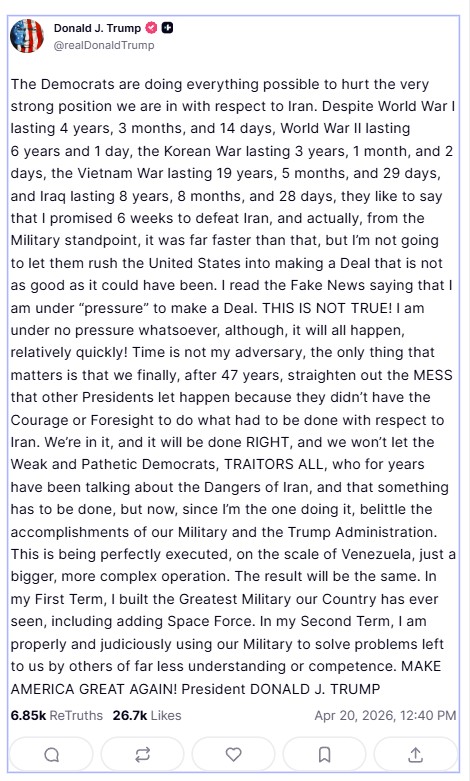
On Monday, President Donald Trump once again declared victory in a war the public cannot meaningfully see, measure, or verify. According to him, the United States is “winning BY A LOT.” Iran is collapsing. Its military is crippled. Its economy is hemorrhaging “$500 million a day.” Its leadership is gone. Its people are confused. Its defeat is inevitable.
And yet, none of this is accompanied by evidence. There are no intelligence summaries, no corroborating Pentagon briefings, no confirmation from allies, no satellite imagery, and no economic data. Just unjustified assertions.
The Anatomy of an Unverifiable Victory
Trump’s statements follow a recognizable structure.
Declare overwhelming success (“We’re winning BY A LOT”)
Discredit all external information sources (“Fake News,” “Anti-American media”)
Attribute dissent to disloyalty (Critics “want Iran to win”)
Introduce dramatic but unsupported metrics (“$500 million a day losses”)
Promise imminent resolution (“The result will be the same—it already is”)
This is not strategic communication. It is narrative insulation. By discrediting all independent verification mechanisms, Trump creates a closed informational loop: the only “truth” available to the public is the one he provides. Everything else is preemptively labeled false.
That is not transparency. That is control.
War as Messaging, Not Reality
Modern warfare, especially involving a country like Iran, is complex, asymmetric, and opaque. Outcomes are not measured in slogans. They are measured in supply chain resilience, force projection capability, regional proxy activity, economic durability under sanctions, and strategic alliances.
None of these variables are addressed in Trump’s claims. Instead, we get something closer to campaign rhetoric than military analysis.
Take the assertion that Iran is losing “$500 million a day.” Even if such a figure were real, it raises immediate questions, like “Relative to what baseline?, “Against what reserves or alternative revenue streams?,” “Over what time horizon is “unsustainable” defined?,” and “What offsetting gains (e.g., black-market trade, geopolitical leverage, oil price shifts) are being ignored?”
These are not minor details; they are the entire analysis. Without them, the number is not intelligence. It is theater.
The Convenient Amnesia of Policy Consequences
Equally absent is any acknowledgment of prior policy decisions that complicate the narrative. There is no mention of periods where sanctions enforcement fluctuated, oil market dynamics benefited adversarial economies, or the long-term strategic consequences of destabilization.
Instead, history is flattened into a single storyline that everything is strong now and everything before was weak. This is not analysis. It is revisionism.
Regime Change as Casual Achievement
Perhaps the most revealing element is the casual framing of regime change as both accomplished and desirable.
Regime change is not a slogan. It is one of the most destabilizing geopolitical outcomes imaginable. It carries with it power vacuums, internal factional struggles, increased influence of military or paramilitary actors, and long-term regional instability.
To speak of it as a clean, successful milestone without acknowledging second-order effects is either a profound oversimplification or a deliberate omission. Either way, it is dangerous.
Blame as a Strategic Tool
As always, when certainty is weakest, blame becomes strongest. Democrats are accused of undermining strength, the media is accused of siding with the enemy, and critics are labeled traitors.
This is not incidental rhetoric, it is structural. It serves two purposes, to delegitimize scrutiny and reframe disagreement as disloyalty. In doing so, it eliminates the possibility of accountability. If all criticism is treason, then no correction is ever required.
The Core Problem: Reality vs. Narrative
The central issue is not whether the United States is succeeding or struggling in this conflict. The issue is that the public is being asked to accept a version of reality that cannot be independently verified, contradicts the known complexity of the situation, and is delivered by a source that simultaneously discredits all alternative information.
This creates a fundamental disconnect between governance and truth.
War, by its nature, involves uncertainty. Responsible leadership acknowledges that uncertainty. It communicates in ranges, probabilities, and evolving assessments.
What we are seeing instead is absolute certainty without evidence. That is not confidence, it is fabrication.
Final Observation
When a leader insists that victory is obvious but cannot demonstrate it and insists that all contrary information is false, then the question is no longer about the war. It is about the information environment itself.
Because in the absence of verifiable facts, the battlefield shifts. And the first casualty is no longer truth. It is trust.
Analysis of Trump’s “winning by a lot” Iran war claims highlights the absence of verifiable data reliance on narrative control and growing disconnect between rhetoric and reality.
Breaking With Trump, or Just His Poll Numbers?
Candidates show some dissent over the Iran war, as Grassley and Ernst vote against limiting Trump’s war powersIowa Republican candidates are changing their positions on the Iran war as Election Day approaches. That is news. Calling it a “break with Trump” may be...
Trump Lost His Lawsuit. But Did the Lawsuit Fail?
An Iowa judge threw out Donald Trump’s lawsuit against Gannett and pollster J. Ann Selzer. But after nearly two years of litigation, the case raises a larger question about what it means to “win.”President Donald Trump lost his lawsuit against Gannett (owner of the...
Iowa Corn Growers Ask for Diesel Price Relief as Harvest Begins
Iowa Corn Growers Association asks for diesel relief as harvest kicks offBy Cami KoonsIowa Capital Dispatch As Iowa farmers begin harvesting their crops, corn growers in the state are asking Iowa congressional delegates to help lower the cost of diesel fuel, which has...
Mortgage Rates Hit 7% as War Increases Housing Market Pressure
Higher energy prices, persistent inflation, and rising borrowing costs are making an already difficult housing market even harder for buyers.The New York Times reports that mortgage rates have climbed above 7% for the first time since January 2025, another economic...
The “Give Us Another Chance” Tour Comes to Iowa
JD Vance to Voters – Please Give Us Another Chance Vice President J.D. Vance is coming to western Iowa Friday with a message for voters that may require a little work from the marketing department. “Give us another chance.” No, really. That was part of the vice...
Trumpapalooza Starts Today – Will Iowa Republicans Present?
Iowa411 SatireTrumpapalooza: Suggested Speaking Topics for Iowa Republicans The Republican Party’s first-ever national midterm convention, also known as “Trumpapalooza” because of its unswerving focus on President Trump, opens today in Dallas. The two-day production...
Diesel Prices Hit An All-Time High, Again
Record Diesel Prices Will Reach Far Beyond the Pump in IowaAn Iowa411 News BriefDiesel has set national records on consecutive days, increasing costs for Iowa agriculture, transportation, businesses, public services, and eventually, consumers.Record Diesel Prices...
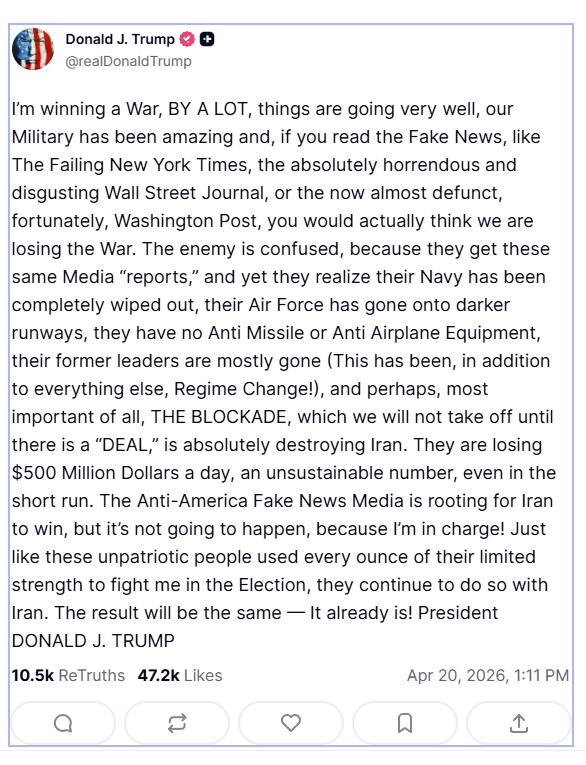
Trump’s dubious and unsubstantiated claims about the Iran War.
A good leader accepts both credit and blame. Trump just blames others.