
Peace Deal or Capitulation? Critics Question Trump’s Iran Agreement
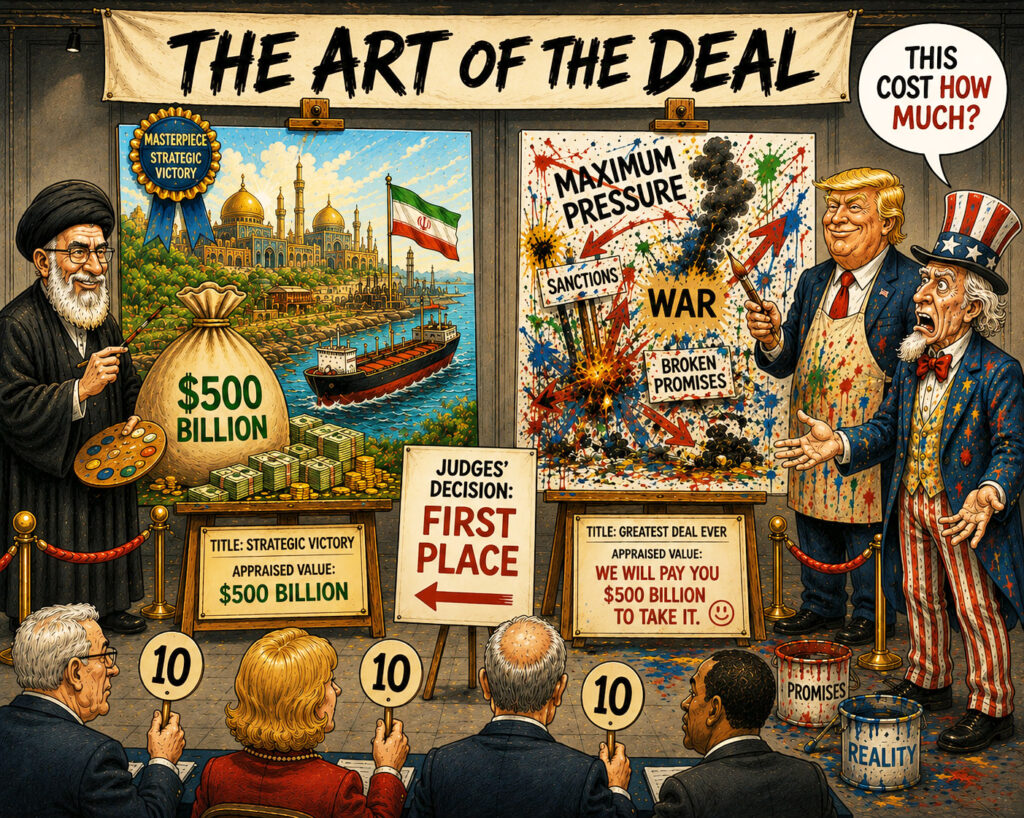
Did Trump Just Hand Iran a Strategic Victory?
President Donald Trump is calling his new agreement with Iran a historic peace achievement. According to the president, he succeeded where previous presidents failed. Peace is returning to the Middle East. The Strait of Hormuz will reopen. Iran will never obtain a nuclear weapon.
It is an impressive list of accomplishments. There is just one problem.
As details of the agreement begin to emerge, it is becoming increasingly difficult to determine exactly what the United States gained, and increasingly easy to see what Iran received.
According to multiple reports, Iran stands to benefit from significant sanctions relief, renewed oil exports, access to frozen assets, expanded economic activity, and a substantial increase in government revenue. The regime may also regain access to international markets and investment opportunities that had been severely restricted under sanctions.
In short, Iran appears poised to receive many of the economic benefits it has sought for years. Meanwhile, many of the administration’s original objectives remain unresolved.
The president repeatedly argued that Iran could never be trusted with a path to a nuclear weapon. Yet questions surrounding long-term enrichment, verification, inspections, enforcement, and future compliance remain subject to ongoing negotiations.
The administration spent years criticizing previous agreements for relying on Iranian promises and future enforcement mechanisms. Today, Americans are being asked to celebrate an agreement that appears to rely heavily on both.
The contrast is difficult to ignore.
Prior to the conflict, Iran was already facing substantial economic pressure from sanctions, internal political tensions, international isolation, and growing challenges to its economy. Critics argue that the regime entered negotiations from a position of weakness.
Now it appears poised to emerge with sanctions relief, renewed oil revenue, expanded regional influence, and a pathway toward economic recovery.
The administration argues that diplomacy prevented a wider war. That may be true. Most Americans would prefer diplomacy over another costly Middle Eastern conflict. But diplomacy is not the same thing as victory.
What makes the agreement particularly remarkable is not what Iran gave up. It is what Iran appears to have kept.
The regime remains in power. Its leadership remains in power. Its military remains intact, and its regional influence remains largely intact.
Many of the issues cited as reasons for confrontation, including broader questions regarding Iran’s regional activities and long-term strategic ambitions, remain unresolved.
Yet Iran appears positioned to receive substantial economic benefits. That reality raises an uncomfortable question. What exactly did America gain?
The administration has spent considerable time describing what America avoided. A wider war, higher oil prices, and regional instability. Those are legitimate concerns. But avoiding a worse outcome is not necessarily the same thing as achieving the objectives that were originally promised.
Americans deserve a clear accounting of which stated goals were achieved, abandoned, or postponed. And exactly which concessions were made.
And why does the agreement appear to provide Iran with many of the economic benefits that previous administrations were criticized for offering?
Those questions matter because this is not simply another foreign-policy announcement. This is the culmination of a conflict that the administration itself helped shape.
After years of promises, confrontations, sanctions, threats, military action, and declarations that previous agreements were disastrous, Americans are now being told that peace has arrived and victory has been achieved.
Perhaps that assessment will ultimately prove correct. Perhaps history will judge this agreement as a diplomatic breakthrough.
But today, one fact stands out above all others, that Trump has declared victory and Iran appears prepared to collect the rewards.
And Americans are still waiting to learn whether those two things are the same.
Iowa’s Fiscal Picture Improves?
The $1.1 Billion Budget Gap Tells Another StoryA modest increase in projected revenue does little to change Iowa's underlying budget problem, or the economic growth Republicans are counting on to solve it.Iowa's fiscal outlook is improving. At least, that's how Gov....
Energy Prices Push Inflation to 3.7% in September
Gasoline prices surge 34% over the past year as higher living costs continue to squeeze American householdsThe Federal Reserve is considering additional interest rate increases as American households face growing affordability challenges ahead of the midterm...
Lahn’s Running Mate Receives $540,000 Mystery Loan
The money is from an undisclosed LLC that had formed a week earlierA mysterious lender, a newly formed Illinois company, and a substantial private loan raise questions about the finances of Zach Lahn's running mate.Three weeks after Republican gubernatorial candidate...
Elon Musk’s Millions Are Helping Finance Iowa’s U.S. Senate Race
$31 million in Musk's super-PAC contributions have been spent to support the Ashley Hinton campaignTwo political organizations receiving $234 million from the billionaire since July have spent nearly $31 million supporting Ashley Hinson or opposing Josh Turek in...
Glyphosates Not Mentioned at Hinson Water Quality Event
Hinson Promises to Stand Up to Trump, but What About His Support for Monsanto's Roundup?After pledging to challenge Trump on policies harmful to Iowa, Hinson hosts a water-quality and cancer roundtable without addressing his administration's support for glyphosate.On...
Johnson Campaigns for Miller-Meeks Before GOP PAC Pulls Ads
Four Days After Johnson Campaigns for Miller-Meeks, GOP Congressional PAC Cuts FundingThe House speaker appeared with the Iowa Republican on Friday. By Tuesday, a major political organization aligned with his leadership was redirecting planned campaign spending...
Top Republican PACs Pull Funding from Miller-Meeks
Major Republican super PACs withdraw planned advertising support for Iowa Rep. Mariannette Miller-Meeks as they redirect funds to other House racesNational GOP groups redirect campaign spending to other House races, leaving Iowa's 1st District incumbent without...