GOP Gubernatorial Candidates Lean on Ideology as Iowans’ Needs Persist
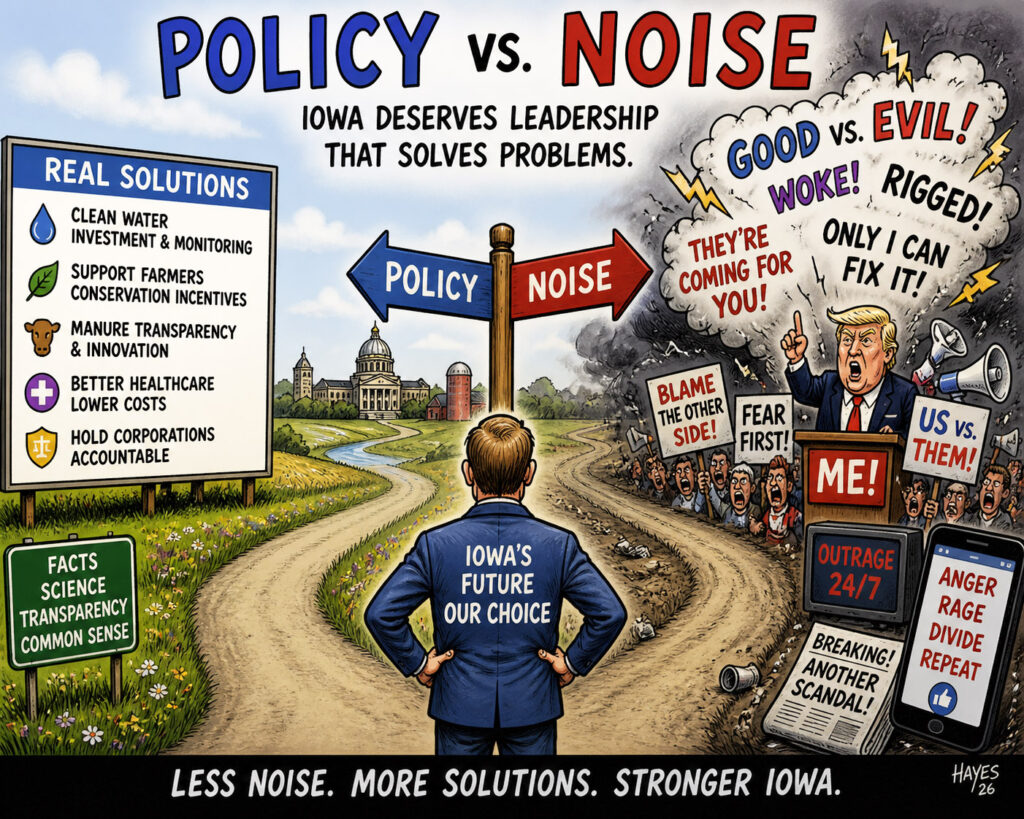
Ideological generalization crowds out responsible public policy
Republican candidates for Iowa governor gathered before more than 1,000 Christian conservative activists this week, offering a preview of a primary race defined less by detailed policy proposals and more by broad ideological positioning and cultural messaging.
The event, hosted by the Iowa Faith and Freedom Coalition, featured five GOP candidates, state Rep. Eddie Andrews, U.S. Rep. Randy Feenstra, businessman Zach Lahn, former agency director Adam Steen, and pastor Brad Sherman, each outlining their priorities while emphasizing the need to defeat Democratic candidate Rob Sand in the general election.
While the forum provided an opportunity to engage on issues facing the state, much of the discussion centered on familiar themes such as “school choice,” religious freedom, and opposition to so-called “woke” ideology. Candidates largely avoided detailed proposals addressing Iowa’s pressing challenges like the price of gasoline and consumer goods, economic stagnation in rural areas, environmental concerns tied to water quality and agriculture, and ongoing healthcare access issues.
Several candidates focused heavily on education policy through the lens of ideological conflict. Feenstra called for Iowa to become “the most robust state in the country” for school choice, while Steen advocated for expanding classical education and reducing what he described as restrictive standards for teachers. These positions align with recent legislative efforts to expand charter schools and private school subsidies, signaling continued momentum toward restructuring Iowa’s public education system.
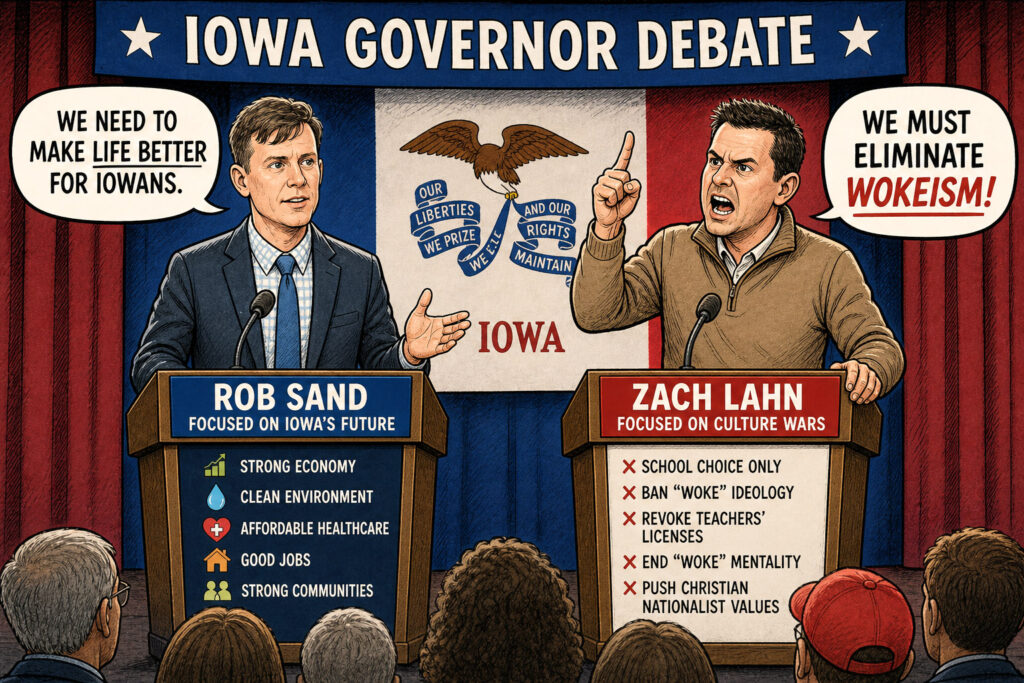
The most controversial remarks came from Lahn, who characterized “wokeism” as a “mental disorder,” reflecting a broader trend among candidates to frame policy debates in cultural rather than operational terms. While such rhetoric resonates with portions of the Republican base, it does little to clarify how candidates would govern in areas requiring technical, data-driven solutions.
Sherman’s remarks on a “culture of life” extended beyond abortion policy to include elder care, cancer rates, and mental health, touching on substantive issues but without outlining specific strategies. Andrews, meanwhile, emphasized electability and religious freedom, positioning himself as a candidate capable of appealing beyond the party base.
The event underscored a broader dynamic in the race: a strong focus on ideological alignment within the Republican primary electorate, contrasted with limited discussion of concrete policy frameworks. That contrast is particularly notable when compared to Sand’s campaign, which has emphasized detailed proposals on economic development, government accountability, and public services.
Our Take
The forum highlighted a central tension in Iowa’s gubernatorial race. Republican candidates are clearly focused on energizing a primary electorate driven by cultural and ideological concerns. However, that approach raises questions about how those positions translate into governance.
Iowa faces complex, interconnected challenges like economic shifts in agriculture and small-town economies, environmental pressures affecting water quality, and gaps in healthcare access, particularly in rural areas. Addressing these issues typically requires policy depth, cross-sector coordination, and long-term planning. Those elements were largely absent from the discussion.
Instead, much of the conversation operated at a higher level of abstraction, relying on broad principles such as “freedom,” “choice,” and opposition to perceived cultural threats. While these themes can be politically effective, they do not inherently provide a roadmap for managing state systems or delivering measurable outcomes.
The result is a widening contrast between campaign styles. On one side, a Republican field emphasizing ideological clarity and alignment with national conservative narratives. On the other, a Democratic candidate focusing on policy specificity and governance mechanics.
For voters, the distinction may ultimately come down to priorities like whether the role of governor is seen primarily as a platform for advancing ideological positions, or as an executive office responsible for addressing the operational realities facing the state.
Iowa’s Fiscal Picture Improves?
The $1.1 Billion Budget Gap Tells Another StoryA modest increase in projected revenue does little to change Iowa's underlying budget problem, or the economic growth Republicans are counting on to solve it.Iowa's fiscal outlook is improving. At least, that's how Gov....
Energy Prices Push Inflation to 3.7% in September
Gasoline prices surge 34% over the past year as higher living costs continue to squeeze American householdsThe Federal Reserve is considering additional interest rate increases as American households face growing affordability challenges ahead of the midterm...
Lahn’s Running Mate Receives $540,000 Mystery Loan
The money is from an undisclosed LLC that had formed a week earlierA mysterious lender, a newly formed Illinois company, and a substantial private loan raise questions about the finances of Zach Lahn's running mate.Three weeks after Republican gubernatorial candidate...
Elon Musk’s Millions Are Helping Finance Iowa’s U.S. Senate Race
$31 million in Musk's super-PAC contributions have been spent to support the Ashley Hinton campaignTwo political organizations receiving $234 million from the billionaire since July have spent nearly $31 million supporting Ashley Hinson or opposing Josh Turek in...
Glyphosates Not Mentioned at Hinson Water Quality Event
Hinson Promises to Stand Up to Trump, but What About His Support for Monsanto's Roundup?After pledging to challenge Trump on policies harmful to Iowa, Hinson hosts a water-quality and cancer roundtable without addressing his administration's support for glyphosate.On...
Johnson Campaigns for Miller-Meeks Before GOP PAC Pulls Ads
Four Days After Johnson Campaigns for Miller-Meeks, GOP Congressional PAC Cuts FundingThe House speaker appeared with the Iowa Republican on Friday. By Tuesday, a major political organization aligned with his leadership was redirecting planned campaign spending...
Top Republican PACs Pull Funding from Miller-Meeks
Major Republican super PACs withdraw planned advertising support for Iowa Rep. Mariannette Miller-Meeks as they redirect funds to other House racesNational GOP groups redirect campaign spending to other House races, leaving Iowa's 1st District incumbent without...