Iowa Faith Leaders Gather to Support the Moral Issue of Our Time – Voting Rights
Faith Gathering to Support Voting Rights
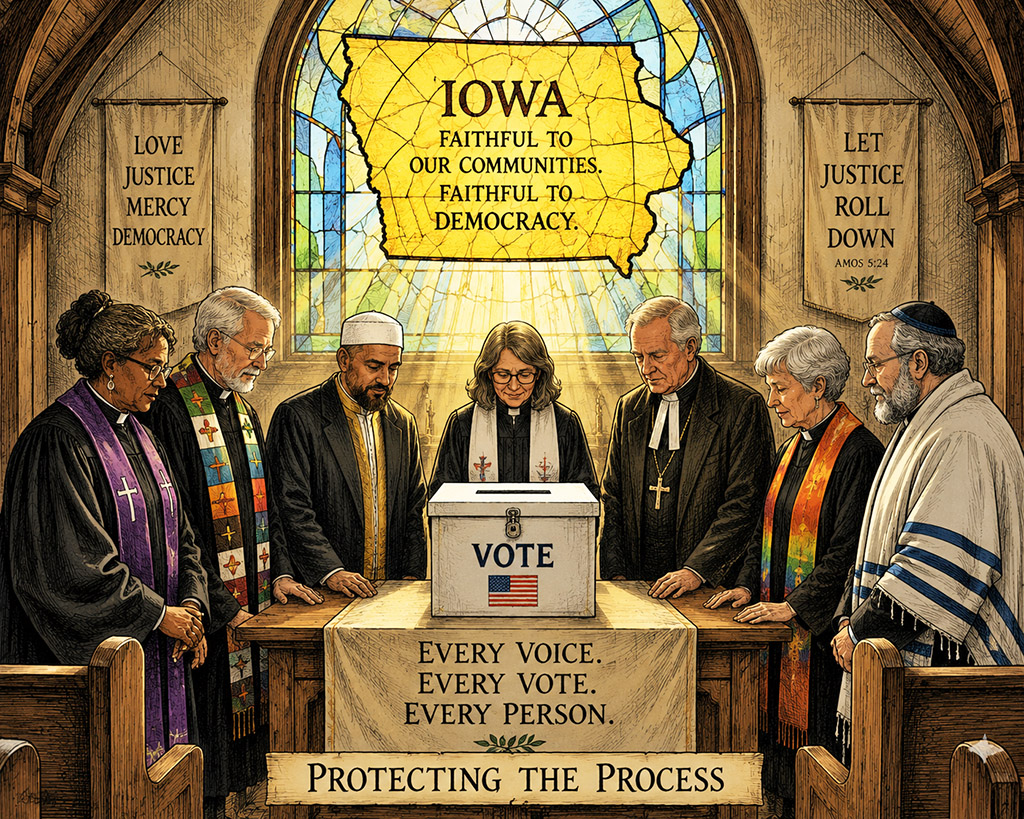
Des Moines Register writer Isabelle Foland reported that religious leaders from across Iowa gathered in downtown Des Moines earlier this month to urge elected officials to protect voting rights. The event was part of a nationwide “Faith in Us” campaign amid an expanding national debate over election administration and voting access.
Approximately 30 clergy members and community leaders met at Cowles Commons on July 7, arguing that protecting the right of every eligible citizen to vote is both a constitutional responsibility and a moral obligation.
Faith leaders cited several recent state and federal actions that organizers believe could make voting more difficult for some eligible citizens. Among them was the proposed Safeguard American Voter Eligibility (SAVE) Act, which would require documentary proof of U.S. citizenship to register to vote. Supporters say the legislation would strengthen election integrity by preventing non-citizen voting, while opponents argue it could create obstacles for eligible voters who have changed their names or have difficulty obtaining the required documentation.
Schirm also criticized recent federal efforts to expand Washington’s role in election administration through executive action. Earlier this year, a federal district court blocked key provisions of an executive order that sought to increase federal involvement in voter eligibility verification and mail ballot procedures, concluding that the executive branch likely exceeded its legal authority in several areas. The litigation is ongoing.
Attendees also referenced Iowa Attorney General Brenna Bird’s ongoing prosecutions involving alleged illegal voting. Of the eight ongoing criminal cases, three defendants have been acquitted, one resulted in a conviction, and the remaining cases are still pending.
Among those addressing the gathering were religious leaders from the Episcopal Diocese of Iowa, the Evangelical Lutheran Church in America, Grinnell College, and Corinthian Baptist Church in Des Moines. Speakers emphasized that respecting the dignity of every person includes protecting the voting rights of every eligible citizen.
The event highlights a debate about the proper balance between election integrity and voter access. Earlier this year, Iowa Secretary of State Paul Pate provided voter registration information, including partial Social Security numbers, to the U.S. Department of Justice following a federal request related to election integrity investigations. Iowa officials said federal law required the state to comply, while several other states declined similar requests, arguing that the Constitution assigns primary responsibility for administering elections to the states.
Attorney General Brenna Bird defended Iowa’s cooperation with federal authorities, saying state and federal officials should work together to ensure illegal votes do not cancel out the votes of eligible citizens.
Protecting election integrity is a legitimate responsibility of election officials. At the same time, extensive research, court findings, and investigations over many years have consistently found that illegal voting by non-citizens and other forms of individual voter fraud are exceedingly rare and have not been shown to occur on a scale capable of changing statewide or national election outcomes.
Our Take
This story is about more than one rally or one piece of legislation. It reflects a broader constitutional debate that is likely to shape American elections for years to come.
The debate over election integrity is not simply about preventing illegal votes. It is also about determining what policies are justified by the available evidence and what tradeoffs they impose on eligible voters. Measures intended to prevent rare instances of illegal voting can also create additional barriers for lawful voters or shift authority over elections in ways that raise constitutional questions.
As legislatures, courts, and election officials continue to address these issues, Iowans deserve policies that are grounded in evidence, transparency, and respect for both election integrity and the constitutional right of eligible citizens to vote.
Most Iowans would probably agree on two basic principles, that only eligible citizens should vote, and every eligible citizen should be able to vote without unnecessary barriers. The challenge is determining how those goals are achieved while respecting the constitutional framework established by the nation’s founders.
Although states have traditionally administered elections, recent efforts by the federal government to expand its role have raised important constitutional questions. Courts are now being asked to determine where the line should be drawn between federal authority and state responsibility. Iowa’s decision to comply with federal voter data requests, while several other states refused, illustrates that reasonable legal disagreements exist over that balance of power.
Regardless of political affiliation, changes affecting who administers elections, how voter information is shared, and how eligibility is determined deserve careful public attention. Public confidence in elections depends not only on preventing fraud, but also on preserving constitutional safeguards, protecting eligible voters’ rights, and maintaining trust in the integrity and independence of the electoral process.
Breaking With Trump, or Just His Poll Numbers?
Candidates show some dissent over the Iran war, as Grassley and Ernst vote against limiting Trump’s war powersIowa Republican candidates are changing their positions on the Iran war as Election Day approaches. That is news. Calling it a “break with Trump” may be...
Has the UI Center Lost Its Academic Legitimacy?
How Much Academic Legitimacy Does Iowa's Center for Intellectual Freedom Have Left?Eleven scholars recruited to help establish the Center have resigned. Their departure raises a bigger question about what made this politically created institution academic in the first...
Trump Lost His Lawsuit. But Did the Lawsuit Fail?
An Iowa judge threw out Donald Trump’s lawsuit against Gannett and pollster J. Ann Selzer. But after nearly two years of litigation, the case raises a larger question about what it means to “win.”President Donald Trump lost his lawsuit against Gannett (owner of the...
As Iowans Suffer, Grassley Turns His Focus to Transgender Sports
Iowa already prohibits transgender girls from competing in girls' sports. With farmers struggling with diesel prices and families confronting inflation and housing costs, why is Chuck Grassley making the issue a national priority now?Should we be concerned about his...
Would a Ban of Diesel Exports Actually Lower Prices? Likely Not.
It’s More Complicated Than Grassley BelievesSen. Chuck Grassley says the U.S. should stop exporting diesel to bring down prices for farmers and truckers. The oil industry says that could backfire. Its explanation deserves a closer look.Iowa farmers are heading into...