
Were We Misled About Inflation?
For millions of Americans, inflation after Covid was real, painful, and impossible to ignore.
Families saw grocery bills climb. Gas prices surged. Housing costs rose. Interest rates jumped. Whether you were a Democrat, Republican, independent, or politically exhausted altogether, nearly everyone felt the financial pressure.
And that is precisely why inflation became one of the most powerful political weapons of the 2024 election cycle. But there is an important distinction between feeling inflation and understanding the full story behind it, and many Americans may have been given a misleading impression about what happened.
The Part We All Remember
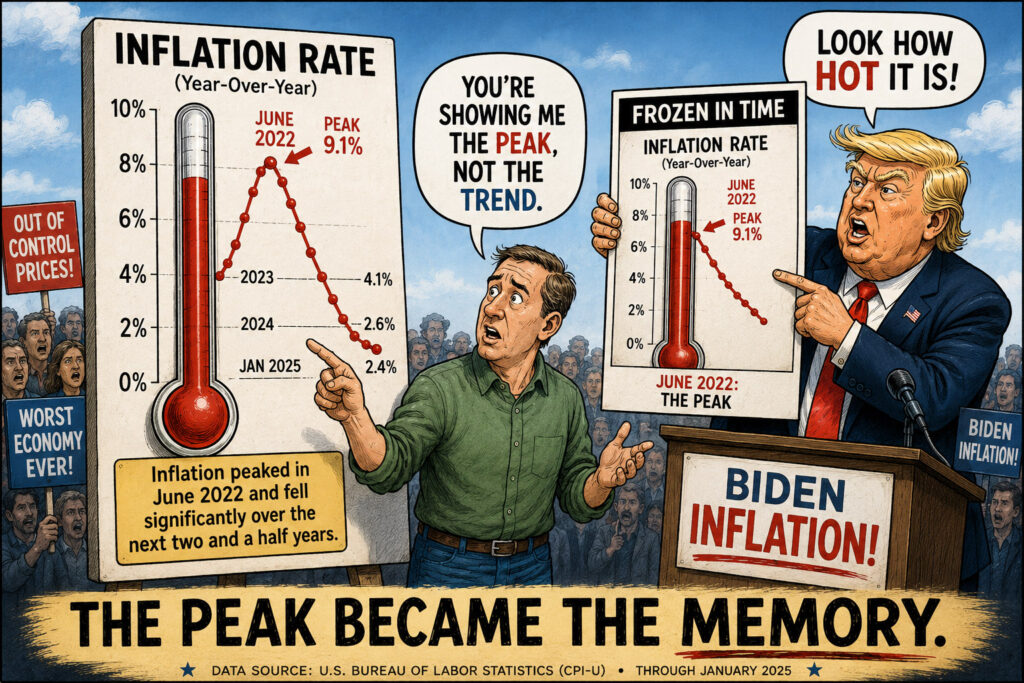
In June 2022, inflation in the United States reached its highest level in roughly 40 years. That moment became politically defining.
Television ads, social media posts, campaign speeches, and cable news commentary repeated the same themes repeatedly as “Biden inflation,” “Out-of-control prices,” “Economic disaster,” and “Worst economy ever.”
For many voters, those messages became permanently attached to their understanding of the economy. But here is the part that often gets lost. Inflation did not continue to accelerate through the Biden presidency. It peaked in mid-2022 and then declined steadily every month for the remainder of the Biden administration.
The Global Context Was Often Ignored
The inflation surge was not unique to the United States. Countries throughout Europe, Canada, Asia, and other industrialized economies experienced major inflation spikes following the Covid pandemic.
Inflation exploded as several forces collided at once. Global supply chain breakdowns, pent-up consumer demand after lockdowns, labor shortages, shipping disruptions, energy instability, and Russia’s invasion of Ukraine and resulting fuel shocks.
The result was a worldwide inflation crisis.
That context frequently disappeared from American political messaging, where inflation was often presented as though it had been caused solely by domestic leadership decisions. But economists across the political spectrum generally recognized that the inflation surge was global in nature.
The Part Many Americans Never Heard
While inflation remained frustratingly high for many households, the United States recovered from the inflation spike faster than any other industrialized nation. Month after month, inflation rates declined from their 2022 peak.
And by the end of the Biden administration inflation had fallen dramatically from its highs, unemployment remained relatively low, supply chains had stabilized significantly, and the U.S. economy was outperforming many peer economies internationally.
That did not mean Americans suddenly felt prosperous again. Prices that rise quickly rarely fall back to previous levels. Many families were still struggling with accumulated higher costs.
But there is an important difference between prices remaining high, and inflation continuing to spiral upward, but deceptive political messaging often blurred that distinction.
How Political Messaging Can Shape Memory and Perception
This is important because political narratives do not always update when economic conditions change. Campaign messaging works by reinforcing emotional impressions like fear, frustration, anger, and blame.
Once many Americans emotionally connected the economy to “Biden inflation,” that perception often remained frozen in time, even as inflation rates had declined over the last two years. But the inflation narrative became especially powerful because it tapped into something people experienced personally every week at the grocery store and gas pump.
In short, the emotional memory remained stronger than the reality of changing economic data.
A More Honest Conversation
Americans had every right to be angry about inflation. But voters also deserve an honest conversation about when inflation peaked, why it happened globally, how the United States compared internationally, and how political messaging can sometimes preserve outrage long after circumstances begin changing.
Perhaps the larger lesson is that we are all vulnerable to simplified narratives during periods of economic stress. When people are struggling financially, political slogans are easy to remember. Timelines, global economics, and nuanced context are harder.
But they still matter.
Breaking With Trump, or Just His Poll Numbers?
Candidates show some dissent over the Iran war, as Grassley and Ernst vote against limiting Trump’s war powersIowa Republican candidates are changing their positions on the Iran war as Election Day approaches. That is news. Calling it a “break with Trump” may be...
Trump Lost His Lawsuit. But Did the Lawsuit Fail?
An Iowa judge threw out Donald Trump’s lawsuit against Gannett and pollster J. Ann Selzer. But after nearly two years of litigation, the case raises a larger question about what it means to “win.”President Donald Trump lost his lawsuit against Gannett (owner of the...
As Iowans Suffer, Grassley Turns His Focus to Transgender Sports
Iowa already prohibits transgender girls from competing in girls' sports. With farmers struggling with diesel prices and families confronting inflation and housing costs, why is Chuck Grassley making the issue a national priority now?Should we be concerned about his...
Iowa Corn Growers Ask for Diesel Price Relief as Harvest Begins
Iowa Corn Growers Association asks for diesel relief as harvest kicks offBy Cami KoonsIowa Capital Dispatch As Iowa farmers begin harvesting their crops, corn growers in the state are asking Iowa congressional delegates to help lower the cost of diesel fuel, which has...
Mortgage Rates Hit 7% as War Increases Housing Market Pressure
Higher energy prices, persistent inflation, and rising borrowing costs are making an already difficult housing market even harder for buyers.The New York Times reports that mortgage rates have climbed above 7% for the first time since January 2025, another economic...
The Company Miller-Meeks Keeps
The Company She Keeps: Who Is Miller-Meeks Bringing to Iowa?Mariannette Miller-Meeks brought Rick Scott and Markwayne Mullin to Iowa to help make the case for her reelection. Their backgrounds raise a reasonable question: What should voters make of the people a...
AG Bird Needs to Explain Culture War and Political Lawsuits
Whose Lawyer is Brenna Bird?Beyond the everyday work of Iowa's Attorney General, Brenna Bird has repeatedly put the state's name behind national political and policy battles. What does Iowa get from them?Attorney General Brenna Bird has a day job. Her office...