
Could Democrats Hold Both Iowa Senate Seats by 2027? The Path Is Narrow but Real.
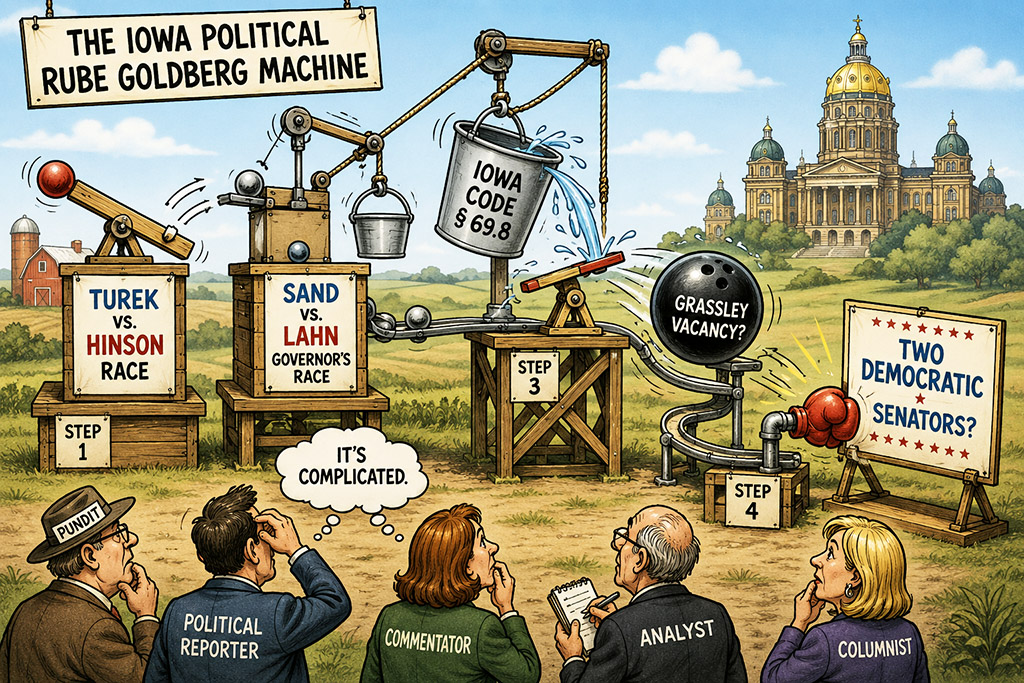
How Iowa’s Governor Race Could Shape the Future of Chuck Grassley’s Senate Seat
Iowa411 | Political Analysis | June 2026
For the first time in more than a decade, Democrats have a credible, if far from certain, path to holding both of Iowa’s U.S. Senate seats simultaneously. The scenario requires several moving parts to fall into place, but as of June 2026, none of them are out of reach.
The Open Seat: Hinson vs. Turek
The more straightforward opportunity is the race to succeed Joni Ernst, who chose not to seek a third term. Republican U.S. Representative Ashley Hinson won her primary on June 2 and will face Democrat Josh Turek, a state representative and four-time Paralympic wheelchair basketball athlete, in the November 3 general election.
The race is currently rated “Lean Republican” by the Cook Political Report, which is a more competitive outlook than most observers expected heading into the cycle. Polling has been tight. An Echelon Insights survey found Turek leading Hinson 46–44, and prediction markets give Republicans roughly a 61 percent chance of winning, down from over 70 percent earlier this year.
Democrats face structural headwinds. Iowa has not sent a Democrat to the U.S. Senate since Tom Harkin retired in 2015, and President Trump carried the state by more than 10 points in 2024. But the open-seat dynamic, Ernst’s unpopularity, and a national environment that has trended toward Democrats in recent special elections have made this race genuinely competitive.
The Governor’s Race and Its Senate Implications
The second path to a Democratic Senate seat runs through the statehouse and hinges on the outcome of the governor’s race.
State Auditor Rob Sand, the only Democrat currently holding statewide office in Iowa, is the Democratic nominee for governor. He faces Republican businessman Zach Lahn in what the Cook Political Report has rated a toss-up. Sand’s durability as a statewide candidate, he narrowly won re-election as auditor in 2022 even as Republicans swept other races, has made him a credible contender in a state that has otherwise trended sharply red.
If Sand wins in November, he will take office on January 12, 2027, under the Iowa Constitution’s provision that the governor’s term begins on the Tuesday after the second Monday in January following the election.
The Decision That May Have Changed Everything
Before examining the mechanics of succession, it is worth pausing on a decision Grassley made four years ago that now looms over Iowa’s entire political landscape.
In 2022, at age 88, Grassley chose to seek another term in the U.S. Senate. He won, extending his tenure through January 2029. At the time, the decision was framed largely as a question of whether Grassley remained capable of serving. And he made clear that he believed he did.
What received less attention was the structural consequence of his choice. By running for another full six-year term, Grassley guaranteed that if he could not complete it, the question of who fills his seat would fall to whoever happened to be Iowa’s governor at the time of the vacancy. In 2022, with Republicans firmly in control of the statehouse, that risk seemed abstract. In 2026, with the governorship rated a toss-up, that calculation looks entirely different.
Like Justice Ruth Bader Ginsburg’s decision to remain on the Supreme Court until her death in 2020, Grassley’s decision to seek another full term means that future political circumstances, not today’s, may ultimately determine who succeeds him if a vacancy occurs before his term expires.
Grassley’s situation is not identical to the Ginsburg story. He is an elected official, not an appointee, and voters in Iowa chose to return him in 2022 with full knowledge of his age. But the structural dynamic is similar. A senior figure in a political party, past the point where longevity could reasonably be assumed, made a choice to hold on. And in doing so, transferred a consequential decision about their succession to forces outside their party’s control.
There is no indication Grassley anticipated this possibility when he ran. But the irony is difficult to ignore: a decision made to continue serving his state may ultimately be the mechanism by which a Democrat holds his seat.
The Grassley Succession Scenario
This is where the two races intersect in a way that has received relatively little public attention.
Senator Chuck Grassley, who turned 92 in September 2025, is the oldest sitting U.S. Senator in American history. His term does not expire until January 2029. Should he die or resign before then, Iowa law (Iowa Code §69.8) gives the governor the authority to appoint a temporary replacement to serve until the seat is filled by election. That said, there is no indication that Grassley plans to leave office before the end of his term.
Critically, Iowa law does not require the governor to appoint a member of the same political party as the departing senator. Some states, like Arizona, Montana, Wyoming, and others, have same-party appointment requirements. Iowa has no such restriction, and the governor has broad discretion in making an appointment.
That means if Rob Sand were governor and a vacancy occurred in Grassley’s seat, he would be legally free to appoint a Democrat. Sand would face significant political pressure not to do so, as such an appointment would likely become one of the most consequential and controversial decisions by an Iowa governor in modern history. But the law would be on his side. Sand has not publicly stated what he would do in that scenario.
The appointed senator would serve until the next general election, at which point the seat would be filled by a statewide vote for the remainder of Grassley’s term, which runs through January 2029.
What the Path Looks Like
For Democrats to hold both Senate seats, the sequence would need to unfold roughly as follows. Josh Turek defeats Ashley Hinson in November, flipping the open seat. Rob Sand defeats Zach Lahn, winning the governorship and taking office in January 2027. A vacancy then occurs in Grassley’s seat, whether through death, resignation for health reasons, or another circumstance. Governor Sand appoints a Democrat to fill the seat. That appointee then wins in the 2028 election cycle or holds the seat until then.
Each step carries real uncertainty. The Senate race is competitive but leans Republican. The governor’s race is a toss-up. A Grassley vacancy is not guaranteed, and even if it occurred, a Democratic appointment would be politically explosive in a state Trump carried by double digits.
The Republican Counter-Scenario
Republicans have their own levers. If incumbent Governor Kim Reynolds’ party retains the governorship with Zach Lahn winning in November, a Grassley vacancy would almost certainly result in a Republican appointment, preserving the seat. Lahn would also have no obligation to appoint a member of any faction of the party.
Additionally, Iowa Republicans introduced legislation in early 2026 to limit the next governor’s appointment authority over state boards and commissions, reflecting concern within the party about the possibility of a Sand victory. No legislation passed to alter the Senate vacancy appointment process itself, however.
The Bottom Line
The scenario in which Democrats hold both Iowa Senate seats heading into 2028 is not a political fantasy. It has a plausible, if narrow, logical chain. It would require Democratic wins in two separate statewide races in a state that has moved decisively toward Republicans in recent cycles, followed by a circumstance like a Grassley vacancy that is possible but not certain.
What makes the moment unusual is that all the prerequisite conditions exist simultaneously for the first time in years: a competitive open Senate seat, a toss-up governor’s race, and a 92-year-old incumbent whose health and longevity are genuine variables in Iowa’s political calculus.
Whether that alignment produces results will be answered on November 3.
Iowa411 presents this piece as political analysis based on publicly available information and current polling. It does not represent an editorial endorsement of any candidate or party.
Breaking With Trump, or Just His Poll Numbers?
Candidates show some dissent over the Iran war, as Grassley and Ernst vote against limiting Trump’s war powersIowa Republican candidates are changing their positions on the Iran war as Election Day approaches. That is news. Calling it a “break with Trump” may be...
Has the UI Center Lost Its Academic Legitimacy?
How Much Academic Legitimacy Does Iowa's Center for Intellectual Freedom Have Left?Eleven scholars recruited to help establish the Center have resigned. Their departure raises a bigger question about what made this politically created institution academic in the first...
Trump Lost His Lawsuit. But Did the Lawsuit Fail?
An Iowa judge threw out Donald Trump’s lawsuit against Gannett and pollster J. Ann Selzer. But after nearly two years of litigation, the case raises a larger question about what it means to “win.”President Donald Trump lost his lawsuit against Gannett (owner of the...
As Iowans Suffer, Grassley Turns His Focus to Transgender Sports
Iowa already prohibits transgender girls from competing in girls' sports. With farmers struggling with diesel prices and families confronting inflation and housing costs, why is Chuck Grassley making the issue a national priority now?Should we be concerned about his...
Would a Ban of Diesel Exports Actually Lower Prices? Likely Not.
It’s More Complicated Than Grassley BelievesSen. Chuck Grassley says the U.S. should stop exporting diesel to bring down prices for farmers and truckers. The oil industry says that could backfire. Its explanation deserves a closer look.Iowa farmers are heading into...
Iowa Corn Growers Ask for Diesel Price Relief as Harvest Begins
Iowa Corn Growers Association asks for diesel relief as harvest kicks offBy Cami KoonsIowa Capital Dispatch As Iowa farmers begin harvesting their crops, corn growers in the state are asking Iowa congressional delegates to help lower the cost of diesel fuel, which has...
Mortgage Rates Hit 7% as War Increases Housing Market Pressure
Higher energy prices, persistent inflation, and rising borrowing costs are making an already difficult housing market even harder for buyers.The New York Times reports that mortgage rates have climbed above 7% for the first time since January 2025, another economic...