Iowa Farmers Invested in America’s Energy Future. Then the Rules Changed.
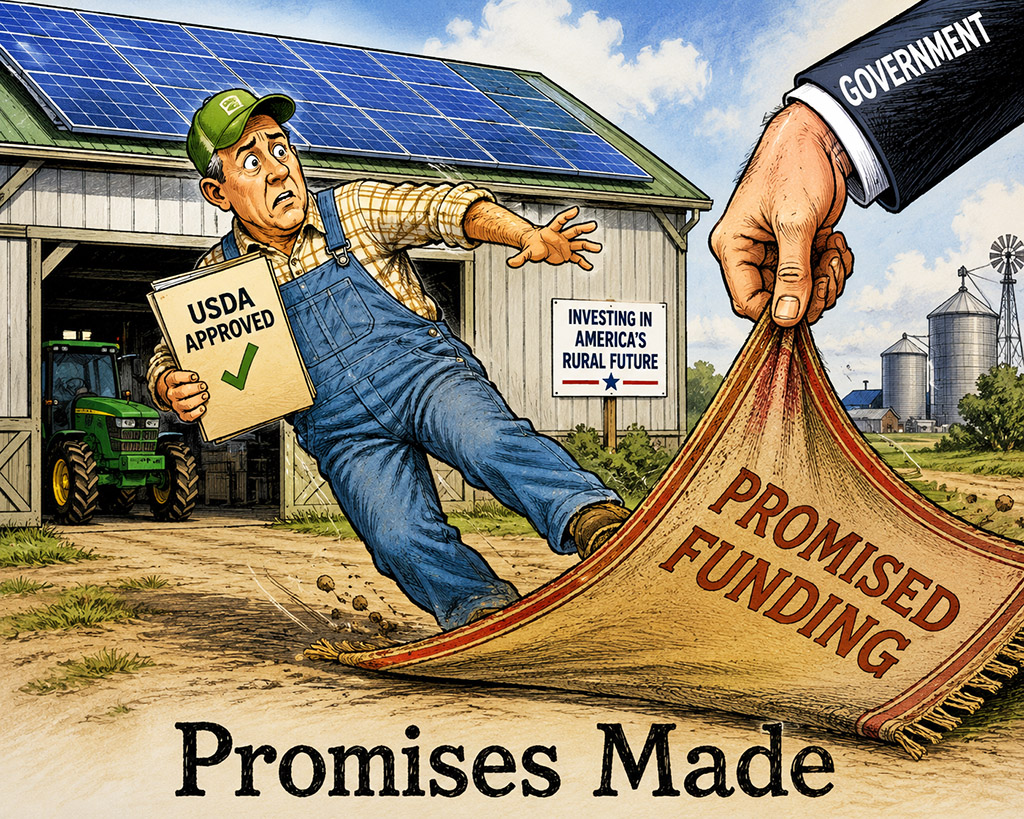
Federal Funding Freeze Leaves Many Producers Waiting for Promised Reimbursements
Across Iowa, farmers answered the federal government’s call to invest in rural energy projects.
They installed solar panels on machine sheds and livestock buildings. They upgraded grain dryers, irrigation systems, and other equipment to improve energy efficiency. Many borrowed money, signed contracts, and completed projects with the understanding that the federal government would reimburse a portion of their costs through the Rural Energy for America Program (REAP).
Then the rules changed. Following the change in administrations, funding for many USDA programs created or expanded under the Biden administration, including REAP projects funded through the Inflation Reduction Act, was paused or delayed while the Trump administration conducted a broad review of federal spending priorities.
For many Iowa farmers, the review created uncertainty after investments had already been made.
Unlike future grant applicants who could simply choose not to participate, many producers had already completed projects, hired contractors, or taken on debt with the expectation that approved federal reimbursements would follow.
The funding delays left some wondering whether commitments they had relied upon would ultimately be honored.
What is REAP?
The Rural Energy for America Program helps agricultural producers and rural small businesses reduce energy costs through grants and loan guarantees.
Projects include solar energy systems, energy-efficient grain drying equipment, irrigation improvements, livestock facility energy upgrades, renewable energy installations, and other technologies that reduce operating costs and improve energy efficiency.
The program has existed for years under the Farm Bill but received significant additional funding through the Inflation Reduction Act.
Supporters say the investments lower long-term operating costs while strengthening rural energy independence. Critics have questioned some of the program’s climate-related priorities and overall federal spending levels.
When policy changes affect completed projects
The REAP controversy illustrates a broader question facing many federally funded programs. The issue is not simply whether future administrations should establish different priorities. Every administration has that authority.
The question becomes more complicated when policy changes occur after citizens have already acted in reliance on government commitments.
Many participating farmers had already signed contracts, purchased equipment, borrowed money, completed construction, and begun operating their projects. The uncertainty surrounding reimbursement left some producers carrying financial obligations while awaiting decisions about funding they believed had already been approved.
Several lawsuits challenging freezes on congressionally appropriated funding have argued that executive agencies cannot indefinitely suspend programs authorized and funded by Congress. Courts have issued several rulings requiring agencies to continue distributing certain appropriated funds while legal disputes continue.
Why It Matters in Iowa
Energy costs remain one of the largest operating expenses for many Iowa farms. Programs such as REAP are intended to help producers reduce those costs while modernizing agricultural operations.
Regardless of whether Iowans support or oppose the program itself, the funding dispute highlights a broader issue affecting rural communities: how changes in federal policy can create uncertainty for people who have already made significant financial decisions based on existing government commitments.
Our Take
This story is not fundamentally about renewable energy. It is about trust.
Governments change and new administrations establish new priorities. That is part of our democratic system.
But when citizens act in good faith based on existing laws, signed agreements, or approved federal programs, those changes can have real financial consequences.
An Iowa farmer who borrows money to complete a project after receiving government approval has already accepted the risk of the investment. If promised funding is later delayed or suspended, the farmer, not the government, often bears the immediate financial burden.
Courts will continue deciding where the constitutional boundaries lie between Congress’s authority to fund programs and an administration’s authority to administer them.
But the broader lesson extends beyond this one program.
Stable government is built not only on elections and laws, but also on the public’s confidence that commitments will be honored. Or, when they must change, that they will change fairly, transparently, and within the law.
That confidence is essential to agriculture, business, and every community that depends on predictable public policy.
Breaking With Trump, or Just His Poll Numbers?
Candidates show some dissent over the Iran war, as Grassley and Ernst vote against limiting Trump’s war powersIowa Republican candidates are changing their positions on the Iran war as Election Day approaches. That is news. Calling it a “break with Trump” may be...
Has the UI Center Lost Its Academic Legitimacy?
How Much Academic Legitimacy Does Iowa's Center for Intellectual Freedom Have Left?Eleven scholars recruited to help establish the Center have resigned. Their departure raises a bigger question about what made this politically created institution academic in the first...
Trump Lost His Lawsuit. But Did the Lawsuit Fail?
An Iowa judge threw out Donald Trump’s lawsuit against Gannett and pollster J. Ann Selzer. But after nearly two years of litigation, the case raises a larger question about what it means to “win.”President Donald Trump lost his lawsuit against Gannett (owner of the...
As Iowans Suffer, Grassley Turns His Focus to Transgender Sports
Iowa already prohibits transgender girls from competing in girls' sports. With farmers struggling with diesel prices and families confronting inflation and housing costs, why is Chuck Grassley making the issue a national priority now?Should we be concerned about his...
Would a Ban of Diesel Exports Actually Lower Prices? Likely Not.
It’s More Complicated Than Grassley BelievesSen. Chuck Grassley says the U.S. should stop exporting diesel to bring down prices for farmers and truckers. The oil industry says that could backfire. Its explanation deserves a closer look.Iowa farmers are heading into...