
What the Lincoln Memorial Reflecting Pool Controversy Says About Government Accountability
An Iowa411 Editorial
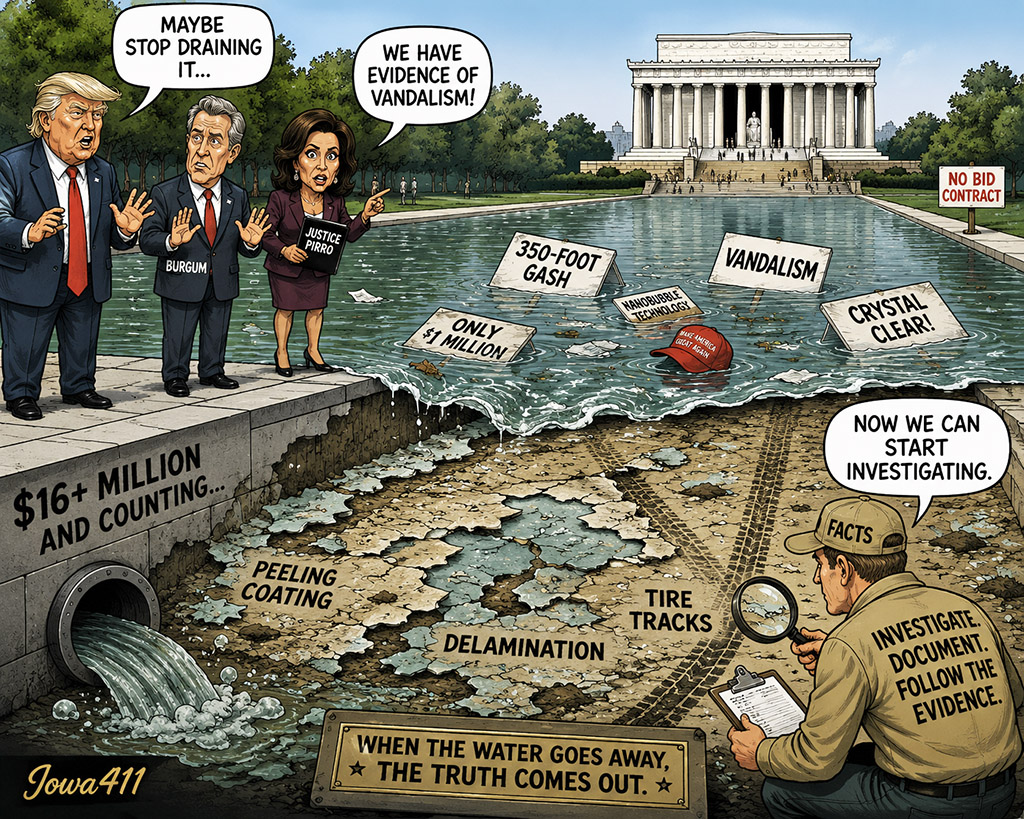
Truth is revealed by evidence
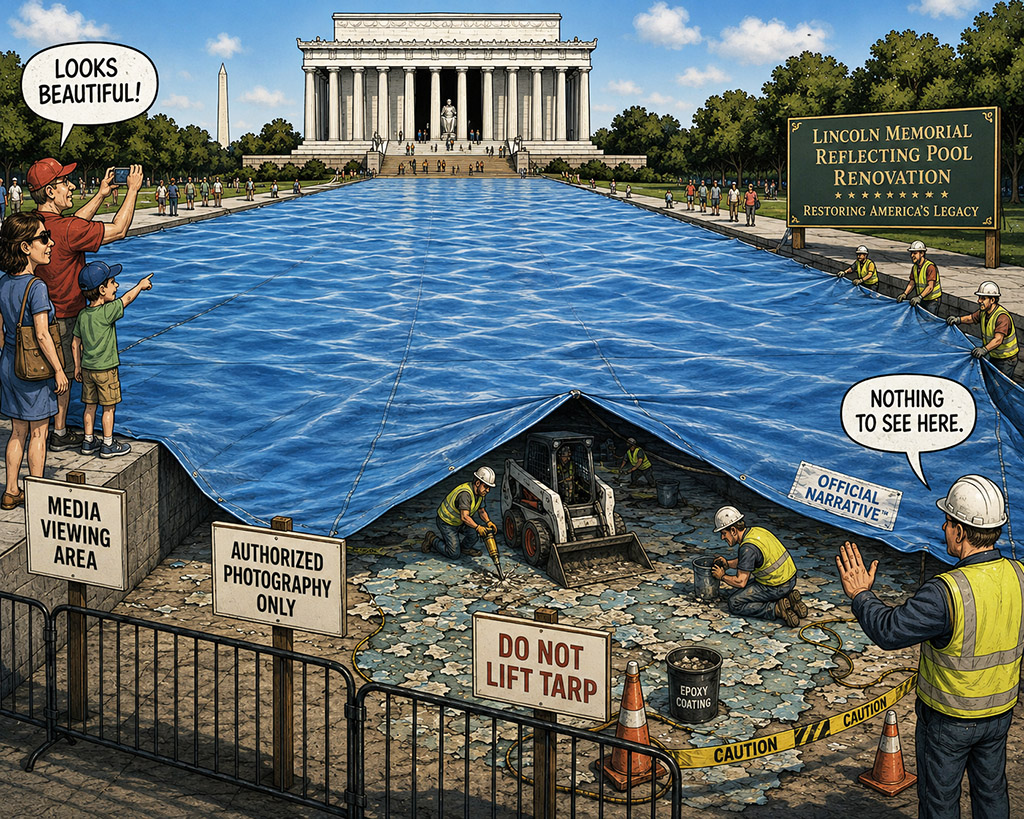
Appearances can be manufactured
Government Vandalism Charges Are Questioned
When governments make extraordinary claims, they should expect extraordinary scrutiny. That is not cynicism. It is accountability.
The controversy surrounding the Lincoln Memorial Reflecting Pool has become much more than a troubled construction project. It has become a test of whether Americans are willing to follow the evidence wherever it leads, even when that evidence may challenge the official narrative.
Exploding renovation costs
When the Trump administration announced the renovation of the historic reflecting pool, it was presented as a relatively modest project. Since then, reported costs have climbed dramatically, the new coating has failed, the pool has repeatedly been drained, algae and peeling materials have appeared, and repairs are already underway.
Those facts are not in dispute. What is disputed is why the project failed.
Accusations of vandalism
Administration officials, including Interior Secretary Doug Burgum, have repeatedly asserted that the primary cause was deliberate vandalism. They have described extensive cuts in the pool’s liner, reportedly stretching hundreds of feet, and argued that criminal acts, not construction deficiencies, are responsible for the damage.
Criminal charges
Those claims have become the basis for criminal prosecutions, including felony charges against a former Olympian and additional charges against other individuals accused of vandalizing the pool.
The public deserves to know
If those allegations are correct, the public deserves to know. If they are not, the public deserves to know that as well.
That is why the decision to drain the pool again matters. Physical evidence has no political affiliation.
Drain the pool and show the evidence
When the water is gone, investigators should be able to determine whether the damage reflects deliberate cuts, widespread coating failure, poor surface preparation, improper application, damage caused after construction, or some combination of those factors.
The condition of the pool floor should provide important answers that no press conference or social media post can substitute for.
Legitimate questions
There are other legitimate questions that deserve public answers. Why did project costs increase so substantially? What procurement process was used to select the contractor? What evidence supports the claimed extent of vandalism? How was the alleged damage assessed? Why has the same contractor reportedly been selected to perform additional repairs after the original work failed?
These are not partisan questions; they are oversight questions. Exactly the kinds of questions taxpayers should ask whenever public money is spent, and public officials make factual claims.
Claims not backed with evidence
The most troubling aspect of this controversy is not that government officials tried to explain the project’s failure without evidence. It is the possibility that conclusions may have been embraced before the underlying evidence was fully examined.
In a healthy democracy, investigations should follow the evidence. Evidence should not be expected to follow the investigation.
That principle protects everyone, whether they are government officials, contractors, or private citizens facing criminal charges. It also protects public confidence.
Do not accept claims until evidence is presented
Americans should resist the temptation to accept or reject official claims simply because they align with political preferences. Governments sometimes get things right. Governments sometimes get things wrong. The only reliable way to distinguish between the two is to examine the evidence openly and honestly.
When the reflecting pool is drained, the facts beneath the water should speak louder than any political narrative. Because in the end, accountability is not about defending a president, a political party, or a government agency.
It is about defending the principle that public claims should be supported by public evidence. That principle is one of the foundations of both good government and a free society.
Breaking With Trump, or Just His Poll Numbers?
Candidates show some dissent over the Iran war, as Grassley and Ernst vote against limiting Trump’s war powersIowa Republican candidates are changing their positions on the Iran war as Election Day approaches. That is news. Calling it a “break with Trump” may be...
Has the UI Center Lost Its Academic Legitimacy?
How Much Academic Legitimacy Does Iowa's Center for Intellectual Freedom Have Left?Eleven scholars recruited to help establish the Center have resigned. Their departure raises a bigger question about what made this politically created institution academic in the first...
Trump Lost His Lawsuit. But Did the Lawsuit Fail?
An Iowa judge threw out Donald Trump’s lawsuit against Gannett and pollster J. Ann Selzer. But after nearly two years of litigation, the case raises a larger question about what it means to “win.”President Donald Trump lost his lawsuit against Gannett (owner of the...
As Iowans Suffer, Grassley Turns His Focus to Transgender Sports
Iowa already prohibits transgender girls from competing in girls' sports. With farmers struggling with diesel prices and families confronting inflation and housing costs, why is Chuck Grassley making the issue a national priority now?Should we be concerned about his...
Would a Ban of Diesel Exports Actually Lower Prices? Likely Not.
It’s More Complicated Than Grassley BelievesSen. Chuck Grassley says the U.S. should stop exporting diesel to bring down prices for farmers and truckers. The oil industry says that could backfire. Its explanation deserves a closer look.Iowa farmers are heading into...
Iowa Corn Growers Ask for Diesel Price Relief as Harvest Begins
Iowa Corn Growers Association asks for diesel relief as harvest kicks offBy Cami KoonsIowa Capital Dispatch As Iowa farmers begin harvesting their crops, corn growers in the state are asking Iowa congressional delegates to help lower the cost of diesel fuel, which has...
Mortgage Rates Hit 7% as War Increases Housing Market Pressure
Higher energy prices, persistent inflation, and rising borrowing costs are making an already difficult housing market even harder for buyers.The New York Times reports that mortgage rates have climbed above 7% for the first time since January 2025, another economic...