
Republicans Tout Tax Cuts but Ignore the Real Economic Costs of the Big Beautiful Bill
With Costs Factored In, the Tax Cuts Do Not Compare
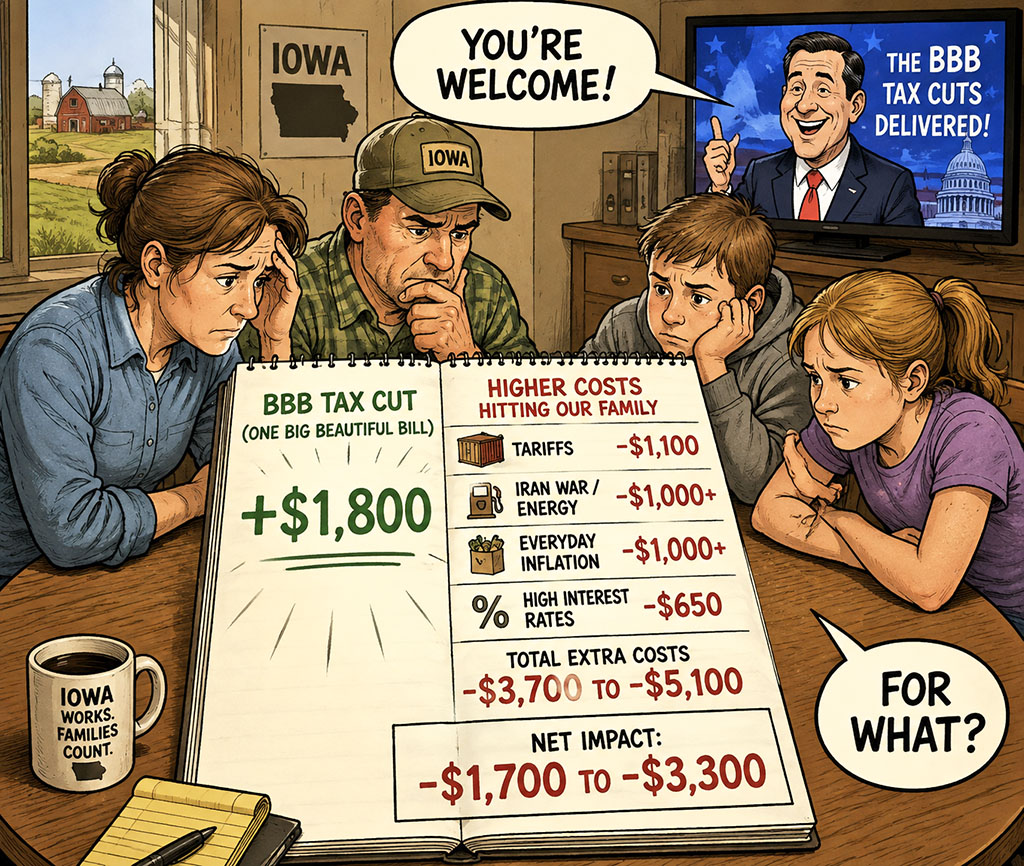
Republicans are touting the tax savings in the One Big Beautiful Bill Act as evidence that families are better off. The tax cuts are real. The Tax Policy Center estimates that middle-income households will receive an average federal tax reduction of about $1,800 in 2026.
But that is only one side of the household ledger. Over the same period, families have been hit by higher prices from tariffs, the Iran war and energy shock, continuing inflation, and expensive consumer credit.
The other side of the ledger
For a typical middle-income household, those added annual costs can reasonably be estimated at roughly $3,500 to $5,100.
| Household Cost | Estimated Annual Impact |
| Tariff-related price increases | $900–$1,700 |
| Iran war and energy shock | $1,000–$1,500 |
| Continuing everyday inflation | $1,000–$1,100 |
| Higher borrowing costs | $600–$800 |
| Estimated added household costs | $3,500–$5,100 |
| Average BBB middle-income tax reduction | +$1,800 |
| Estimated net household impact | -$1,700 to -$3,300 |
Tariffs
Tariffs alone are currently estimated by Yale’s Budget Lab to cost the average household about $1,100 a year, with earlier tariff regimes producing higher estimates.
The Iran War
The Iran war added another major hit. Budget Lab researchers estimated that the increase in gasoline prices alone could cost the average household about $1,000 during 2026. That does not include all the secondary effects of higher energy costs on utilities, transportation, air travel, manufacturing and distribution.
Increased prices for groceries, insurance, healthcare, and services
Families are also still paying more for groceries, insurance, healthcare and services. Inflation remains elevated, and the Federal Reserve has said both tariffs and the Middle East energy shock have contributed to recent price increases.
Borrowing is expensive
Borrowing remains expensive as well. A household carrying a typical credit-card balance and financing a vehicle can easily pay hundreds of dollars more each year than it would under lower-rate conditions.
These figures are estimates, not a universal household bill. Every family spends and borrows differently, and some categories overlap. But the larger point is difficult to miss.
A tax cut is not the same as being better off
Consider a middle-income Iowa family that receives the estimated $1,800 BBB tax reduction.
If that family also pays roughly $1,100 more because of tariffs, $1,000 more from higher gasoline and energy costs, another $1,000 through continuing price increases, and $650 more in borrowing costs, its household budget is about $3,750 worse off before the tax cut.
After the $1,800 tax reduction, the family is still roughly $1,950 behind.
That does not mean every family lost exactly $1,950. It means politicians cannot reasonably measure a family’s economic well-being by looking only at its tax bill.
Our take
Republicans are entitled to point to the BBB tax cuts. But Iowans should look at the whole ledger.
Tariffs raise prices. The Iran war raised energy costs. Inflation continues to erode purchasing power. Credit remains expensive. Those costs are just as real as a tax cut.
So the question voters should ask is not simply “how much did the BBB cut my taxes?” It should be “after all of the higher costs are counted, how much money does my family actually have left?”
For many households, the answer may be that the tax cut did not come close to covering the added cost of living.
Iowa’s Fiscal Picture Improves?
The $1.1 Billion Budget Gap Tells Another StoryA modest increase in projected revenue does little to change Iowa's underlying budget problem, or the economic growth Republicans are counting on to solve it.Iowa's fiscal outlook is improving. At least, that's how Gov....
Energy Prices Push Inflation to 3.7% in September
Gasoline prices surge 34% over the past year as higher living costs continue to squeeze American householdsThe Federal Reserve is considering additional interest rate increases as American households face growing affordability challenges ahead of the midterm...
Lahn’s Running Mate Receives $540,000 Mystery Loan
The money is from an undisclosed LLC that had formed a week earlierA mysterious lender, a newly formed Illinois company, and a substantial private loan raise questions about the finances of Zach Lahn's running mate.Three weeks after Republican gubernatorial candidate...
Elon Musk’s Millions Are Helping Finance Iowa’s U.S. Senate Race
$31 million in Musk's super-PAC contributions have been spent to support the Ashley Hinton campaignTwo political organizations receiving $234 million from the billionaire since July have spent nearly $31 million supporting Ashley Hinson or opposing Josh Turek in...
Glyphosates Not Mentioned at Hinson Water Quality Event
Hinson Promises to Stand Up to Trump, but What About His Support for Monsanto's Roundup?After pledging to challenge Trump on policies harmful to Iowa, Hinson hosts a water-quality and cancer roundtable without addressing his administration's support for glyphosate.On...