
Hinson Promises to Stand Up to Trump, but What About His Support for Monsanto’s Roundup?
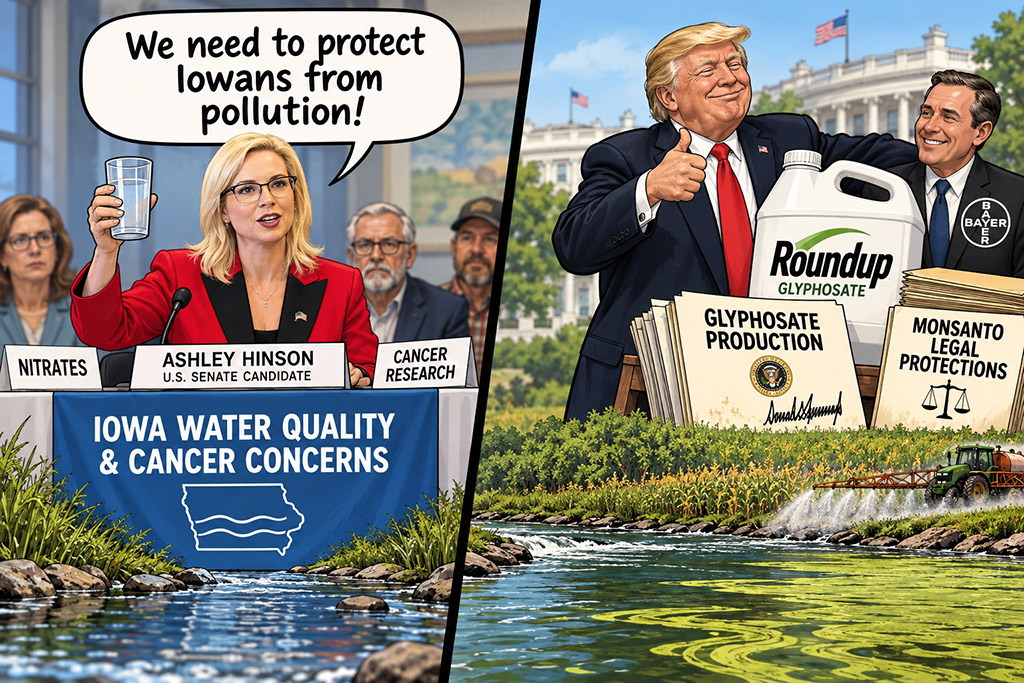
After pledging to challenge Trump on policies harmful to Iowa, Hinson hosts a water-quality and cancer roundtable without addressing his administration’s support for glyphosate.
On October 7, Republican U.S. Senate candidate Ashley Hinson promised Iowa voters that she would stand up to President Donald Trump when his policies were wrong for the state. Two days later, Hinson hosted a roundtable in West Des Moines to discuss Iowa’s water-quality problems, agricultural practices, and concerns about the state’s elevated cancer rates.
The roundtable completely ignored glyphosates, the widely used agricultural herbicide found in Monsanto’s Roundup that is applied to Iowa fields. This may not be surprising, considering that Roundup and glyphosates are supported by President Trump, Governor Reynolds, and Iowa Legislature Republicans.
Hinson’s water-quality roundtable
At the October 9 roundtable, Hinson brought together researchers, farmers, local officials, and community representatives to discuss Iowa’s water systems. Participants examined agricultural runoff, nitrate contamination, infrastructure needs, and the complicated relationship between environmental exposures and cancer.
University of Iowa cancer researcher Mary Charlton emphasized that cancer develops through multiple interacting factors and that researchers must carefully evaluate potential causes. Hinson acknowledged the state’s water-quality challenges and promised to continue advocating for improvements.
But the reported discussion did not address Trump’s glyphosate policies or his administration’s support for Monsanto in litigation involving cancer warnings. Nor has Hinson publicly opposed those three administration actions in the statements identified for this article.
Her promise to push back against Trump
It was during an October 7 Senate debate with political opponent Josh Turek that Hinson made a point of distinguishing her commitment to Iowa from her otherwise unconditional support for Trump.
“I’ll be President Trump’s ally when it is important for Iowa, but I will push back on him,” she said, adding that she would challenge actions that were wrong for the state. That promise provides a standard against which voters can examine her positions.
Hinson has identified Iowa’s water quality and cancer rates as serious concerns. Meanwhile, the administration she supports has protected production of a controversial agricultural chemical and backed a legal argument limiting certain cancer-warning lawsuits against its manufacturer.
There may be reasons Hinson supports those policies. Glyphosate plays an important role in conventional agriculture, and federal regulators have concluded that its approved uses do not present the cancer risks alleged in the litigation. But Hinson has not publicly explained how she weighs those considerations against the environmental and public-health concerns she raised at her roundtable.
Glyphosate and Iowa’s environmental concerns
Glyphosate is one of the most widely used agricultural herbicides in the United States. Its extensive use has made it a significant subject of water-quality monitoring and environmental-health research.
The U.S. Geological Survey has documented widespread glyphosate contamination in American streams and rivers, particularly in agricultural watersheds.
The chemical has also been the subject of a longstanding scientific disagreement over cancer risks. The World Health Organization’s International Agency for Research on Cancer classified glyphosate as probably carcinogenic to humans, while the Environmental Protection Agency has concluded that it is unlikely to cause cancer when used according to its label.
These conflicting assessments are important to understanding the controversy. They also make glyphosate relevant to discussions about agricultural chemicals, water quality, and cancer concerns, even though its contribution to Iowa’s elevated cancer rates has not been established.
Glyphosate residues, from Iowa fields to the dinner table
Concerns about glyphosate extend beyond Iowa’s waterways to the food Americans eat. Glyphosate, the active ingredient in widely used herbicides such as Roundup, is applied to control weeds in agricultural production. Its use has increased dramatically since the 1970s, particularly following the introduction of glyphosate-resistant crops in 1996. A federal study found evidence of recent glyphosate exposure in approximately 81% of Americans tested. Although exposure does not necessarily indicate a health risk, the widespread presence of glyphosate raises questions about how agricultural chemicals move through the food supply. (Source: Consumer Notice)
Testing by the Environmental Working Group (EWG) has detected glyphosate residues in numerous oat-based breakfast cereals, granola bars, and other packaged foods. In one round of testing, more than 95% of sampled oat-based products contained detectable residues, including popular Cheerios and Nature Valley products. Some samples contained hundreds of parts per billion.
However, these findings came from a limited selection of products and should not be interpreted as representative of all foods or as proof that the detected levels are unsafe. EWG’s health-based benchmark is also different from federal regulatory limits. Nevertheless, the findings illustrate an important dimension of Iowa’s agricultural chemical debate, that pesticide exposure is not confined to farm fields, drinking water, or nearby communities. Residues can also reach consumers through everyday foods.
Trump’s support for Monsanto
Since returning to the White House, Trump has taken three significant actions benefiting Monsanto and its parent company, Bayer.
December 2025: The Trump administration urged the U.S. Supreme Court to consider Monsanto’s argument that federal pesticide-labeling law overrides certain state lawsuits alleging the company failed to warn consumers about Roundup’s potential cancer risks.
February 18, 2026: Trump signed an executive order invoking the Defense Production Act to protect domestic production of glyphosate-based herbicides. The administration characterized glyphosate as important to agricultural production and national security.
June 25, 2026: The Supreme Court ruled 7–2 in Monsanto’s favor, restricting state-law lawsuits alleging the company failed to provide adequate cancer warnings. The Trump administration had supported Monsanto’s legal position.
These actions do not establish that glyphosate causes cancer. They do, however, demonstrate the administration’s support for continued glyphosate production and Monsanto’s efforts to limit legal liability.
Monsanto’s support from Iowa Republicans
Support for Monsanto has not been limited to Washington. In March 2025, Iowa’s Republican-controlled Senate passed legislation proposed by Bayer, Monsanto’s parent company, that would have restricted lawsuits alleging pesticide manufacturers failed to warn consumers about health risks when their products carried federally approved labels. And Governor Kim Reynolds signed the bill into law.
The measure passed 26–21, with six Republicans joining Democrats in opposition. Although the bill ultimately failed in the Iowa House, Republican Senate leaders continued encouraging its passage in 2026, even as Iowans protested what opponents called the “Cancer Gag Act.”
The legislation was intended to protect manufacturers from certain liability claims, while supporters argued that companies complying with federal labeling requirements should not face additional state-law obligations. The controversy illustrates that the debate over glyphosate, cancer concerns, and corporate liability has been taking place in Iowa’s own Capitol, and not just in Washington.
An unanswered question
Hosting discussions about water quality is one way to address Iowa’s environmental challenges. Federal agricultural policy, pesticide regulation, and consumer protections are another.
Hinson has promised to challenge Trump when his decisions are wrong for Iowa. His administration’s actions involving glyphosate and Monsanto offer an opportunity for her to explain where she draws that line.
Does Hinson support Trump’s glyphosate policies and his administration’s legal support for Monsanto? And how does she reconcile that position with her stated concerns about Iowa’s water quality and cancer rates?
Those are questions her roundtable did not answer.
Johnson Campaigns for Miller-Meeks Before GOP PAC Pulls Ads
Four Days After Johnson Campaigns for Miller-Meeks, GOP Congressional PAC Cuts FundingThe House speaker appeared with the Iowa Republican on Friday. By Tuesday, a major political organization aligned with his leadership was redirecting planned campaign spending...
Top Republican PACs Pull Funding from Miller-Meeks
Major Republican super PACs withdraw planned advertising support for Iowa Rep. Mariannette Miller-Meeks as they redirect funds to other House racesNational GOP groups redirect campaign spending to other House races, leaving Iowa's 1st District incumbent without...
Putin Calls, and Trump Obeys
After Trump's Call With Putin, Russia Gets Diesel Deal and Ukraine Gets DemandsAfter the call, Trump announced Russian fuel purchases, called for new Ukrainian leadership, and declared a ceasefire neither country had confirmed.Following an October 9 phone conversation...
For Some Reason, Trump Turns to US Adversary Putin for Diesel
Will It Actually Lower Diesel Prices? Doubtful.The United States exports more diesel than it imports. Now Trump is turning to a U.S. Adversary, Russia, for additional fuel. This raises questions about the economic benefits, existing law, and who stands to...
Mortgage Rates Hit 7.49% as Iran War Drives Up Costs
U.S. mortgage rates reach 7.49% in October 2026 amid rising oil prices and inflation concerns linked to the Iran WarIowa411 News BriefThe average interest rate on a 30-year fixed mortgage has climbed to 7.49%, its highest level since November 2023, according to the...
Trump Says He Cut Diesel Taxes. Read the Fine Print.
What Trump's Red-Dye Diesel Executive Order Actually DoesTrump promised “tax-free” diesel for farmers and truckers. His executive order actually directs Treasury to determine whether it can defer the tax while the forces driving record diesel prices remain largely...
Texas City Charges $2 Million for Access to Flock Information
Texas city charges $2 million for Flock records as agencies make it harder to see how cameras are usedHigh invoices and challenges to accessing data on how departments use the surveillance cameras have hindered requests by privacy advocates and journalists.by Ayden...