
The New Trump Accounts Give Eligible Newborns a $1,000 Investment in Their Future. They’ll Need It.
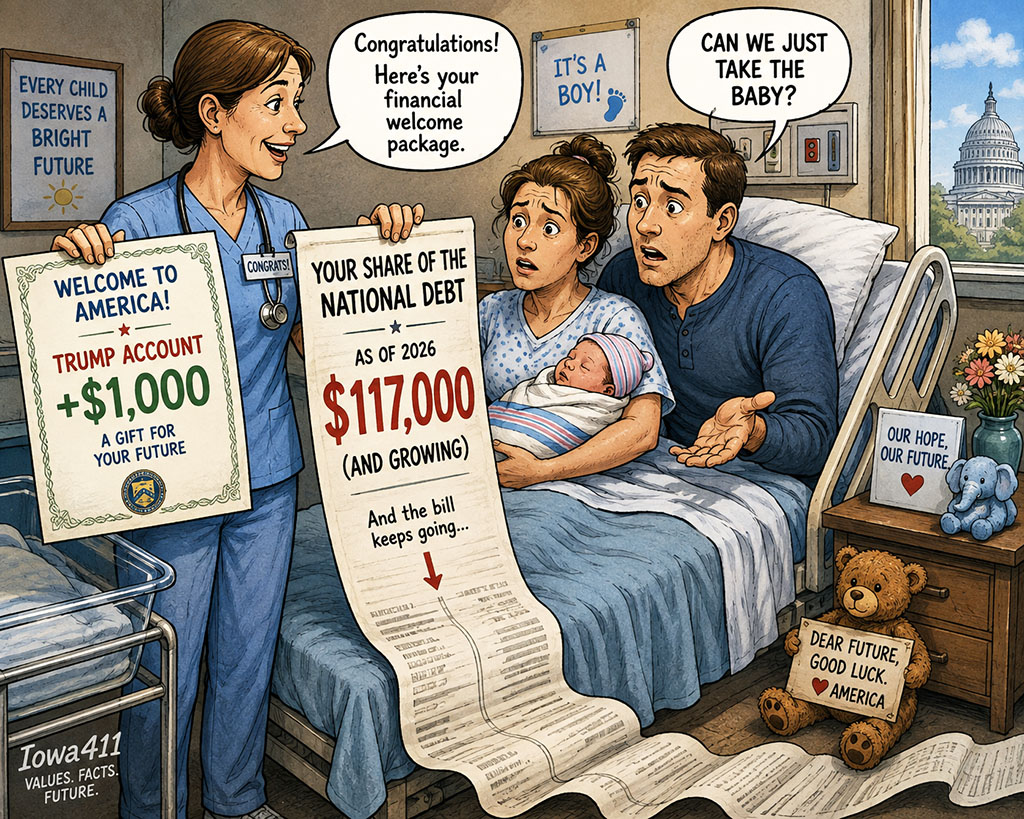
It is a worthwhile idea. But those same children are entering a country carrying more than $40 trillion in federal debt, and current policies are adding trillions more.
One Provision of the One Big Beautiful Bill Deserves Credit
The law created tax-advantaged investment accounts for children and provides a one-time $1,000 Treasury contribution for eligible U.S. citizen children born from 2025 through 2028. Parents, relatives, employers and others can contribute additional money, and the account is generally invested for the child’s future.
The idea is straightforward and potentially powerful: start children investing early, give compound growth time to work, and help more young Americans begin adulthood with some accumulated wealth.
But there is another side to the financial inheritance we’re giving those same children.
Born into $40 trillion of debt
The gross national debt has now crossed $40 trillion.
Dividing that debt among roughly 343 million Americans produces a share approaching $120,000 for every person in the country, including a baby born today. The Census Bureau estimated the population at about 342.6 million in late June.
A newborn doesn’t literally receive a $120,000 government bill, of course. Federal debt is an obligation of the government, not a personal loan assigned to every citizen. But today’s children will inherit its consequences.
They will become the taxpayers, workers and business owners responsible for supporting a federal government that must finance that debt while also paying for Social Security, Medicare, national defense and every other federal responsibility.
And the debt is still growing. CBO projects another $1.9 trillion federal deficit in 2026 and cumulative deficits of $23.1 trillion from 2026 through 2035. Interest on the debt alone is projected to rise from about $1 trillion this year to $2.1 trillion annually by 2036. CBO describes the nation’s fiscal trajectory as unsustainable.
The Big Beautiful Bill adds to the problem
That creates an uncomfortable contradiction within the BBB itself. The law gives an eligible newborn $1,000 to invest for the future. At the same time, the legislation adds substantially to the federal debt that child’s generation will inherit.
CBO originally estimated that the enacted BBB would increase deficits by about $3.4 trillion over 10 years, before accounting for additional interest costs. Including debt-service and other effects, CBO subsequently estimated an increase of roughly $4.1 trillion over the 2025–2034 period.
CBO’s newer 2026 projections put the reconciliation law’s contribution to deficits even higher: approximately $4.7 trillion from 2026 through 2035, after economic effects and related debt-service costs are included.
That doesn’t make Trump Accounts a bad idea. It makes the contrast difficult to ignore.
|
A 2026 Newborn’s Federal Ledger |
Approximate Amount |
| Trump Account seed contribution | +$1,000 |
| Current gross federal debt per American | about -$117,000 |
| 2026 federal deficit | -$1.9 trillion nationally |
| Projected 2026–2035 deficits | -$23.1 trillion nationally |
The first number is an actual asset belonging to the child. The second is a way of illustrating the scale of government indebtedness, not personal legal liability. But both say something important about what one generation is leaving the next. And the long-term picture is worse. There is a temptation to put an even larger number on every newborn by dividing estimates of Social Security and Medicare’s future funding shortfalls among the population.
We wouldn’t go that far
Those “unfunded liability” calculations depend heavily on assumptions about decades of future taxes, benefits, demographics, healthcare costs and government policy. They are useful warnings about long-term fiscal commitments, but they should not be presented as though a baby literally owes another $250,000 or $500,000 at birth.
We don’t need those numbers to see the problem
CBO’s official long-term projections are sobering enough. Federal debt held by the public is projected to grow from 99 percent of GDP at the end of 2025 to 120 percent in 2036 and 175 percent by 2056 if current laws generally remain unchanged.
That means today’s newborns could reach age 30 in an America carrying a substantially heavier debt burden than the country they were born into.
Our Take
Trump Accounts are a good idea. Helping children begin saving and investing from birth recognizes something policymakers should encourage. Long-term thinking and responsibility toward the next generation.
Congress should apply the same principle to the federal budget. A $1,000 investment account says we care about what a newborn’s financial life might look like 18, 30 or 50 years from now. Running trillion-dollar annual deficits says something very different.
And this isn’t simply a Republican problem. Presidents and Congresses of both parties helped create America’s $40 trillion debt. But the current government owns the decisions it makes now. The BBB did not seriously confront the nation’s fiscal trajectory. According to CBO, it made that trajectory worse by adding trillions of dollars to projected deficits.
There is something deeply contradictory about giving a newborn $1,000 for her future while simultaneously adding to the enormous public debt her generation will inherit.
If America’s leaders really want to invest in children, funding an investment account is a good start. Leaving them a government they can afford would be an even better one.
Iowa Legislators at Odds Over the Iran War
Hinson Calls for End to Iran War as Grassley and Ernst Vote to Continue ItIowa Republican Rep. Ashley Hinson is now calling for an “immediate end” to the nearly seven-month Iran war, even as Iowa Republican Sens. Chuck Grassley and Joni Ernst voted Thursday against a...
Breaking With Trump, or Just His Poll Numbers?
Candidates show some dissent over the Iran war, as Grassley and Ernst vote against limiting Trump’s war powersIowa Republican candidates are changing their positions on the Iran war as Election Day approaches. That is news. Calling it a “break with Trump” may be...
Has the UI Center Lost Its Academic Legitimacy?
How Much Academic Legitimacy Does Iowa's Center for Intellectual Freedom Have Left?Eleven scholars recruited to help establish the Center have resigned. Their departure raises a bigger question about what made this politically created institution academic in the first...
Trump Lost His Lawsuit. But Did the Lawsuit Fail?
An Iowa judge threw out Donald Trump’s lawsuit against Gannett and pollster J. Ann Selzer. But after nearly two years of litigation, the case raises a larger question about what it means to “win.”President Donald Trump lost his lawsuit against Gannett (owner of the...
As Iowans Suffer, Grassley Turns His Focus to Transgender Sports
Iowa already prohibits transgender girls from competing in girls' sports. With farmers struggling with diesel prices and families confronting inflation and housing costs, why is Chuck Grassley making the issue a national priority now?Should we be concerned about his...