
How Much Academic Legitimacy Does Iowa’s Center for Intellectual Freedom Have Left?
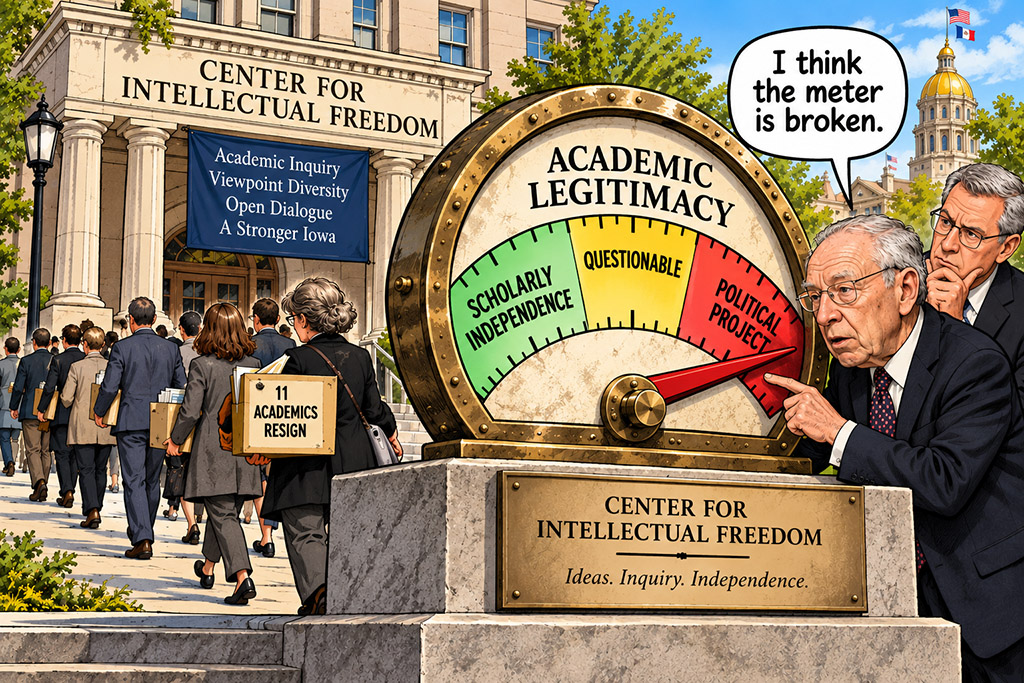
Eleven scholars recruited to help establish the Center have resigned. Their departure raises a bigger question about what made this politically created institution academic in the first place.
There is an irony here that is getting difficult to overlook. Iowa’s political leaders created the Center for Intellectual Freedom because they questioned whether the state’s universities provided sufficient intellectual diversity.
To establish its credibility as an academic institution, however, they recruited academics. Now 11 of those academics have resigned together, saying they no longer have confidence in the people overseeing the Center.
So perhaps the question isn’t whether the Center suddenly lost its academic legitimacy this week. It’s how much academic legitimacy it had established in the first place—and how much remains.
The Academics Were There for a Reason
From its beginning, the Center occupied an unusual space between academia and politics. The Republican-controlled Legislature created it, prescribed its mission and placed it under the authority of the Iowa Board of Regents. But the law also calls it an “independent academic center,” with responsibilities for scholarship, teaching and intellectual inquiry.
The advisory council brought together Iowa political, business and civic figures with scholars from universities including Stanford, Princeton, Northwestern, Chicago and Texas.
Those academics weren’t window dressing. They provided something lawmakers couldn’t create simply by putting the word academic into Iowa law: academic credibility.
In fact, that tension surfaced almost immediately. During early discussions about the Center’s bylaws, scholars argued for maintaining significant academic representation in its leadership. Stanford professor Joshua Rauh said a scholar majority on the executive committee would help signal the Center’s commitment to being an academic institution.
That makes this week’s resignations considerably more important than a boardroom disagreement.
Eleven Scholars Walk Away
The immediate dispute involved the search for the Center’s permanent executive director and how much control the Regents should exercise over the institution.
University of Texas professor Richard Lowery, who chaired the council’s scholar committee, concluded that under the Regents’ direction the Center would fail.
Regents President Robert Cramer countered that Lowery appeared to want to run the Center his way and told him to work collaboratively with Regent Christine Hensley or step down. Lowery stepped down. And 10 other academics went with him.
The departures reduced the advisory council from 26 members to 15 and substantially changed its academic composition. The resigning scholars issued a collective vote of no confidence in the Regents and the Center’s direction.
That doesn’t mean the academics were necessarily right and the Regents wrong. Iowa law clearly gives the Regents considerable authority over the Center. But legal authority and academic legitimacy are different things.
The Regents can appoint a director, oversee a budget and enforce the law. They cannot simply declare scholarly credibility into existence.
An Intellectual Freedom Center Without the Intellectuals?
That’s the problem now confronting the Center. The scholars recruited to help establish its academic credibility have not merely disagreed with a decision. Eleven of them have collectively concluded that they no longer have confidence in its governance.
They didn’t take the words “Center for Intellectual Freedom” with them. But they may have taken a substantial portion of the academic credibility those words were supposed to carry.
The Center can recover from that. It can recruit respected scholars. It can hire a credible permanent director. And the Regents can demonstrate through their actions that an institution created by politicians can nevertheless operate with meaningful academic independence.
But those things now have to be demonstrated, not assumed.
And that brings us back to the remarkable irony at the center of this entire experiment. Iowa’s political leaders created the Center because they questioned the intellectual diversity of academia. Now many of the academics recruited to provide that diversity are questioning whether Iowa’s political leaders will provide sufficient intellectual independence.
Perhaps that is the real test of the Center for Intellectual Freedom. Not whether politicians can create it, but whether academics will consider it credible enough to participate.
Read more: 11 Center for Intellectual Freedom Council Members Resign
Breaking With Trump, or Just His Poll Numbers?
Candidates show some dissent over the Iran war, as Grassley and Ernst vote against limiting Trump’s war powersIowa Republican candidates are changing their positions on the Iran war as Election Day approaches. That is news. Calling it a “break with Trump” may be...
As Iowans Suffer, Grassley Turns His Focus to Transgender Sports
Iowa already prohibits transgender girls from competing in girls' sports. With farmers struggling with diesel prices and families confronting inflation and housing costs, why is Chuck Grassley making the issue a national priority now?Should we be concerned about his...
Mortgage Rates Hit 7% as War Increases Housing Market Pressure
Higher energy prices, persistent inflation, and rising borrowing costs are making an already difficult housing market even harder for buyers.The New York Times reports that mortgage rates have climbed above 7% for the first time since January 2025, another economic...
The Company Miller-Meeks Keeps
The Company She Keeps: Who Is Miller-Meeks Bringing to Iowa?Mariannette Miller-Meeks brought Rick Scott and Markwayne Mullin to Iowa to help make the case for her reelection. Their backgrounds raise a reasonable question: What should voters make of the people a...
Iowa AG Filed Suit in Support of Mega Media Merger
Why Did Brenna Bird Try to Stop the Paramount-Warner Lawsuit?Iowa's attorney general called the challenge to the Paramount-Warner Bros. merger “politicized.” The states that brought the case said they were protecting competition, consumers and workers. Iowa Attorney...
The “Give Us Another Chance” Tour Comes to Iowa
JD Vance to Voters – Please Give Us Another Chance Vice President J.D. Vance is coming to western Iowa Friday with a message for voters that may require a little work from the marketing department. “Give us another chance.” No, really. That was part of the vice...
Trumpapalooza Starts Today – Will Iowa Republicans Present?
Iowa411 SatireTrumpapalooza: Suggested Speaking Topics for Iowa Republicans The Republican Party’s first-ever national midterm convention, also known as “Trumpapalooza” because of its unswerving focus on President Trump, opens today in Dallas. The two-day production...