
Why Did Brenna Bird Try to Stop the Paramount-Warner Lawsuit?
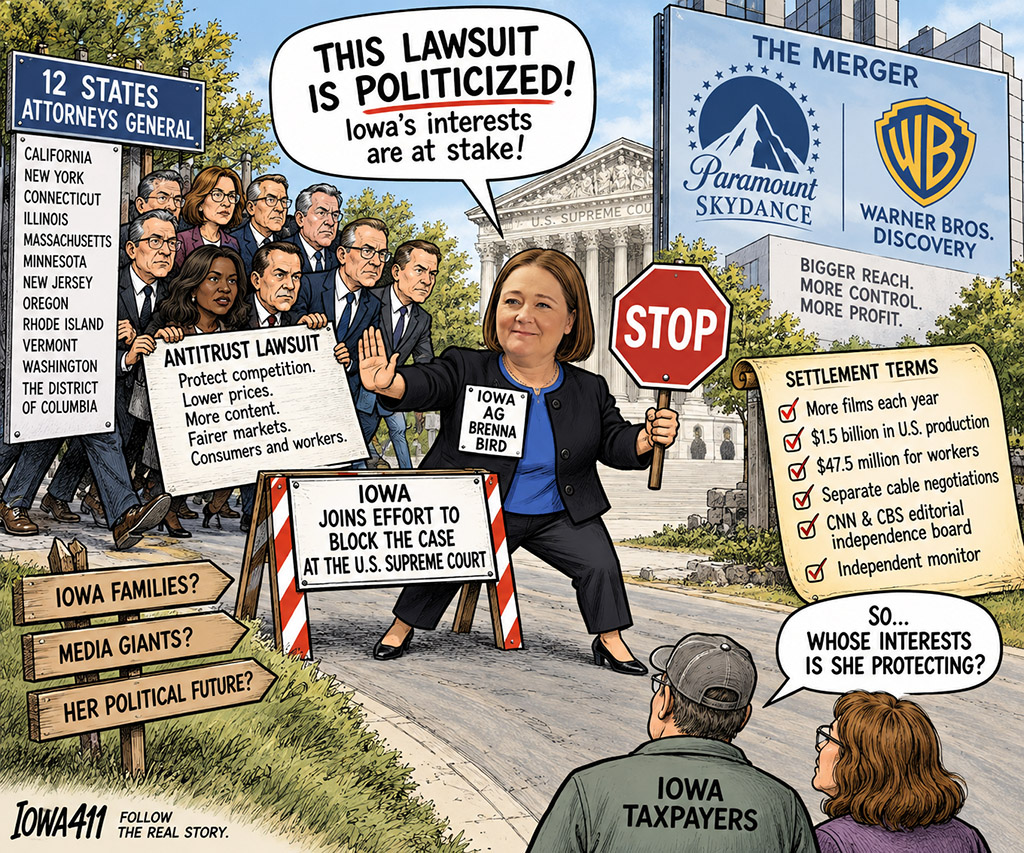
Iowa’s attorney general called the challenge to the Paramount-Warner Bros. merger “politicized.” The states that brought the case said they were protecting competition, consumers and workers.
Iowa Attorney General Brenna Bird wanted the U.S. Supreme Court to stop a 12-state lawsuit challenging Paramount Skydance’s acquisition of Warner Bros. Discovery. Now that lawsuit has produced a settlement.
The agreement allows the massive media merger to move forward, subject to court approval, but requires Paramount to accept enforceable conditions involving film production, workers, cable competition and the editorial independence of CNN and CBS News.
Two Very Different Views of the Lawsuit
Bird and Montana Attorney General Austin Knudsen asked the Supreme Court in August to intervene against California and 11 other states challenging the merger, calling their case a “politicized” antitrust action. They argued that delaying the merger harmed employees, consumers and the economic interests of Iowa and Montana.
The states bringing the lawsuit described their purpose quite differently. Their complaint alleged that combining Paramount and Warner Bros. would eliminate competition between two major film distributors and cable programmers, resulting in higher prices, less content and reduced competition for theaters and television distributors. The case was brought under Section 7 of the Clayton Act, the federal law governing mergers that may substantially lessen competition.
There was a substantive antitrust argument behind the case. A combined Paramount-Warner would control about 27% of wide-release theatrical film distribution, according to the states, while four companies would control approximately 86% of that market. The states also argued that combining the companies’ cable holdings would eliminate competition that currently gives distributors leverage when negotiating prices.
Paramount disputed that analysis, arguing in part that the states defined the relevant markets too narrowly and didn’t adequately account for competition from streaming giants.
What the States Got
The settlement does not block the merger. California Attorney General Rob Bonta explicitly said it should not be interpreted as an endorsement of the deal.
Instead, Paramount agreed to several enforceable conditions. The company must release at least 30 films annually during the first two years and 32 annually during the following three; invest at least an additional $1.5 billion in U.S. film production over five years; establish a $47.5 million fund for workers displaced by the merger; and negotiate Paramount and Warner Bros. basic-cable channels separately for five years to preserve some of the competition that would otherwise disappear.
The agreement also addresses another concern surrounding the merger: what happens when CNN and CBS News come under the same corporate ownership.
Paramount must establish a News Editorial Independence Board intended to protect the editorial independence of both news organizations. An independent monitor will oversee the company’s compliance with the broader settlement. New York Attorney General Letitia James described the independent board as a mechanism to ensure journalistic independence at CNN and CBS.
The safeguard falls short of separating the news organizations from Paramount, and critics of the settlement argue that the overall agreement remains too weak to offset the competitive consequences of such a large media consolidation.
Meanwhile, Back in Iowa
The settlement doesn’t establish that Bird was wrong to challenge the states’ lawsuit. Nor does it establish whether political considerations influenced either side.
But it does sharpen an important Iowa question. Bird used the resources of the Iowa Attorney General’s Office to ask the nation’s highest court to intervene in litigation brought by 12 other states against two enormous media corporations. Those states said they were enforcing federal antitrust law to protect competition, consumers and workers. Their litigation ultimately resulted in enforceable commitments involving production, jobs, cable competition and journalistic independence.
So, what specific Iowa interest justified trying to stop them? And how much Iowa taxpayer-funded staff time and other state resources were devoted to doing it? Or, was it just a case of serving America’s oligarch billionaires?
Those are questions the Iowa Attorney General’s Office should answer.
The “Give Us Another Chance” Tour Comes to Iowa
JD Vance to Voters – Please Give Us Another Chance Vice President J.D. Vance is coming to western Iowa Friday with a message for voters that may require a little work from the marketing department. “Give us another chance.” No, really. That was part of the vice...
Trumpapalooza Starts Today – Will Iowa Republicans Present?
Iowa411 SatireTrumpapalooza: Suggested Speaking Topics for Iowa Republicans The Republican Party’s first-ever national midterm convention, also known as “Trumpapalooza” because of its unswerving focus on President Trump, opens today in Dallas. The two-day production...
Diesel Prices Hit An All-Time High, Again
Record Diesel Prices Will Reach Far Beyond the Pump in IowaAn Iowa411 News BriefDiesel has set national records on consecutive days, increasing costs for Iowa agriculture, transportation, businesses, public services, and eventually, consumers.Record Diesel Prices...
Experts: Iowa Already Has the Tools to Fight Medicaid Fraud
Former Iowa Officials: Iowa Already Has the Tools to Fight Medicaid FraudReynolds, Bird Failed to Use Existing State Resources Two former Iowa officials with extensive experience investigating health care fraud argue that Gov. Kim Reynolds and Attorney General Brenna...
Treasury Allows Companies to Hide their Ownership Identification
Editorial: Treasury Is Making It Easier to Hide Who Is Behind American CompaniesAn Iowa411 Iowa Values Editorial"It is the deliberate removal of a transparency safeguard created specifically to make financial crime harder to hide."Bessent Touts Policy that Makes It...
Baby Gets a $1,000 Trump Account and a Much Bigger Future Bill
The New Trump Accounts Give Eligible Newborns a $1,000 Investment in Their Future. They'll Need It.It is a worthwhile idea. But those same children are entering a country carrying more than $40 trillion in federal debt, and current policies are adding trillions...
The BBB Cut Your Taxes. And Increased Your Cost of Living
Republicans Tout Tax Cuts but Ignore the Real Economic Costs of the Big Beautiful BillWith Costs Factored In, the Tax Cuts Do Not Compare Republicans are touting the tax savings in the One Big Beautiful Bill Act as evidence that families are better off. The tax cuts...