
Iowa’s “MAHA” Legislation: Public Health Policy or Political Obedience Messaging?
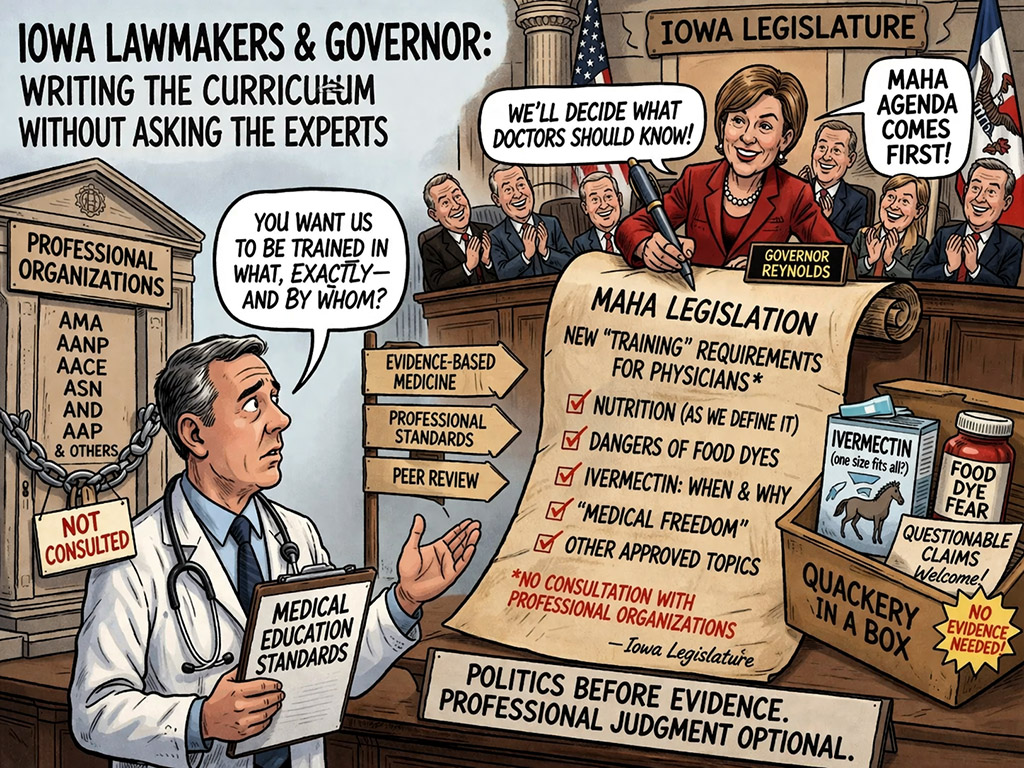
New proposals on food dyes, ivermectin, and medical training raise questions about science, policy, and priorities
A package of public health legislation moving through the Iowa Legislature aligned with the “Make America Healthy Again” (MAHA) movement has sparked debate over what constitutes sound health policy and what may instead reflect political influence.
The proposals, backed by Governor Kim Reynolds and Republican majorities, include measures related to restrictions on artificial food dyes in school meals, changes to SNAP food eligibility, nutrition and physical activity initiatives, required nutrition education for physicians, and notably, allowing pharmacists to dispense ivermectin.
Where Policy Meets Controversy
At a high level, many elements of the legislation are difficult to dispute. Improving childhood nutrition, addressing obesity, encouraging physical activity, and promoting healthier food choices are all non-controversial and legitimate public health goals.
But the concern is not with the goals. It is with how they are being pursued, and what is being included alongside them.
Ivermectin: A Policy Flashpoint
One of the most controversial provisions allows pharmacists to dispense ivermectin. Ivermectin is a legitimate antiparasitic medication that is widely used in both human and veterinary medicine.
However, it has been extensively studied and discredited as a treatment for COVID-19 by the U.S. Food and Drug Administration and the broader medical community. Including it in public health legislation raises concerns that policy is being influenced by previous misinformation narratives, and scientific consensus is being undermined or selectively ignored.
Artificial Dyes: A More Nuanced Issue
The proposed restrictions on artificial dyes present a different kind of challenge. Unlike ivermectin, there is ongoing scientific debate about certain food additives and some countries have stricter regulations than the United States. However, federal regulators have not implemented broad bans, and recent signals suggest a more cautious, evidence-based approach rather than sweeping restrictions.
This raises an important policy question. Should individual states move ahead of federal science, or align with it?
Who Decides Medical Training?
Another provision would require expanded nutrition education for physicians and medical students. On its face, this may seem reasonable. But critics point out that medical education is typically governed by accredited institutions and professional bodies. Mandating curriculum changes through state legislation risks politicizing medical training and overriding established expertise.
The SNAP Debate: Nutrition vs. Access
Changes to SNAP eligibility also highlight competing priorities. Supporters argue that public funds should promote healthier food choices. Critics counter that current eligibility rules are based on tax classification, not nutrition science. Restrictions could reduce access for families already under financial strain.
The result is a tension between public health goals and economic reality for working families.
A Broader Pattern
Taken together, the legislation reflects a broader pattern where legitimate health concerns are paired with more controversial provisions, scientific consensus is inconsistently applied, and policy decisions intersect with political messaging.
This creates a fundamental question. Is this a coordinated public health strategy or a collection of ideas driven by multiple, sometimes conflicting influences?
Iowa411 Perspective
Improving public health is a worthy goal. But effective policy requires consistency, scientific alignment, and clear prioritization.
When legislation combines evidence-based measures with provisions tied to disputed or discredited claims, it risks undermining its own credibility.
The Bottom Line
Iowa’s MAHA legislation raises important questions. Not just about health policy, but about how that policy is formed. Are decisions grounded in current scientific consensus? Are priorities aligned with real-world needs? And are public health goals being advanced, or made more complicated?
These are questions worth asking as the legislation moves forward.
Breaking With Trump, or Just His Poll Numbers?
Candidates show some dissent over the Iran war, as Grassley and Ernst vote against limiting Trump’s war powersIowa Republican candidates are changing their positions on the Iran war as Election Day approaches. That is news. Calling it a “break with Trump” may be...
Trump Lost His Lawsuit. But Did the Lawsuit Fail?
An Iowa judge threw out Donald Trump’s lawsuit against Gannett and pollster J. Ann Selzer. But after nearly two years of litigation, the case raises a larger question about what it means to “win.”President Donald Trump lost his lawsuit against Gannett (owner of the...
Iowa Corn Growers Ask for Diesel Price Relief as Harvest Begins
Iowa Corn Growers Association asks for diesel relief as harvest kicks offBy Cami KoonsIowa Capital Dispatch As Iowa farmers begin harvesting their crops, corn growers in the state are asking Iowa congressional delegates to help lower the cost of diesel fuel, which has...
Mortgage Rates Hit 7% as War Increases Housing Market Pressure
Higher energy prices, persistent inflation, and rising borrowing costs are making an already difficult housing market even harder for buyers.The New York Times reports that mortgage rates have climbed above 7% for the first time since January 2025, another economic...
The “Give Us Another Chance” Tour Comes to Iowa
JD Vance to Voters – Please Give Us Another Chance Vice President J.D. Vance is coming to western Iowa Friday with a message for voters that may require a little work from the marketing department. “Give us another chance.” No, really. That was part of the vice...
Trumpapalooza Starts Today – Will Iowa Republicans Present?
Iowa411 SatireTrumpapalooza: Suggested Speaking Topics for Iowa Republicans The Republican Party’s first-ever national midterm convention, also known as “Trumpapalooza” because of its unswerving focus on President Trump, opens today in Dallas. The two-day production...
Diesel Prices Hit An All-Time High, Again
Record Diesel Prices Will Reach Far Beyond the Pump in IowaAn Iowa411 News BriefDiesel has set national records on consecutive days, increasing costs for Iowa agriculture, transportation, businesses, public services, and eventually, consumers.Record Diesel Prices...