Warning Signs Placed Outside Smithsonian History Museum
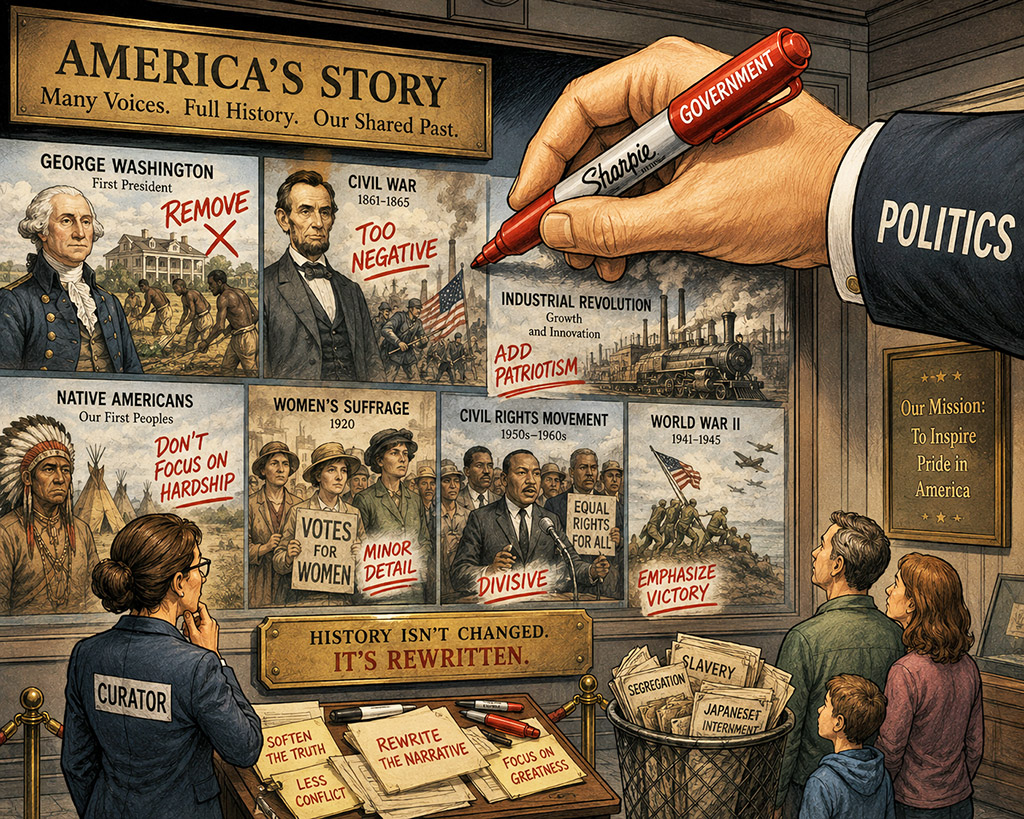
Critics say latest order expands debate over government’s role in shaping how Americans understand their history
President Donald Trump has ordered federal officials to install temporary signs outside the Smithsonian’s National Museum of American History, saying the museum presents an inaccurate and overly negative portrayal of the United States.
Using the Park Service for political communication
The executive order directs the National Park Service to place signs outside the museum highlighting what the administration describes as “inaccurate information” contained in its exhibits.
White House report accuses the Smithsonian of Anti-Americanism
The action follows a White House Domestic Policy Council report accusing the Smithsonian of promoting “thinly veiled anti-Americanism” and “extreme political activism.”
Among the report’s recommendations is a proposed warning at the museum entrance stating “Warning: the exhibits in this museum were prepared by people who don’t want you to love your country.”
Smithsonian leaders reject the characterization
The Smithsonian, however, is an independent institution, not a federal agency directly controlled by the White House. Museum leaders have rejected the administration’s characterization of their work.
National Museum of American History Director Anthea Hartig recently told a congressional committee that the museum seeks to inspire patriotism through honest historical examination rather than political messaging. Smithsonian Secretary Lonnie Bunch has similarly criticized the White House report as misrepresenting the museum’s exhibits.
Historians dispute report conclusions
The Organization of American Historians, the nation’s largest association of U.S. history scholars, also rejected the report’s conclusions.
The order is the latest in a series of actions by the Trump administration involving historical institutions. Earlier actions have included directing reviews of museum exhibits, restoring Confederate monuments removed in recent years, and revisiting how topics such as slavery, race, and civil rights are presented at federally supported institutions.
Viewpoints of supporters and critics
Supporters argue the administration is correcting what it views as politically biased portrayals of American history and restoring greater emphasis on the nation’s achievements. Critics contend the effort risks allowing elected officials to shape historical interpretation according to current political priorities.
The Smithsonian operates 21 museums and galleries, along with the National Zoo, and is widely regarded as one of the nation’s premier institutions for preserving and interpreting American history and culture.
Our Take
History should never be immune from scrutiny. New evidence emerges. Scholars challenge old assumptions. Interpretations evolve. That is how historical research advances.
Political editing is something different. Whether the goal is to remove uncomfortable facts, soften difficult chapters, or emphasize one narrative over another, governments should approach history with humility rather than certainty.
Museums exist not simply to celebrate a nation, but to help citizens understand its accomplishments, its failures, and the complex path between them.
That conversation is not limited to Washington. In Iowa, lawmakers recently approved consolidating the State Historical Society and state archives under a new government structure, prompting questions about how historical collections should be managed and how independent historical institutions should remain from political influence.
Those decisions deserve thoughtful public discussion because they raise a larger question that reaches beyond any single president or legislature. Who should decide how history is told? The answer matters because a nation’s understanding of its past shapes how it understands its present and imagines its future.
Trumpapalooza Starts Today – Will Iowa Republicans Present?
Iowa411 SatireTrumpapalooza: Suggested Speaking Topics for Iowa Republicans The Republican Party’s first-ever national midterm convention, also known as “Trumpapalooza” because of its unswerving focus on President Trump, opens today in Dallas. The two-day production...
Diesel Prices Hit An All-Time High, Again
Record Diesel Prices Will Reach Far Beyond the Pump in IowaAn Iowa411 News BriefDiesel has set national records on consecutive days, increasing costs for Iowa agriculture, transportation, businesses, public services, and eventually, consumers.Record Diesel Prices...
Vandals Strike the National Mall – AGAIN!
Investigators Question July 4 Crews About Mysterious Grass Vandals Satire President Donald Trump has identified what he claims to be another act of vandalism on the National Mall. And this time, the victim is grass. Trump posted a photograph showing large patches of...
AG Bird’s Medicaid Fraud Task Force Reports Big Progress
After Exhaustive Search, Task Force Discovers that Iowa Already Has a Medicaid Fraud Unit Satire Iowa Attorney General Brenna Bird’s Medicaid Fraud Elimination Task Force has made a remarkable discovery: Iowa already has a Medicaid Fraud Control Unit. Even more...
Experts: Iowa Already Has the Tools to Fight Medicaid Fraud
Former Iowa Officials: Iowa Already Has the Tools to Fight Medicaid FraudReynolds, Bird Failed to Use Existing State Resources Two former Iowa officials with extensive experience investigating health care fraud argue that Gov. Kim Reynolds and Attorney General Brenna...
Treasury Allows Companies to Hide their Ownership Identification
Editorial: Treasury Is Making It Easier to Hide Who Is Behind American CompaniesAn Iowa411 Iowa Values Editorial"It is the deliberate removal of a transparency safeguard created specifically to make financial crime harder to hide."Bessent Touts Policy that Makes It...
Baby Gets a $1,000 Trump Account and a Much Bigger Future Bill
The New Trump Accounts Give Eligible Newborns a $1,000 Investment in Their Future. They'll Need It.It is a worthwhile idea. But those same children are entering a country carrying more than $40 trillion in federal debt, and current policies are adding trillions...