
What Iowa Livestock Producers Need to Know About the New World Screwworm
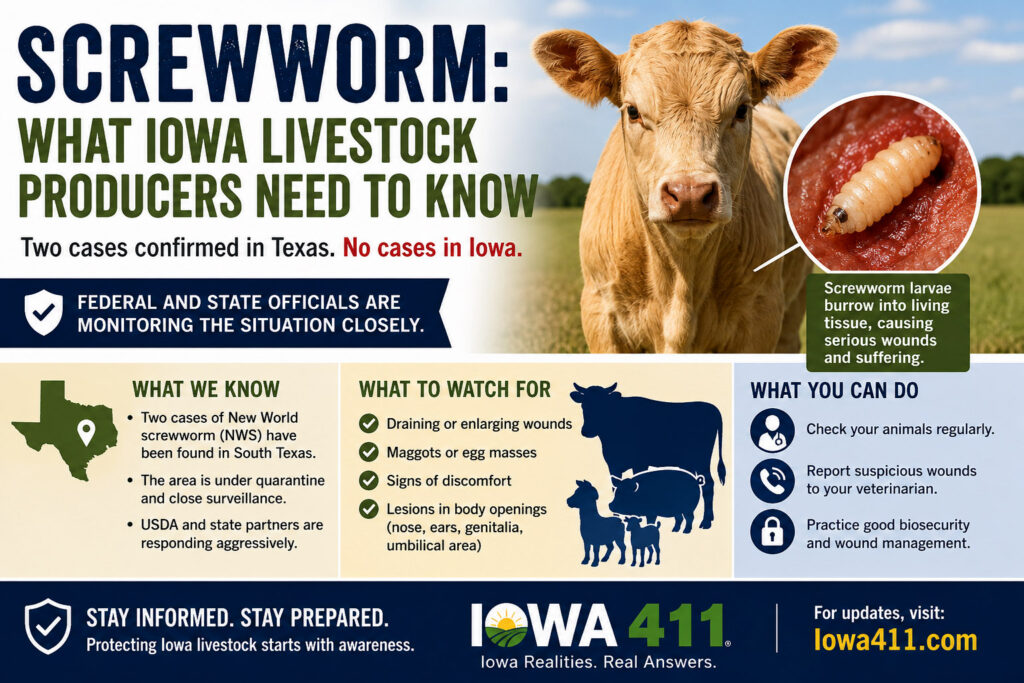
A livestock pest once eradicated from the United States has returned
A pest that many livestock producers hoped never to see again has reappeared in the United States.
Federal officials recently confirmed two cases of New World screwworm (NWS) in cattle in South Texas, triggering an aggressive response from the U.S. Department of Agriculture (USDA), the Texas Animal Health Commission, veterinarians, and livestock producers.
For now, the outbreak remains confined to a small area of Texas, more than 1,000 miles from Iowa. But because New World screwworm is one of the most destructive livestock pests ever encountered in North America, producers across the country are paying close attention.
So, what exactly is New World screwworm, and what does it mean for Iowa?
What Is the New World Screwworm?
New World screwworm is not actually a worm. It is the larval stage of a fly known as Cochliomyia hominivorax.
Unlike common maggots that feed on dead tissue, screwworm larvae feed on living tissue. Female flies lay eggs in wounds, surgical sites, navels of newborn animals, or other openings. After hatching, the larvae burrow into living flesh, causing painful and potentially life-threatening infestations.
The pest can affect a variety of animals, including cattle, horses, sheep, goats, swine, dogs and cats, deer and other wildlife, captive exotic animals, and in rare cases, humans. Without treatment, infestations can expand rapidly and may lead to severe injury or death.
Why Is It Such a Big Deal?
For much of the early and mid-20th century, New World screwworm caused enormous losses to American agriculture. Millions of dollars were spent annually treating livestock and controlling infestations.
A massive federal eradication effort eventually eliminated the pest from the United States using sterile fly releases, one of the most successful pest-control programs ever undertaken.
For decades, producers have operated without needing to worry about screwworm infestations. That is why the recent Texas detections have received so much attention.
While only two cases have been confirmed, animal health officials are treating them seriously because early intervention is critical to preventing wider spread.
Is Iowa at Risk?
At present, there is no indication that New World screwworm is present in Iowa.
The current detections remain confined to South Texas, where federal and state officials have established quarantine zones, increased surveillance, deployed response teams, and begun releasing millions of sterile flies to stop the pest from reproducing.
The immediate risk to Iowa livestock producers remains low. However, Iowa’s livestock industry is one of the largest in the nation. Any animal health threat that affects cattle, swine, sheep, goats, or other livestock is worth monitoring closely.
The situation serves as a reminder that animal diseases and pests do not recognize state boundaries.
What Are Officials Doing?
USDA has launched a comprehensive response that includes quarantine and movement-control zones, increased trapping and surveillance, veterinary field teams, laboratory support, expanded treatment resources, and aerial and ground release of sterile flies. Federal officials have also authorized and approved multiple treatments for various animal species to support prevention and response efforts.
The goal is straightforward: eliminate the pest before it becomes established.
What Should Producers Watch For?
Livestock owners should be familiar with the signs of possible screwworm infestation, including wounds that do not heal normally, enlarged or draining wounds, maggots present in wounds, irritation or unusual animal behavior, lesions around the eyes, ears, nose, mouth, or genital areas, and problems around the umbilical area of newborn animals.
Any suspicious wounds should be evaluated promptly by a veterinarian. Early detection remains one of the most effective tools for preventing spread.
A Lesson in Preparedness
Perhaps the most important takeaway for Iowa producers is not panic but preparedness.
The response in Texas demonstrates the value of animal health surveillance, veterinary partnerships, and coordinated state and federal response systems.
The fact that only two confirmed cases have been identified and that extensive response measures were activated almost immediately reflects years of planning and monitoring by animal health officials.
Agriculture faces a growing number of challenges, from emerging diseases and invasive pests to weather extremes and supply chain disruptions. Preparedness cannot prevent every threat, but it can make the difference between a manageable incident and a major crisis.
The Bottom Line
New World screwworm is one of the most serious livestock pests ever encountered in North America. The recent Texas detections are concerning, but there is currently no evidence of the pest in Iowa.
For Iowa producers, the most important actions are awareness, vigilance, and good animal health management practices.
Federal and state officials are aggressively responding to the Texas outbreak, and the hope is that early intervention will once again prevent New World screwworm from becoming a widespread threat to American agriculture.
For now, the message to Iowa livestock producers is simple. Stay informed, monitor your animals, and know that animal health officials are working to contain any outbreak.
More information
For more information, visit the USDA’s screwworm website.
Breaking With Trump, or Just His Poll Numbers?
Candidates show some dissent over the Iran war, as Grassley and Ernst vote against limiting Trump’s war powersIowa Republican candidates are changing their positions on the Iran war as Election Day approaches. That is news. Calling it a “break with Trump” may be...
Has the UI Center Lost Its Academic Legitimacy?
How Much Academic Legitimacy Does Iowa's Center for Intellectual Freedom Have Left?Eleven scholars recruited to help establish the Center have resigned. Their departure raises a bigger question about what made this politically created institution academic in the first...
Trump Lost His Lawsuit. But Did the Lawsuit Fail?
An Iowa judge threw out Donald Trump’s lawsuit against Gannett and pollster J. Ann Selzer. But after nearly two years of litigation, the case raises a larger question about what it means to “win.”President Donald Trump lost his lawsuit against Gannett (owner of the...
As Iowans Suffer, Grassley Turns His Focus to Transgender Sports
Iowa already prohibits transgender girls from competing in girls' sports. With farmers struggling with diesel prices and families confronting inflation and housing costs, why is Chuck Grassley making the issue a national priority now?Should we be concerned about his...
Would a Ban of Diesel Exports Actually Lower Prices? Likely Not.
It’s More Complicated Than Grassley BelievesSen. Chuck Grassley says the U.S. should stop exporting diesel to bring down prices for farmers and truckers. The oil industry says that could backfire. Its explanation deserves a closer look.Iowa farmers are heading into...
Iowa Corn Growers Ask for Diesel Price Relief as Harvest Begins
Iowa Corn Growers Association asks for diesel relief as harvest kicks offBy Cami KoonsIowa Capital Dispatch As Iowa farmers begin harvesting their crops, corn growers in the state are asking Iowa congressional delegates to help lower the cost of diesel fuel, which has...
Mortgage Rates Hit 7% as War Increases Housing Market Pressure
Higher energy prices, persistent inflation, and rising borrowing costs are making an already difficult housing market even harder for buyers.The New York Times reports that mortgage rates have climbed above 7% for the first time since January 2025, another economic...