
When Government Watches Government
Why Auditors May Be Among the Most Important Public Servants You’ve Never Met
Most people spend very little time thinking about auditors. That is understandable. Auditors do not build roads, teach children, fight fires, or respond to emergencies. Their work is largely invisible until something goes wrong.
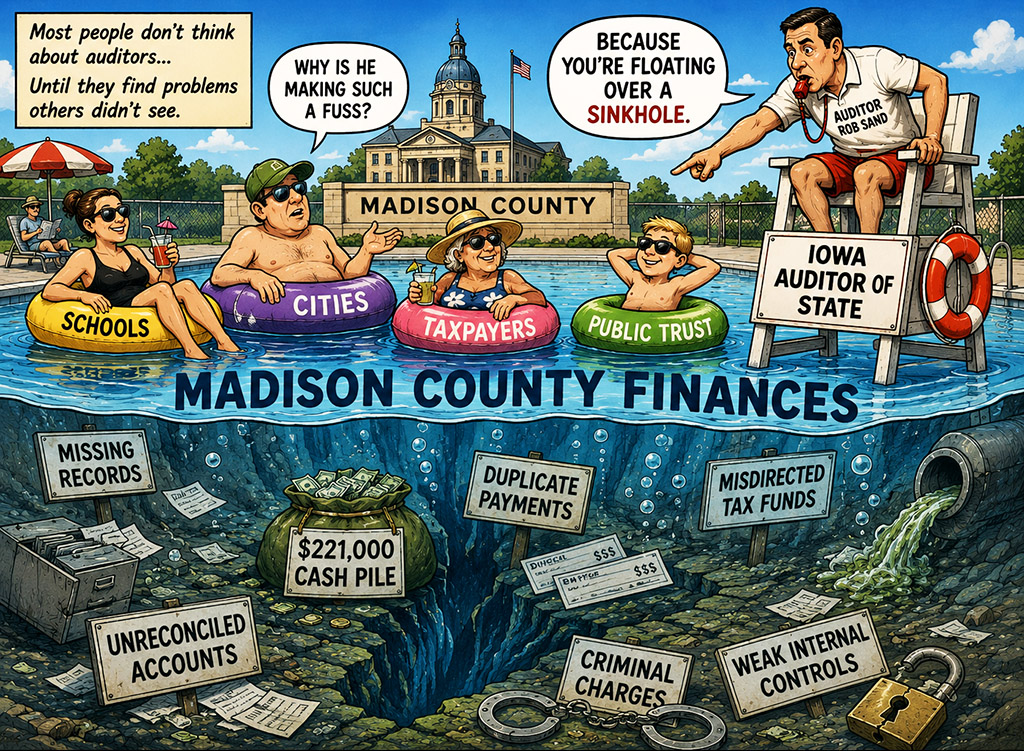
That is why the recent findings in Madison County deserve attention far beyond Winterset and the surrounding communities. The headlines have focused on missing records, questionable transactions, criminal charges, and more than $221,000 in cash, checks, and coins sitting in a county office without adequate documentation. Those details are certainly alarming. But the most significant finding may be one that received less attention.
The Iowa Auditor of State’s Office concluded that it could not provide assurance that Madison County’s financial statements were materially accurate. Think about what that means for a moment. Every county government collects taxes, pays bills, distributes funds to schools and cities, maintains infrastructure, and provides essential public services. All of that depends upon accurate financial records. When auditors reach the point where they cannot confidently determine whether those records are reliable, taxpayers are left with a fundamental problem: they can no longer be certain where their money is going or whether the system is functioning as intended.
That uncertainty is precisely why auditors exist. In everyday life, most of us rely on verification more than we realize. We expect banks to reconcile accounts. Businesses review their books. Nonprofits conduct audits. Investors expect independent reviews of financial statements before trusting a company with their money. Government is no different.
The purpose of an audit is not to catch people doing something wrong. The purpose of an audit is to provide confidence that things are being done right. When auditors discover problems, they are not creating controversy. They are uncovering it. That distinction matters.
Too often, oversight becomes political. People applaud investigations when they target someone they dislike and dismiss them when they affect someone they support. But accountability does not belong to Republicans, Democrats, or independents. It belongs to taxpayers.
Imagine for a moment that the Auditor’s Office had never looked closely at Madison County’s records. The public might never have known about unreconciled accounts, delayed tax distributions, duplicated payments, or cash that could not be tied to receipts. Schools, cities, and taxpayers would have continued operating under the assumption that everything was fine. Instead, the problems were identified, documented, and brought into the open.
That may be uncomfortable for public officials. It may be embarrassing for a county government. It may even contribute to criminal investigations and lawsuits. But transparency is not the problem. Transparency is what allows problems to be corrected before they become even larger.
The Madison County story is ultimately a story about trust. Citizens place enormous trust in government institutions to manage public resources honestly and competently. That trust cannot rest solely on assurances from elected officials or government employees. It requires independent verification. That is the role auditors play.
Most of the time, their work receives little attention because most audits do not uncover dramatic failures. But when controls break down and financial records become unreliable, auditors become one of the last lines of defense between taxpayers and the misuse of public resources.
The lesson from Madison County is not that government cannot be trusted. The lesson is that government works best when independent people are empowered to verify that trust is deserved. Taxpayers in Madison County have every reason to be frustrated by what these audits revealed. They also have a reason to be grateful. The reason they know about the problems at all is because someone was looking.
Breaking With Trump, or Just His Poll Numbers?
Candidates show some dissent over the Iran war, as Grassley and Ernst vote against limiting Trump’s war powersIowa Republican candidates are changing their positions on the Iran war as Election Day approaches. That is news. Calling it a “break with Trump” may be...
Has the UI Center Lost Its Academic Legitimacy?
How Much Academic Legitimacy Does Iowa's Center for Intellectual Freedom Have Left?Eleven scholars recruited to help establish the Center have resigned. Their departure raises a bigger question about what made this politically created institution academic in the first...
Trump Lost His Lawsuit. But Did the Lawsuit Fail?
An Iowa judge threw out Donald Trump’s lawsuit against Gannett and pollster J. Ann Selzer. But after nearly two years of litigation, the case raises a larger question about what it means to “win.”President Donald Trump lost his lawsuit against Gannett (owner of the...
As Iowans Suffer, Grassley Turns His Focus to Transgender Sports
Iowa already prohibits transgender girls from competing in girls' sports. With farmers struggling with diesel prices and families confronting inflation and housing costs, why is Chuck Grassley making the issue a national priority now?Should we be concerned about his...
Would a Ban of Diesel Exports Actually Lower Prices? Likely Not.
It’s More Complicated Than Grassley BelievesSen. Chuck Grassley says the U.S. should stop exporting diesel to bring down prices for farmers and truckers. The oil industry says that could backfire. Its explanation deserves a closer look.Iowa farmers are heading into...
Iowa Corn Growers Ask for Diesel Price Relief as Harvest Begins
Iowa Corn Growers Association asks for diesel relief as harvest kicks offBy Cami KoonsIowa Capital Dispatch As Iowa farmers begin harvesting their crops, corn growers in the state are asking Iowa congressional delegates to help lower the cost of diesel fuel, which has...
Mortgage Rates Hit 7% as War Increases Housing Market Pressure
Higher energy prices, persistent inflation, and rising borrowing costs are making an already difficult housing market even harder for buyers.The New York Times reports that mortgage rates have climbed above 7% for the first time since January 2025, another economic...