
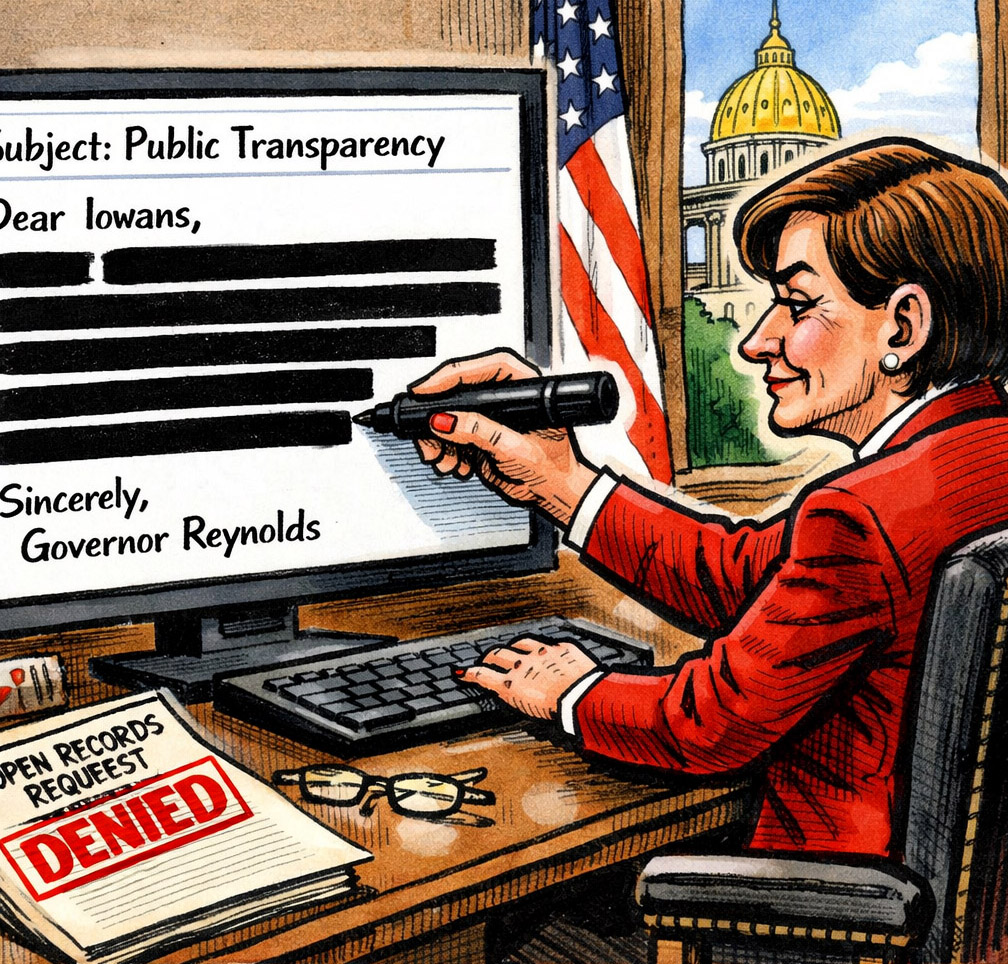
Judge Sides with Reynolds on Email Dispute as Executive Privilege Claim Faces Scrutiny
A Polk County judge has ruled that Gov. Kim Reynolds does not need to turn over disputed internal emails to the Des Moines Register, at least not yet, while the court considers whether those communications are protected under “executive privilege.”
The case stems from a February 2025 congressional hearing in which Reynolds declined to directly address claims made by a Trump administration official alleging that Lutheran Family Services was engaged in wrongdoing, an allegation the organization has denied and Reynolds later said she did not believe.
Following that exchange, the Register requested records related to Reynolds’ response, including internal emails reportedly involving “media prep” discussions among her staff. The governor’s office withheld four emails, asserting they are protected by executive privilege. In response, Reynolds filed suit seeking a judicial ruling that the records are exempt from disclosure.
The Register challenged that claim, arguing that executive privilege is not explicitly recognized under Iowa law and that the public has a right to access the records. The newspaper also requested that its attorneys be allowed to review the emails confidentially to better argue the case. Judge Jason Walke denied that request, stating that allowing access before ruling on privilege would be premature. He rejected claims that the governor’s office had acted improperly and criticized the Register for delaying its response to the state’s motion for summary judgment.
The court has given the Register until April 6 to respond, after which a ruling on whether executive privilege applies in Iowa is expected.
Our Take: This Is Bigger Than Four Emails
This case is not about four emails. It is about whether a governor can create, through litigation, a new layer of secrecy not explicitly granted under Iowa law.
Executive privilege, as commonly understood, is a limited doctrine tied primarily to the presidency, rooted in separation-of-powers concerns at the federal level. Even there, it is not absolute and has been repeatedly challenged and constrained by courts.
In Iowa, the situation is materially different. There is no explicit constitutional basis for executive privilege. It is not codified in Iowa’s open records law, and the state’s transparency framework generally favors broad public access.
What is happening here is a legal test case; one that could expand executive authority at the state level without legislative approval.
Key Issues and Implications
Precedent Creation
If the court recognizes executive privilege in this context, it could establish a new, judge-made exemption to public records law in Iowa.
Transparency vs. Control
The emails are described as “media prep.” That raises a critical question: Should communications about how public officials respond to controversy be shielded from the public?
Process Concerns
The court denied even confidential review by the requesting party’s attorneys, meaning that the claim of privilege is being evaluated without independent scrutiny of the documents by the opposing side.
That asymmetry raises legitimate concerns about fair adjudication in transparency disputes.
National Context
Reynolds’ approach mirrors a broader trend of expanding claims of executive authority, Increasing resistance to records disclosure, and framing internal communications as inherently protected
Bottom Line
At stake is a fundamental question. Who decides what the public is allowed to see, the law, or the officeholder?
If executive privilege is recognized here, it would mark a significant shift in Iowa governance—one that could allow future administrations to withhold information simply by labeling it advisory or internal.
This is not a procedural dispute. It is a test of whether government transparency remains the default, or becomes negotiable.
Breaking With Trump, or Just His Poll Numbers?
Candidates show some dissent over the Iran war, as Grassley and Ernst vote against limiting Trump’s war powersIowa Republican candidates are changing their positions on the Iran war as Election Day approaches. That is news. Calling it a “break with Trump” may be...
Has the UI Center Lost Its Academic Legitimacy?
How Much Academic Legitimacy Does Iowa's Center for Intellectual Freedom Have Left?Eleven scholars recruited to help establish the Center have resigned. Their departure raises a bigger question about what made this politically created institution academic in the first...
Trump Lost His Lawsuit. But Did the Lawsuit Fail?
An Iowa judge threw out Donald Trump’s lawsuit against Gannett and pollster J. Ann Selzer. But after nearly two years of litigation, the case raises a larger question about what it means to “win.”President Donald Trump lost his lawsuit against Gannett (owner of the...
As Iowans Suffer, Grassley Turns His Focus to Transgender Sports
Iowa already prohibits transgender girls from competing in girls' sports. With farmers struggling with diesel prices and families confronting inflation and housing costs, why is Chuck Grassley making the issue a national priority now?Should we be concerned about his...
Would a Ban of Diesel Exports Actually Lower Prices? Likely Not.
It’s More Complicated Than Grassley BelievesSen. Chuck Grassley says the U.S. should stop exporting diesel to bring down prices for farmers and truckers. The oil industry says that could backfire. Its explanation deserves a closer look.Iowa farmers are heading into...
Iowa Corn Growers Ask for Diesel Price Relief as Harvest Begins
Iowa Corn Growers Association asks for diesel relief as harvest kicks offBy Cami KoonsIowa Capital Dispatch As Iowa farmers begin harvesting their crops, corn growers in the state are asking Iowa congressional delegates to help lower the cost of diesel fuel, which has...
Mortgage Rates Hit 7% as War Increases Housing Market Pressure
Higher energy prices, persistent inflation, and rising borrowing costs are making an already difficult housing market even harder for buyers.The New York Times reports that mortgage rates have climbed above 7% for the first time since January 2025, another economic...