Beyond the Dollars: What Campaign Fundraising Reports Reveal About the Iowa Governor’s Race
Iowa Politics Analysis
Campaign finance reports often produce a single headline about who raised the most money. This reporting period certainly did.
Democratic gubernatorial candidate Rob Sand raised a record-breaking $9.38 million in less than two months and enters the final months of the campaign with nearly $18 million cash on hand, while Republican nominee Zach Lahn raised approximately $6.4 million and reported just over $1 million remaining after significant campaign expenditures.
Those numbers are important, but they may not be the most interesting part of the reports.
Two Very Different Fundraising Models
The latest filings suggest the two campaigns are relying on fundamentally different approaches to financing their campaigns. According to campaign filings and public reporting:
Rob Sand’s campaign
Sand’s campaign reported approximately 33,500 individual contributions during the reporting period. Of those, 95% of contributions were $100 or less and the average contribution of approximately $280. Sand finished the reporting period with roughly $17.9 million cash on hand.
Zach Lahn’s campaign
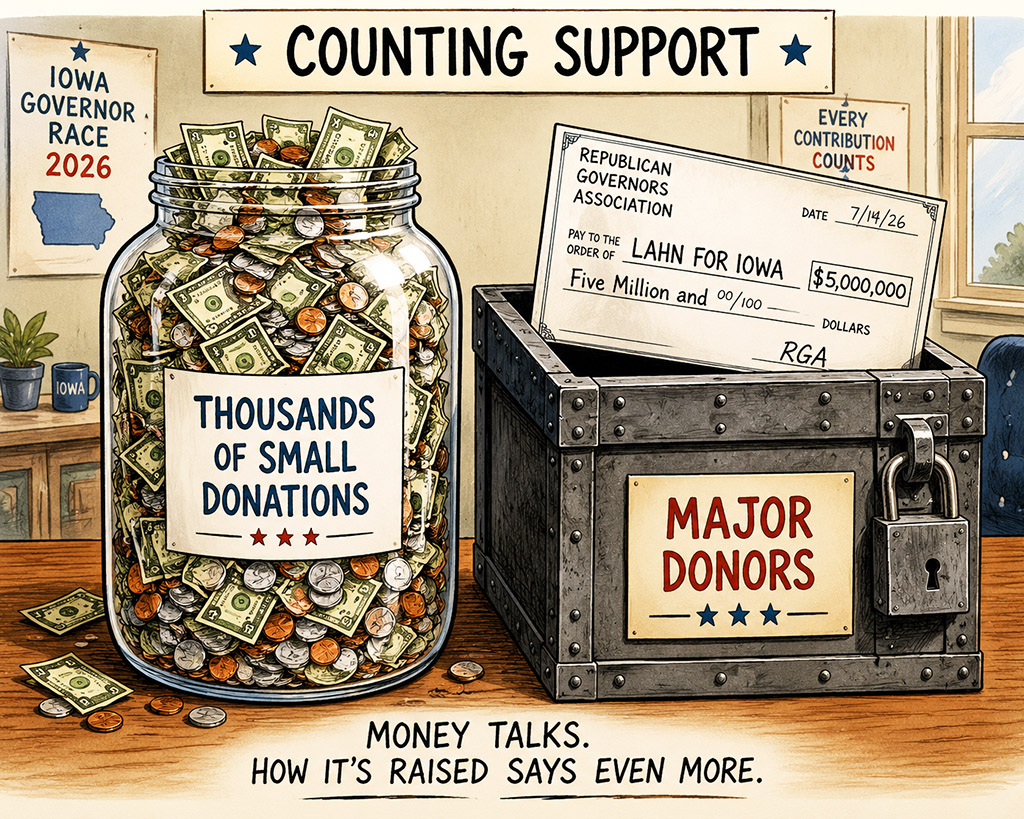
Lahn’s campaign received approximately 431 contributions during the same period. It reported that 61% of contributions were $100 or less, with an average contribution of approximately $14,786. It raised about $6.4 million, including approximately $5 million from the Republican Governors Association’s Right Direction PAC. It ended the period with just over $1 million cash on hand after spending much of what it raised. (https://www.kcrg.com)
Those figures describe more than different fundraising totals. They describe different campaign coalitions.
What the Reports Suggest
Campaign finance reports cannot tell voters which candidate will win, nor do they necessarily predict election day outcomes. They can, however, provide clues about how campaigns are building support.
Sand’s fundraising reflects a campaign supported by many relatively small contributions. A broad donor base can indicate widespread engagement and gives a campaign repeated opportunities to reconnect with supporters throughout the election.
Lahn’s fundraising, by contrast, relied much more heavily on large institutional support during this reporting period, particularly from the Republican Governors Association. That approach can quickly provide significant financial resources, but it results in a much different fundraising profile than one driven primarily by individual donors.
Cash on Hand Matters
Another important measure is not how much money was raised, but how much remains available. Cash on hand represents a campaign’s ability to purchase advertising, expand field operations, respond to unexpected events, and communicate with voters during the final months before Election Day.
On that measure, Sand currently holds a substantial advantage.
What to Watch
These reports provide a snapshot, not a final verdict. Future filings will help answer several important questions. Will Sand continue attracting large numbers of small-dollar donors? Will Lahn broaden his individual donor base as the general election progresses? How will outside organizations and independent expenditures shape the race during the final months? Will fundraising patterns begin to converge, or will each campaign continue relying on distinctly different financial strategies?
Our Take
Campaign finance reports are often treated like a scoreboard, but they can reveal much more than who raised the most money.
This reporting period suggests two campaigns pursuing different paths. One that emphasizes a broad base of individual contributors, the other relying more heavily on large institutional support. Neither approach guarantees electoral success, but together they offer voters insight into how each campaign is organizing its financial support.
As the campaign enters its final stretch, the fundraising totals may become less important than whether each candidate can translate those resources into voter engagement and, ultimately, votes at the ballot box.
Breaking With Trump, or Just His Poll Numbers?
Candidates show some dissent over the Iran war, as Grassley and Ernst vote against limiting Trump’s war powersIowa Republican candidates are changing their positions on the Iran war as Election Day approaches. That is news. Calling it a “break with Trump” may be...
Has the UI Center Lost Its Academic Legitimacy?
How Much Academic Legitimacy Does Iowa's Center for Intellectual Freedom Have Left?Eleven scholars recruited to help establish the Center have resigned. Their departure raises a bigger question about what made this politically created institution academic in the first...
Trump Lost His Lawsuit. But Did the Lawsuit Fail?
An Iowa judge threw out Donald Trump’s lawsuit against Gannett and pollster J. Ann Selzer. But after nearly two years of litigation, the case raises a larger question about what it means to “win.”President Donald Trump lost his lawsuit against Gannett (owner of the...
As Iowans Suffer, Grassley Turns His Focus to Transgender Sports
Iowa already prohibits transgender girls from competing in girls' sports. With farmers struggling with diesel prices and families confronting inflation and housing costs, why is Chuck Grassley making the issue a national priority now?Should we be concerned about his...
Would a Ban of Diesel Exports Actually Lower Prices? Likely Not.
It’s More Complicated Than Grassley BelievesSen. Chuck Grassley says the U.S. should stop exporting diesel to bring down prices for farmers and truckers. The oil industry says that could backfire. Its explanation deserves a closer look.Iowa farmers are heading into...