
Policy by Assumption, Not Evidence
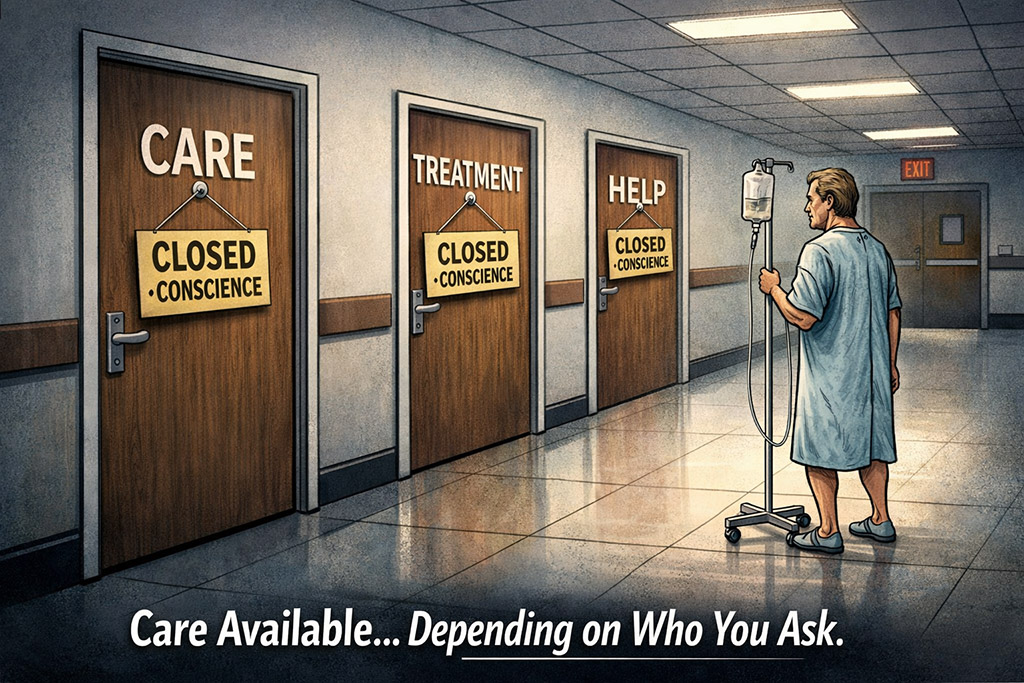
Iowa’s Conscience Bill Rests on Weak Workforce Claims while Overlooking Patient Safeguards
Iowa lawmakers have advanced a “conscience” bill framed to protect health care providers and address workforce shortages. But when you look closely, a fundamental question emerges. What problem does this bill attempt to solve?
The workforce argument doesn’t hold up
Supporters argue the bill is needed to prevent doctors and nurses from leaving the profession due to conflicts with their moral or religious beliefs. That sounds serious, until you examine the evidence.
The often-cited claim that “nine out of ten” faith-based providers would consider leaving medicine comes not from Iowa workforce data, but from a 2019 survey of a specific, self-selected group of faith-based professionals. It does not represent the broader medical workforce, and it does not demonstrate that providers in Iowa are leaving, or planning to leave, because of existing policies.
In other words, the bill is being justified by advocacy polling, not by demonstrated workforce trends.
If Iowa is facing a health care workforce shortage, and it is, that challenge deserves solutions grounded in real data, not hypothetical scenarios.
A law that protects providers. But what about patients?
There is a deeper issue in how the bill is structured. It clearly protects a provider’s right to refuse certain services based on conscience. But it does not clearly protect the patient on the other side of that decision.
There is no requirement for the provider to inform the patient, provide a referral, or guarantee of continuity of care.
That matters. Because when a provider refuses care, the system does not step in to guide the patient. Instead, the burden shifts to the patient to figure out what to do next. In a city, that may be inconvenient. In a rural community with limited providers, it can become a real barrier to care.
Even lawmakers saw the risk
The bill originally included health care payors, insurance companies, within its scope. That provision was removed.
Supporters may call that a refinement, but it signals something important. That even lawmakers recognized how easily “conscience” protections could extend into denial of coverage.
If insurers can refuse to pay based on moral grounds, access to care can collapse quickly. The removal of payors suggests that concern was not theoretical; it was immediate and credible.
The problem with “conscience” as a policy tool
Another issue is the breadth of the term itself. “Conscience” is defined broadly as moral, ethical, or religious beliefs. That may sound reasonable, but in policy design, broad terms create uncertainty.
And uncertainty leads to inconsistent application that is uneven access across regions and creates confusion for patients. Two providers in the same community could interpret their obligations very differently. The result is not clarity, it’s variability.
A better standard: Show the need, then solve it
None of this is to dismiss the idea that providers should have protections. They already do, in many cases, under federal law. But if lawmakers want to expand those protections, they should meet a basic standard. Show clear, Iowa-specific evidence that a problem exists and that this bill addresses it.
Right now, that connection is weak.
Bottom line
This bill does one thing clearly. It protects provider discretion. What it does not do is equally clear. It does not ensure that patients, especially in vulnerable or rural areas, can still access the care they need. That’s the missing piece.
Public policy doesn’t end when a right is protected. It must also answer what happens next. Who helps the patient? Who ensures continuity of care? Who fills the gap?
Until those questions are addressed, this bill looks less like a solution and more like a policy built on assumption, with consequences left for others to manage.
Breaking With Trump, or Just His Poll Numbers?
Candidates show some dissent over the Iran war, as Grassley and Ernst vote against limiting Trump’s war powersIowa Republican candidates are changing their positions on the Iran war as Election Day approaches. That is news. Calling it a “break with Trump” may be...
Has the UI Center Lost Its Academic Legitimacy?
How Much Academic Legitimacy Does Iowa's Center for Intellectual Freedom Have Left?Eleven scholars recruited to help establish the Center have resigned. Their departure raises a bigger question about what made this politically created institution academic in the first...
Trump Lost His Lawsuit. But Did the Lawsuit Fail?
An Iowa judge threw out Donald Trump’s lawsuit against Gannett and pollster J. Ann Selzer. But after nearly two years of litigation, the case raises a larger question about what it means to “win.”President Donald Trump lost his lawsuit against Gannett (owner of the...
As Iowans Suffer, Grassley Turns His Focus to Transgender Sports
Iowa already prohibits transgender girls from competing in girls' sports. With farmers struggling with diesel prices and families confronting inflation and housing costs, why is Chuck Grassley making the issue a national priority now?Should we be concerned about his...
Would a Ban of Diesel Exports Actually Lower Prices? Likely Not.
It’s More Complicated Than Grassley BelievesSen. Chuck Grassley says the U.S. should stop exporting diesel to bring down prices for farmers and truckers. The oil industry says that could backfire. Its explanation deserves a closer look.Iowa farmers are heading into...
Iowa Corn Growers Ask for Diesel Price Relief as Harvest Begins
Iowa Corn Growers Association asks for diesel relief as harvest kicks offBy Cami KoonsIowa Capital Dispatch As Iowa farmers begin harvesting their crops, corn growers in the state are asking Iowa congressional delegates to help lower the cost of diesel fuel, which has...
Mortgage Rates Hit 7% as War Increases Housing Market Pressure
Higher energy prices, persistent inflation, and rising borrowing costs are making an already difficult housing market even harder for buyers.The New York Times reports that mortgage rates have climbed above 7% for the first time since January 2025, another economic...