
It’s More Complicated Than Grassley Believes
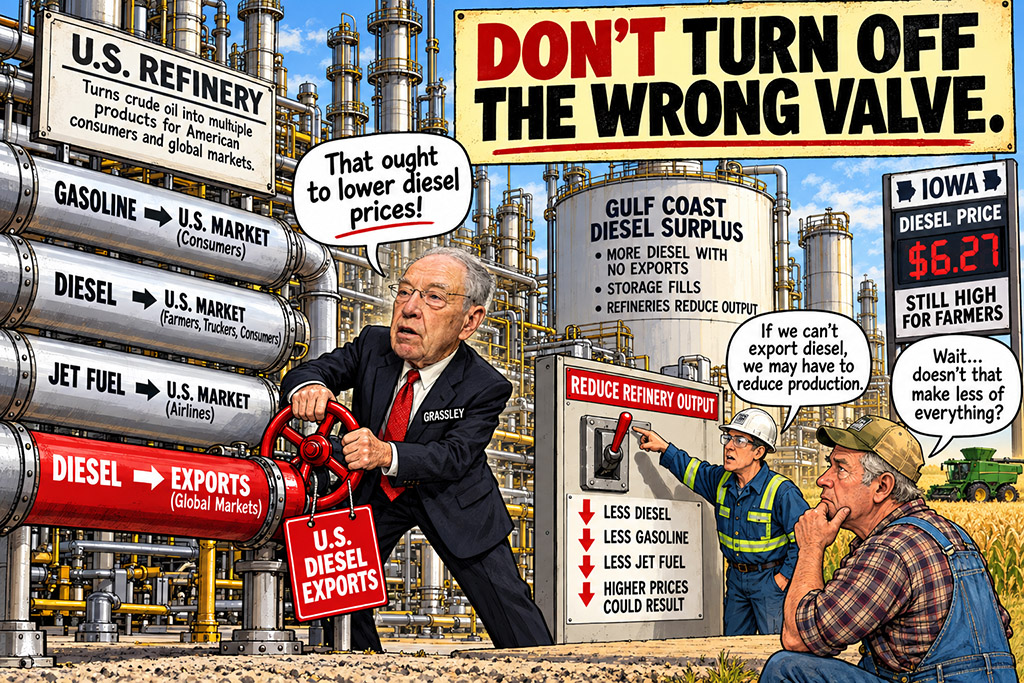
Sen. Chuck Grassley says the U.S. should stop exporting diesel to bring down prices for farmers and truckers. The oil industry says that could backfire. Its explanation deserves a closer look.
Iowa farmers are heading into harvest with record diesel prices, and Sen. Chuck Grassley believes one solution is straightforward: temporarily stop exporting American diesel.
Grassley dismissed warnings from the oil industry that an export ban could make matters worse. In a social media post Wednesday, he said he hoped the White House would ignore what he called “Big Oil” claims and argued that oil companies should charge Americans less and make their money from customers overseas.
But the American Petroleum Institute, the trade association representing the oil and natural gas industry, has now offered a detailed explanation for why it believes Grassley’s proposal could produce the opposite result.
API has an obvious interest in keeping petroleum exports unrestricted. That doesn’t make its argument correct or incorrect. But unlike Grassley’s assertion, it lays out a mechanism explaining how an export ban could affect supply and prices.
Diesel is a global market
The first problem with the idea of simply keeping American diesel at home is that diesel prices aren’t determined solely by how much fuel physically remains inside the United States.
According to API, about 8 million barrels of diesel are traded globally by sea each day, with the United States supplying approximately 1.5 million barrels, or roughly 20%.
Removing that supply wouldn’t make the world’s demand for diesel disappear. It would make an already scarce product scarcer.
API argues that further tightening the global market could push international diesel prices higher, and because the United States participates in that same market, some of that pressure could come back to American consumers.
Independent analysts have also warned that an export restriction could create unintended consequences rather than simply producing cheaper American diesel.
American diesel isn’t necessarily where Americans need it
There is another complication. The United States doesn’t operate as one giant fuel tank from which diesel can simply be redirected wherever prices are highest.
About 54% of U.S. refining capacity is located along the Gulf Coast, according to API. Those refineries produce more diesel than their region consumes, making exports an important destination for the surplus.
The East Coast has the opposite problem. It lacks enough refining capacity to satisfy all of its needs and relies partly on imports; API says imports account for about 10% of East Coast diesel supply. Infrastructure and geography therefore matter.
Preventing a refinery in Texas or Louisiana from exporting diesel does not necessarily mean that barrel can economically or physically be delivered to Iowa, New England or another region experiencing high prices.
Then comes the refinery problem
Perhaps the most interesting part of API’s argument involves how refineries actually operate. A refinery doesn’t process crude oil and simply decide to make diesel today because diesel prices are high.
Refining crude simultaneously produces gasoline, diesel, jet fuel and other petroleum products in proportions that refiners can adjust only to a limited degree.
If Gulf Coast refiners were prohibited from exporting surplus diesel, storage tanks could eventually fill. At that point, refiners might have to process less crude. And processing less crude oil means producing less diesel, but also less gasoline and jet fuel.
API therefore argues that an export restriction intended to increase domestic fuel availability could eventually reduce total U.S. refinery output.
Grassley’s argument needs another step
None of this proves that a temporary export restriction couldn’t provide some relief under particular conditions. Nor does an oil-industry trade association get the final word on energy policy.
But it does expose a missing piece in Grassley’s argument. Grassley says American producers should sell diesel to Americans first. That’s easy to understand. The harder questions are what happens next.
Where would the additional diesel go? Can it efficiently reach the parts of the country that need it? What happens to Gulf Coast inventories? Would refiners maintain current production levels if they lost access to export markets? And what effect would the removal of roughly 20% of internationally traded seaborne diesel have on global prices?
Those aren’t theoretical questions when Iowa farmers are paying record prices to run combines, tractors and semis during harvest. The Iowa Corn Growers Association says high diesel costs are adding to the financial strain farmers are already experiencing.
Grassley may ultimately disagree with the petroleum industry’s answers. But if Washington is considering a major intervention in the fuel market in the middle of a global supply disruption, saying the industry is wrong isn’t enough.
Iowa farmers deserve to know why.
Mortgage Rates Hit 7% as War Increases Housing Market Pressure
Higher energy prices, persistent inflation, and rising borrowing costs are making an already difficult housing market even harder for buyers.The New York Times reports that mortgage rates have climbed above 7% for the first time since January 2025, another economic...
The Company Miller-Meeks Keeps
The Company She Keeps: Who Is Miller-Meeks Bringing to Iowa?Mariannette Miller-Meeks brought Rick Scott and Markwayne Mullin to Iowa to help make the case for her reelection. Their backgrounds raise a reasonable question: What should voters make of the people a...
Iowa AG Filed Suit in Support of Mega Media Merger
Why Did Brenna Bird Try to Stop the Paramount-Warner Lawsuit?Iowa's attorney general called the challenge to the Paramount-Warner Bros. merger “politicized.” The states that brought the case said they were protecting competition, consumers and workers. Iowa Attorney...
The “Give Us Another Chance” Tour Comes to Iowa
JD Vance to Voters – Please Give Us Another Chance Vice President J.D. Vance is coming to western Iowa Friday with a message for voters that may require a little work from the marketing department. “Give us another chance.” No, really. That was part of the vice...
Trumpapalooza Starts Today – Will Iowa Republicans Present?
Iowa411 SatireTrumpapalooza: Suggested Speaking Topics for Iowa Republicans The Republican Party’s first-ever national midterm convention, also known as “Trumpapalooza” because of its unswerving focus on President Trump, opens today in Dallas. The two-day production...
Diesel Prices Hit An All-Time High, Again
Record Diesel Prices Will Reach Far Beyond the Pump in IowaAn Iowa411 News BriefDiesel has set national records on consecutive days, increasing costs for Iowa agriculture, transportation, businesses, public services, and eventually, consumers.Record Diesel Prices...
Experts: Iowa Already Has the Tools to Fight Medicaid Fraud
Former Iowa Officials: Iowa Already Has the Tools to Fight Medicaid FraudReynolds, Bird Failed to Use Existing State Resources Two former Iowa officials with extensive experience investigating health care fraud argue that Gov. Kim Reynolds and Attorney General Brenna...