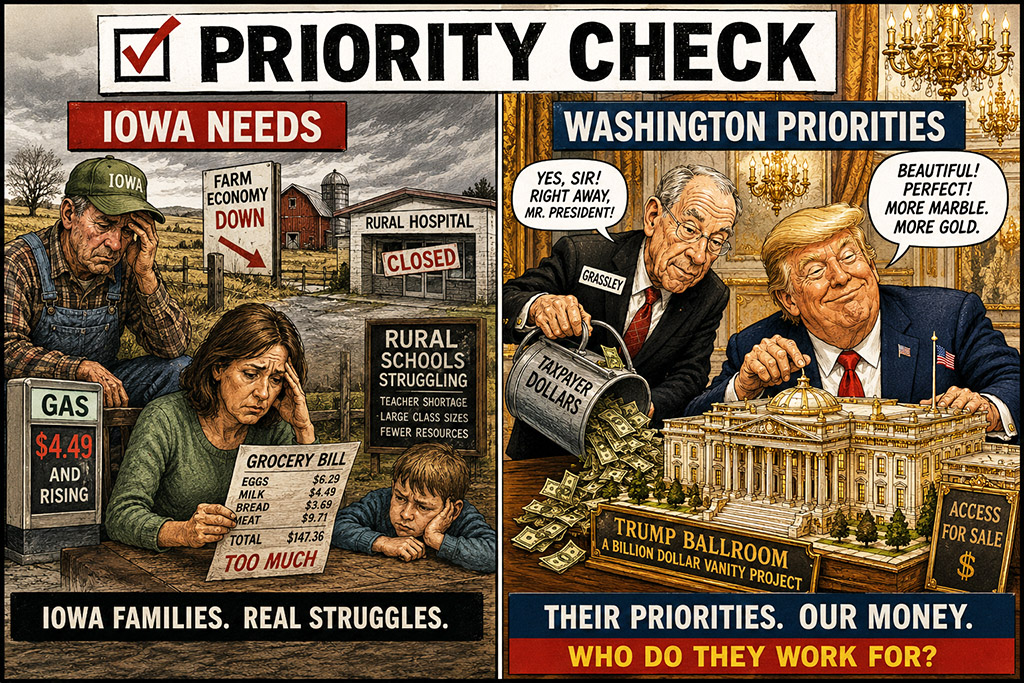
Trump Attacks Fed Renovation Costs as Republicans Back Ballooning Ballroom Spending

This editorial cartoon is not meant to be funny. In fact, it should help you understand Trump’s deception.
A Classic Trump Deflection and Placement of Responsibility onto Others
One of the more remarkable aspects of the current debate surrounding Donald Trump’s proposed White House ballroom project is the contrast between Republican outrage over the Federal Reserve renovation project and the relative silence surrounding the rapidly escalating costs tied to Trump’s own luxury ballroom ambitions.
The comparison is difficult to ignore.
Trump and his allies have repeatedly attacked Federal Reserve Chair Jerome Powell over cost overruns associated with the Federal Reserve’s headquarters renovation project in Washington, D.C., portraying the project as an example of government excess and elitist spending. Yet at the same time, Republicans, including Iowa Sen. Chuck Grassley, are helping advance more than $1 billion in taxpayer-funded spending connected to Trump’s proposed White House ballroom and East Wing modernization project.
And unlike the Fed renovation project, the White House ballroom was initially described by Trump himself as something that would supposedly be privately funded through donations from wealthy corporations and donors. It started as a $200 million project. Then the cost rose to $300 million. And $400 million. And now the cost has ballooned to more than $1 billion in proposed federal expenditures tied to “security” and modernization elements surrounding the project.
At what point does this stop being an unnecessary private vanity project and become a taxpayer-funded luxury expansion?
The Marble Irony
Perhaps the most politically ironic aspect of the controversy involves the issue of marble. Trump and his allies have criticized the Federal Reserve renovation as excessive and overly luxurious because of the use of expensive marble finishes.
But records show that during the 2020 design review process, Trump-era appointees to the Commission of Fine Arts pushed for the use of white Georgia marble in portions of the project, rejecting earlier modern glass-wall concepts in favor of a more historically styled facade.
In other words, some of the very design choices now being criticized were demanded during Trump’s own administration.
What Actually Drove the Fed Cost Overruns?
The Federal Reserve renovation project reportedly increased from approximately $1.9 billion to roughly $2.5 billion. And the causes were broader and more complex than political talking points suggest.
According to project explanations and testimony, factors increasing the renovation costs were asbestos removal requirements, toxic soil remediation, inflation, structural complications, historic preservation requirements, and evolving regulatory demands. They all contributed significantly to the rising costs.
Federal Reserve officials have also disputed some of the more extravagant claims made by Trump allies regarding luxury upgrades, stating that several criticized features were either mischaracterized, modified, or no longer part of the final plans.
In other words, many of the overruns were tied to realities commonly encountered during major renovation projects involving aging historic federal buildings.
Different Standards for Different Projects?
That raises an obvious question. Why is there intense political outrage over renovation overruns tied to a critical federal financial institution, while many Republicans appear comfortable supporting more than $1 billion connected to a presidential ballroom project that was originally promised as privately funded?
Especially at a time when Americans continue struggling with inflation, gas prices are high and rising, family budgets are under pressure, and many rural communities face ongoing economic strain.
For many observers, the issue is no longer simply about architecture or renovation budgets. It is about priorities, accountability, and political double standards.
The Optics Could Not Be Worse
The symbolism is politically devastating. On one side is the renovation of an aging historic building that involves asbestos removal, structural remediation, historic preservation, and federally required modernization.
On the other is an unnecessary luxury presidential ballroom with gold-trimmed imagery, a grift with billionaire donor involvement, and growing taxpayer expenditures attached to a project promoted heavily by Donald Trump himself.
And now Iowa’s senior senator, Chuck Grassley, finds himself helping advance the federal spending connected to it.
Final Thought
For decades, Republicans positioned themselves as the party of fiscal restraint and government accountability.
But increasingly, many voters are watching Republican leaders attack infrastructure and renovation costs when politically convenient while simultaneously defending escalating expenditures tied to Donald Trump’s personal projects and political image.
And that contradiction is becoming more difficult to explain to the suffering taxpayers who are expected to pay the bill.

What the Fundraising Reports Are Beginning to Tell Us
What the Candidate Fundraising Reports Are Beginning to Tell UsBeyond the Dollars: Emerging Fundraising Trends in Iowa's 2026 Elections A Look Into Early Iowa Campaign Financing Reports Every campaign finance reporting period produces a familiar set of headlines about...
Editorial: Beyond One Candidate, Election, and Lawsuit
Iowa judge to decide if Libertarian governor ticket will be on ballotAn Iowa411 EditorialWho Should Decide Ballot Access: Courts or Voters? In the coming days, a Polk County judge will decide whether Libertarian candidates Nicholas Gluba and Jules Cutler will appear...
What Fundraising Reports Reveal About the Iowa Governor’s Race
Beyond the Dollars: What Campaign Fundraising Reports Reveal About the Iowa Governor's RaceIowa Politics Analysis Campaign finance reports often produce a single headline about who raised the most money. This reporting period certainly did. Democratic gubernatorial...
Iowa Layoffs Hit One-Year High, Most Are Manufacturing Jobs
Iowa Layoffs Reach One-Year High as Manufacturing Sector Leads June Job LossesIowa Economy Brief Iowa employers announced 656 layoffs in June, the highest monthly total in a year, with manufacturing accounting for most of the job losses, according to Iowa's Worker...
Iowa Religious Leaders Gather to Support Voting Rights
Iowa Faith Leaders Gather to Support the Moral Issue of Our Time - Voting RightsFaith Gathering to Support Voting Rights Des Moines Register writer Isabelle Foland reported that religious leaders from across Iowa gathered in downtown Des Moines earlier this month to...
Reynolds’ Medicaid Task Force to Examine a Miniscule Problem
Reynolds Creates Medicaid Fraud Task Force as Iowa Reports One of Nation's Lowest Improper Payment RatesNew panel aims to eliminate fraud, waste and abuse while state already performs well below national average Gov. Kim Reynolds has created a new task force to combat...
As Opposition Grows, Iowa Continues to Recruit Data Centers
State actively markets Iowa to technology companies as communities debate costs and benefitsState actively markets Iowa to technology companies as communities debate costs and benefits As several proposed data center projects encounter growing local opposition, Iowa...