Miller-Meeks Recycles “Doctor” Brand, Will Face Harder Questions This Time
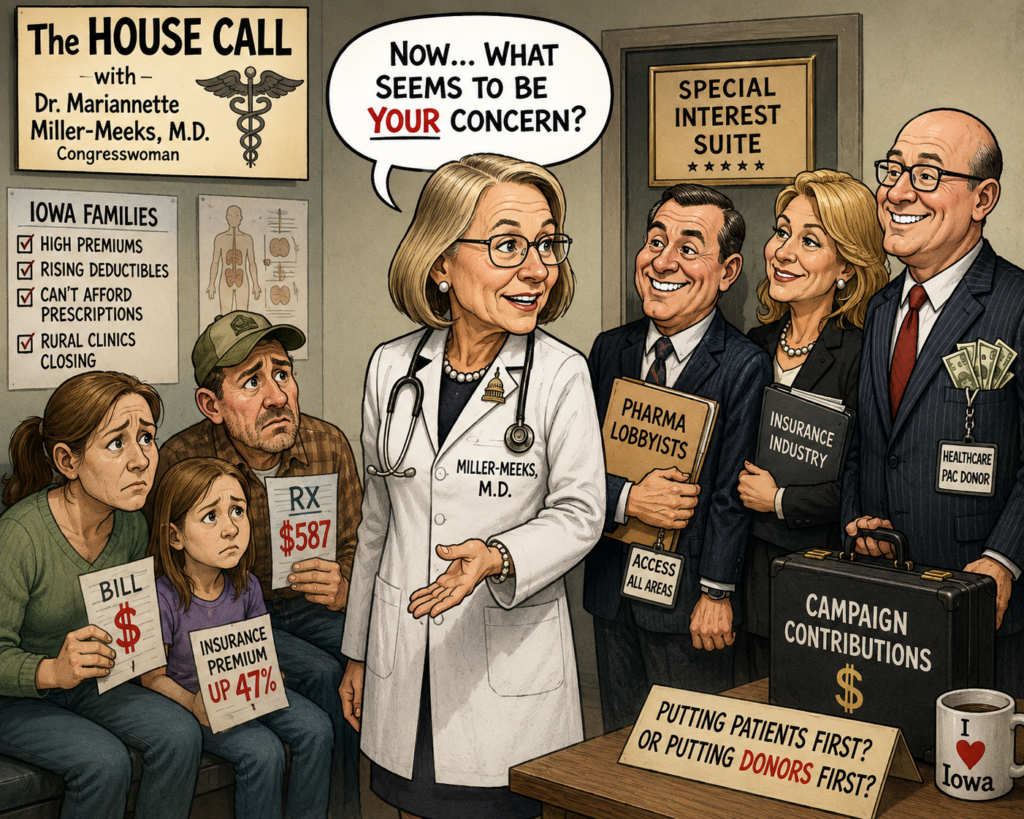
Even with Iowans suffering from healthcare expenses and access, Miller-Meeks follows the money.
Miller-Meeks Launches First Major 2026 TV Ad, Revisits Familiar Branding
U.S. Rep. Mariannette Miller-Meeks has launched her first major television ad of the 2026 campaign cycle, and the strategy is immediately familiar. Return to the biography. The ad, titled “Doctor in the House,” (clever) highlights Miller-Meeks’ personal story leaving home at 16, joining the Army at 18, becoming a nurse, becoming a physician, and treating patients in southeast Iowa.
Politically, it is easy to understand why her campaign is leading with this message. Her medical background remains one of the strongest parts of her public image. It is credible, relatable, service-oriented, and less polarizing than national Republican politics.
In a swing district where healthcare affordability remains a major concern, the ad attempts to position Miller-Meeks not as a partisan culture-war politician, but as a practical healthcare professional focused on patient costs.
The challenge for Miller-Meeks is that Iowa voters are no longer evaluating only the biography. They are examining the record.
The Difference Between Image and Policy
The ad’s central message is straightforward, that Miller-Meeks understands healthcare because she worked inside it. And where that is likely true, Iowa voters may increasingly ask a different question. Has her voting record improved healthcare affordability for ordinary Iowans?
That is where politics become more complicated. The article accompanying the ad notes that Miller-Meeks opposed extending enhanced Affordable Care Act premium subsidies that had been expanded during the pandemic.
Health policy analysts warned that allowing those subsidies to expire could increase premiums and reduce insurance coverage, especially in rural areas. Miller-Meeks argues the subsidies primarily benefited insurance companies and supported alternative approaches aimed at reducing long-term federal spending and benchmark premiums.
But the non-partisan Congressional Budget Office (CBO) analysis projects that those approaches could lead to more uninsured Americans over time.
That creates a political vulnerability, where the campaign is emphasizing affordability and patient protection while critics point to votes that may ultimately increase costs or reduce coverage for some Iowans.
Rural Healthcare Is No Longer Abstract
This issue matters especially in Iowa because rural healthcare strain is no longer theoretical. Across parts of the state, communities have experienced service reductions, staffing shortages, hospital instability, provider shortages, and growing affordability concerns.
At the same time, many Iowa families continue struggling with insurance costs, prescription expenses, deductibles, and broader inflation pressure affecting household budgets.
That environment makes healthcare messaging politically sensitive. Voters may be increasingly skeptical of slogans unless they see tangible improvements in health care affordability, coverage, access, and stability.
The Industry-Ties Problem
Miller-Meeks has received scrutiny for her ties to pharmaceutical-industry lobbyists. She rented a Capitol Hill apartment from lobbyists connected to PhRMA, the pharmaceutical industry’s primary lobbying organization. And her campaign finance records also show contributions from pharmaceutical and medical technology PACs.
Her office denies wrongdoing and says she was unaware of the lobbying connections. And to be fair, members of Congress routinely interact with industry representatives and donor networks.
Still, politically, optics are difficult. Especially when a candidate is simultaneously presenting herself as a fighter against healthcare costs and insurance-industry pressures. In modern politics, perception often matters as much as technical ethics compliance.
The “Not a Career Politician” Problem
Another challenge for Miller-Meeks is that the outsider framing has become harder to sustain. During previous campaigns, she frequently emphasized that she was “not a career politician.”
But after multiple congressional terms, and many years operating within Washington’s political structure, opponents are likely to argue that she has increasingly become exactly that. She has shown herself to be a reliable partisan incumbent aligned closely with national Republican leadership and Donald Trump.
That transition matters in a district where independent voters often decide elections. The more Miller-Meeks becomes identified primarily with national Republican messaging, the more difficult it may become to rely solely on her personal biography as political insulation.
Why the Early Ad Matters
The timing of the ad is revealing. Iowa’s 1st Congressional District is once again expected to be one of the most competitive House races in the country. Political forecasters continue to rate the district as a Toss-Up.
That means Miller-Meeks likely understands something important, that she cannot afford to allow the campaign narrative to become dominated entirely by Trump politics, healthcare affordability frustrations, Medicaid concerns, or corporate influence questions.
Because of those factors, the campaign is trying to define her early through her biography, service, healthcare expertise, and personal credibility.
It is a smart strategy. But biography can only carry a candidate so far once voters begin comparing image with policy outcomes.
Final Thought
Mariannette Miller-Meeks’ medical background is real, impressive, and politically valuable. But in 2026, Iowa voters may be less interested in who she was before Congress than in what her votes in Congress have produced.
That is the core political challenge facing her campaign. Because for many Iowans struggling with rising costs, insurance instability, prescription prices, and healthcare access concerns, the question is no longer “Is she a doctor?” The question is “Has her leadership made healthcare more affordable and accessible for ordinary people?”

Breaking With Trump, or Just His Poll Numbers?
Candidates show some dissent over the Iran war, as Grassley and Ernst vote against limiting Trump’s war powersIowa Republican candidates are changing their positions on the Iran war as Election Day approaches. That is news. Calling it a “break with Trump” may be...
Has the UI Center Lost Its Academic Legitimacy?
How Much Academic Legitimacy Does Iowa's Center for Intellectual Freedom Have Left?Eleven scholars recruited to help establish the Center have resigned. Their departure raises a bigger question about what made this politically created institution academic in the first...
Trump Lost His Lawsuit. But Did the Lawsuit Fail?
An Iowa judge threw out Donald Trump’s lawsuit against Gannett and pollster J. Ann Selzer. But after nearly two years of litigation, the case raises a larger question about what it means to “win.”President Donald Trump lost his lawsuit against Gannett (owner of the...
As Iowans Suffer, Grassley Turns His Focus to Transgender Sports
Iowa already prohibits transgender girls from competing in girls' sports. With farmers struggling with diesel prices and families confronting inflation and housing costs, why is Chuck Grassley making the issue a national priority now?Should we be concerned about his...
Would a Ban of Diesel Exports Actually Lower Prices? Likely Not.
It’s More Complicated Than Grassley BelievesSen. Chuck Grassley says the U.S. should stop exporting diesel to bring down prices for farmers and truckers. The oil industry says that could backfire. Its explanation deserves a closer look.Iowa farmers are heading into...
Iowa Corn Growers Ask for Diesel Price Relief as Harvest Begins
Iowa Corn Growers Association asks for diesel relief as harvest kicks offBy Cami KoonsIowa Capital Dispatch As Iowa farmers begin harvesting their crops, corn growers in the state are asking Iowa congressional delegates to help lower the cost of diesel fuel, which has...
Mortgage Rates Hit 7% as War Increases Housing Market Pressure
Higher energy prices, persistent inflation, and rising borrowing costs are making an already difficult housing market even harder for buyers.The New York Times reports that mortgage rates have climbed above 7% for the first time since January 2025, another economic...