
Law will force students to take (and pay for) biased, unpopular classes to graduate
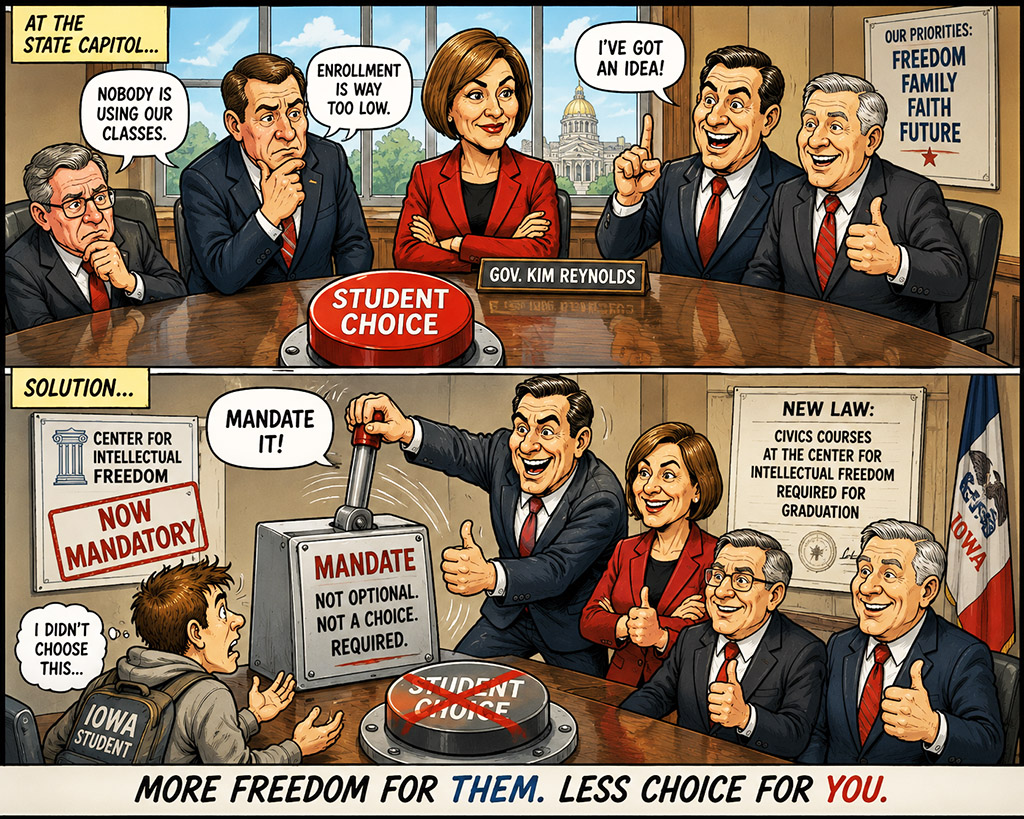
Law Mandates Ideologically Biased Civics Courses at Iowa Universities
Governor Kim Reynolds has signed legislation requiring students attending Iowa’s public universities to complete six credit hours of civics coursework as a condition of graduation beginning with the 2028-29 academic year.
The requirement was included in House File 2800, a 34-page higher education bill approved during the closing hours of the 2026 legislative session.
Under the new law, students at the University of Iowa, Iowa State University, and the University of Northern Iowa must complete a three-credit American history course and a three-credit American government course as part of their general education requirements. At current Board of Regents tuition levels for Iowa resident undergraduates, that would amount to approximately $2,400-$3,300 in tuition and fees.
Courses Must Be Taken at University Indoctrination Centers
At the University of Iowa, the law specifies that the Center for Intellectual Freedom “shall be the sole academic unit” responsible for offering courses that satisfy the requirement. It does not allow students to choose alternate courses in American history and government offered by the university.
The Center for Intellectual Freedom was established by the GOP Iowa Legislature in 2025 as part of a broader Republican effort to expand “civics education” at Iowa’s public universities.
Supporters argue the center helps address what they view as ideological imbalance within higher education and strengthens instruction in American history, government, and civic institutions.
Critics contend the center was created primarily to promote conservative political perspectives and question whether lawmakers should direct academic content at public universities.
Low Interest in Center’s Course Offerings
The graduation requirement comes despite limited student interest in the center’s initial course offerings. According to enrollment figures reported this spring, only 21 of 64 available seats were filled in the center’s first courses.
Since its creation, lawmakers have appropriated approximately $2 million to support the center’s operations, staffing, programming, and course development.
Courses Made Mandatory by Reynolds and GOP Legislators
Supporters of the legislation argue the new requirements restore focus on traditional liberal arts education and civic literacy. Opponents argue students and families will now be required to pay for courses they may not have chosen to take voluntarily.
The measure takes effect for students entering under the 2028-29 graduation requirements.
The debate surrounding the Center for Intellectual Freedom has become one of the most visible examples of a broader national discussion over politics, academic freedom, curriculum development, and the role of government in higher education.
Our Take
Civic education is important. Understanding American history, government, constitutional principles, and civic responsibility should be part of a well-rounded education. Few would disagree with that goal.
What concerns us is not the subject matter, but the method.
The Center for Intellectual Freedom’s initial courses attracted limited student interest when participation was voluntary. Rather than asking why students were not enrolling or whether the courses met student needs, state lawmakers responded by making them mandatory. That decision raises important questions about academic independence, student choice, and the proper role of government in higher education.
Universities should expose students to a wide range of ideas and perspectives. They should encourage critical thinking, inquiry, and debate. Those goals are best achieved when ideas compete on their merits, not when lawmakers use state power to guarantee enrollment.
Whether one agrees or disagrees with the center’s mission, the principle remains the same: education should be about expanding minds, not directing them. Iowans should carefully consider what precedent is being established when elected officials determine not only what students must learn, but which academic institution must teach it.
Related Links
Iowa GOP’s Push for “Intellectual Freedom” Is Neither Intellectual nor Free
The UI Center for Intellectual Freedom Shows Its True Colors
Breaking With Trump, or Just His Poll Numbers?
Candidates show some dissent over the Iran war, as Grassley and Ernst vote against limiting Trump’s war powersIowa Republican candidates are changing their positions on the Iran war as Election Day approaches. That is news. Calling it a “break with Trump” may be...
Has the UI Center Lost Its Academic Legitimacy?
How Much Academic Legitimacy Does Iowa's Center for Intellectual Freedom Have Left?Eleven scholars recruited to help establish the Center have resigned. Their departure raises a bigger question about what made this politically created institution academic in the first...
Trump Lost His Lawsuit. But Did the Lawsuit Fail?
An Iowa judge threw out Donald Trump’s lawsuit against Gannett and pollster J. Ann Selzer. But after nearly two years of litigation, the case raises a larger question about what it means to “win.”President Donald Trump lost his lawsuit against Gannett (owner of the...
As Iowans Suffer, Grassley Turns His Focus to Transgender Sports
Iowa already prohibits transgender girls from competing in girls' sports. With farmers struggling with diesel prices and families confronting inflation and housing costs, why is Chuck Grassley making the issue a national priority now?Should we be concerned about his...
Would a Ban of Diesel Exports Actually Lower Prices? Likely Not.
It’s More Complicated Than Grassley BelievesSen. Chuck Grassley says the U.S. should stop exporting diesel to bring down prices for farmers and truckers. The oil industry says that could backfire. Its explanation deserves a closer look.Iowa farmers are heading into...
Iowa Corn Growers Ask for Diesel Price Relief as Harvest Begins
Iowa Corn Growers Association asks for diesel relief as harvest kicks offBy Cami KoonsIowa Capital Dispatch As Iowa farmers begin harvesting their crops, corn growers in the state are asking Iowa congressional delegates to help lower the cost of diesel fuel, which has...
Mortgage Rates Hit 7% as War Increases Housing Market Pressure
Higher energy prices, persistent inflation, and rising borrowing costs are making an already difficult housing market even harder for buyers.The New York Times reports that mortgage rates have climbed above 7% for the first time since January 2025, another economic...