The Court Limits Roundup Lawsuits, Affecting Litigation from Iowa Farmers and Cancer Victims
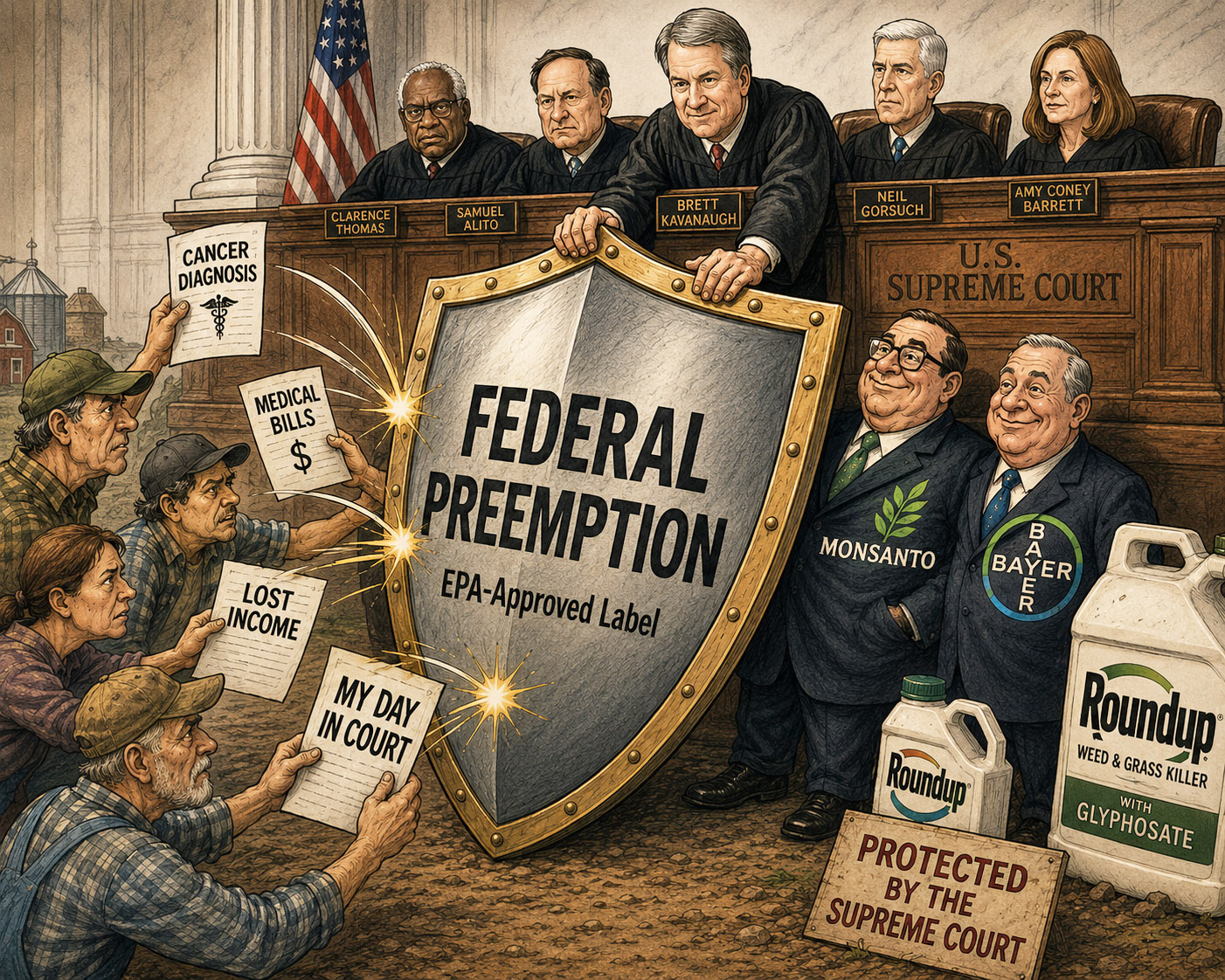
High Court Protects Monsanto and Bayer, Makers of Roundup
The U.S. Supreme Court has significantly limited the ability of individuals to sue Bayer and Monsanto over claims that the weedkiller Roundup caused cancer, a ruling expected to affect thousands of pending and future lawsuits nationwide.
In a 7-2 decision, the Court held that federal pesticide labeling requirements preempt certain state “failure-to-warn” lawsuits because the Environmental Protection Agency (EPA) has repeatedly approved Roundup’s label without requiring a cancer warning.
Writing for the majority, Justice Brett Kavanaugh concluded that Monsanto cannot simultaneously comply with both federal labeling requirements and state court rulings requiring additional cancer warnings.
The decision overturns a Missouri verdict awarding $1.25 million to John Durnell, who alleged that decades of using Roundup caused his non-Hodgkin lymphoma.
A Long-Running Scientific Debate
Roundup’s active ingredient, glyphosate, has been at the center of scientific and legal controversy for years. In 2015, the International Agency for Research on Cancer (IARC), part of the World Health Organization, classified glyphosate as “probably carcinogenic to humans.”
However, the EPA has repeatedly concluded that glyphosate is not likely to pose a cancer risk when used according to its approved label, although a federal appeals court later directed the agency to more fully evaluate its cancer assessment during an ongoing registration review.
That review remains unfinished. As a result, scientific debate over glyphosate’s potential health risks continues.
Major Impact on Iowa
Few states have more at stake in this than Iowa. Roundup has been one of the most widely used herbicides in modern agriculture for decades and remains an important weed-management tool for many corn and soybean producers.
Supporters of the Court’s decision argue that uniform federal labeling standards provide certainty for farmers and help preserve access to essential crop protection products. The Iowa Corn Growers Association welcomed the ruling, saying it removes years of uncertainty surrounding pesticide labeling and product availability.
Others strongly disagreed.
The Iowa Farmers Union called the ruling “a huge step backward,” arguing that limiting lawsuits reduces accountability for manufacturers while leaving farmers and others with fewer legal options if they believe exposure contributed to serious illness.
Political Response
The decision quickly became a campaign issue in Iowa’s 2026 gubernatorial race.
Republican nominee Zach Lahn criticized the ruling, saying farmers who believe they were harmed by pesticide exposure should retain access to the courts.
Democratic nominee Rob Sand also condemned the decision and reiterated his opposition to legislative proposals that would shield pesticide manufacturers from liability under Iowa law.
Earlier this year, Iowa lawmakers considered, but ultimately did not pass, legislation that would have provided additional legal protections for pesticide manufacturers against certain failure-to-warn claims.
What Happens Next?
Although the Supreme Court’s ruling significantly limits one category of lawsuits, it does not end the broader debate over glyphosate. The EPA continues its long-delayed registration review following a federal court order requiring additional analysis of glyphosate’s potential cancer risks.
Researchers, regulators, agricultural organizations, public health advocates, and the courts are likely to continue debating the herbicide’s safety for years to come.
Our Take
The Supreme Court’s decision resolves an important legal question, but it does not resolve the underlying scientific debate.
Instead, the Court answered a narrower question: when the EPA has approved a federally required product label, can individual states use their own laws to require additional warnings?
For thousands of people who believe Roundup contributed to their cancer, the ruling represents the loss of one of their primary legal avenues for seeking compensation. For many farmers, it provides greater certainty that an important agricultural tool will remain available.
For everyone else, the decision highlights a broader issue: Who should determine whether a product warning is adequate? Federal regulators, state juries, or both?
That question extends far beyond Roundup. It touches pharmaceuticals, medical devices, pesticides, consumer products, and countless other areas where federal regulation and state liability law intersect.
Regardless of where one stands on glyphosate itself, the ruling reinforces how much public trust ultimately depends on rigorous, transparent, and timely scientific review by federal regulators. And how it is largely absent in this case.
Breaking With Trump, or Just His Poll Numbers?
Candidates show some dissent over the Iran war, as Grassley and Ernst vote against limiting Trump’s war powersIowa Republican candidates are changing their positions on the Iran war as Election Day approaches. That is news. Calling it a “break with Trump” may be...
Has the UI Center Lost Its Academic Legitimacy?
How Much Academic Legitimacy Does Iowa's Center for Intellectual Freedom Have Left?Eleven scholars recruited to help establish the Center have resigned. Their departure raises a bigger question about what made this politically created institution academic in the first...
Trump Lost His Lawsuit. But Did the Lawsuit Fail?
An Iowa judge threw out Donald Trump’s lawsuit against Gannett and pollster J. Ann Selzer. But after nearly two years of litigation, the case raises a larger question about what it means to “win.”President Donald Trump lost his lawsuit against Gannett (owner of the...
As Iowans Suffer, Grassley Turns His Focus to Transgender Sports
Iowa already prohibits transgender girls from competing in girls' sports. With farmers struggling with diesel prices and families confronting inflation and housing costs, why is Chuck Grassley making the issue a national priority now?Should we be concerned about his...
Would a Ban of Diesel Exports Actually Lower Prices? Likely Not.
It’s More Complicated Than Grassley BelievesSen. Chuck Grassley says the U.S. should stop exporting diesel to bring down prices for farmers and truckers. The oil industry says that could backfire. Its explanation deserves a closer look.Iowa farmers are heading into...