Iowa Attorney General Brenna Bird Continues to Pursue Illegal Voting Cases Despite Mixed Court Results
Mixed Results with a Miniscule Number of Infractions
Iowa Attorney General Brenna Bird is continuing criminal prosecutions involving alleged illegal voting, even after several of the state’s earliest cases resulted in acquittals.
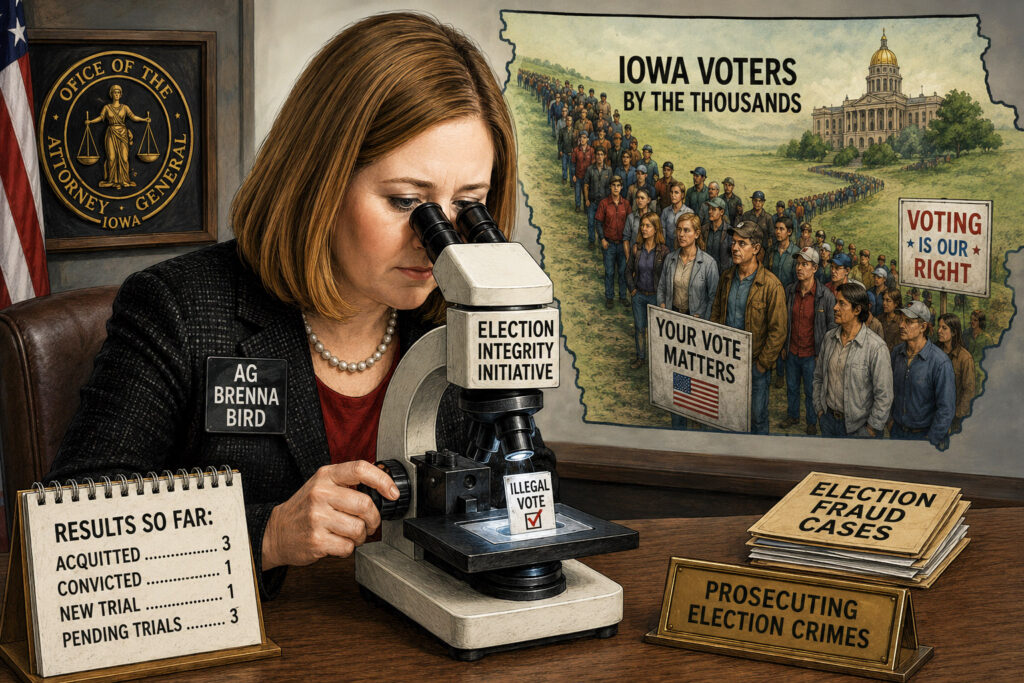
Since taking office in 2023, Bird has made election integrity one of her office’s highest-profile initiatives. As of June 2025, her office has charged eight individuals with election-related offenses involving allegations that non-citizens illegally registered, voted, or attempted to vote in local, state, or federal elections between 2021 and 2024.
So far, the results have been mixed. Of the first six reported cases, three defendants were acquitted by juries, one received a deferred judgment following conviction, one conviction was later set aside pending a new trial, and one case remains scheduled for trial.
Bird’s office has since filed two additional prosecutions, including the first criminal case connected to Iowa’s 2024 general election.
Election Integrity Remains a Priority
A spokesperson for Bird said the prosecutions remain an important part of protecting election integrity.
“We’ve seen firsthand in Iowa that elections can be determined by very few votes, so it’s crucial every vote is a legal vote,” Bird’s office said in a statement. “Iowans deserve safe and secure elections.”
The statement added that Iowa law authorizes the Attorney General to prosecute illegal voting and that the office intends to continue doing so.
Rare but Highly Visible
The prosecutions come amid continued national debate over election integrity.
Following a voter registration audit, Iowa Secretary of State Paul Pate reported earlier this year that 40 non-citizens voted or attempted to vote during the 2024 election and that 277 non-citizens had been identified on Iowa’s voter rolls.
Illegal voting by non-citizens remains uncommon.
Nationally, studies and investigations have consistently found that documented cases represent only a tiny fraction of ballots cast, although state officials continue to argue that even isolated violations deserve prosecution because close elections can be decided by only a handful of votes.
The issue has remained politically prominent despite its rarity, particularly as election security continues to be a major issue in national and state campaigns.
Our Take
Every illegal vote is one too many. Election laws exist for a reason, and individuals who knowingly violate those laws can reasonably expect to face legal consequences.
At the same time, public policy should be evaluated not only by its intentions but also by its measurable impact. The relatively small number of prosecutions, combined with several acquittals, illustrates that illegal voting is both uncommon and often difficult to prove beyond a reasonable doubt.
That reality creates two separate public questions. The first is whether Iowa should continue investigating and prosecuting alleged illegal voting.
The second is whether the public discussion surrounding election fraud accurately reflects its documented frequency.
Protecting election integrity and maintaining public confidence are legitimate governmental objectives. At the same time, public confidence is strengthened when discussions about election security are grounded in documented evidence rather than assumptions.
For voters, the challenge is to distinguish between isolated criminal cases that deserve investigation, and broader claims about widespread election fraud, which require equally substantial evidence.
Breaking With Trump, or Just His Poll Numbers?
Candidates show some dissent over the Iran war, as Grassley and Ernst vote against limiting Trump’s war powersIowa Republican candidates are changing their positions on the Iran war as Election Day approaches. That is news. Calling it a “break with Trump” may be...
Has the UI Center Lost Its Academic Legitimacy?
How Much Academic Legitimacy Does Iowa's Center for Intellectual Freedom Have Left?Eleven scholars recruited to help establish the Center have resigned. Their departure raises a bigger question about what made this politically created institution academic in the first...
Trump Lost His Lawsuit. But Did the Lawsuit Fail?
An Iowa judge threw out Donald Trump’s lawsuit against Gannett and pollster J. Ann Selzer. But after nearly two years of litigation, the case raises a larger question about what it means to “win.”President Donald Trump lost his lawsuit against Gannett (owner of the...
As Iowans Suffer, Grassley Turns His Focus to Transgender Sports
Iowa already prohibits transgender girls from competing in girls' sports. With farmers struggling with diesel prices and families confronting inflation and housing costs, why is Chuck Grassley making the issue a national priority now?Should we be concerned about his...
Would a Ban of Diesel Exports Actually Lower Prices? Likely Not.
It’s More Complicated Than Grassley BelievesSen. Chuck Grassley says the U.S. should stop exporting diesel to bring down prices for farmers and truckers. The oil industry says that could backfire. Its explanation deserves a closer look.Iowa farmers are heading into...