When the White House Starts Calling Iowa Candidates
There was a time when Iowa was viewed as comfortably Republican. Not anymore.
This week, a Washington Post investigation reported that U.S. Health and Human Services Secretary Robert F. Kennedy Jr. contacted two Iowa Libertarian congressional candidates, encouraging them to leave their races because Republicans fear losing control of the U.S. House.
According to the report, Kennedy described himself as acting as a “liaison with the White House” and argued that Democratic control of Congress would jeopardize President Donald Trump’s agenda. Whether those conversations crossed any legal or ethical lines will ultimately be decided elsewhere.
But they reveal something equally important. Washington is watching Iowa. Very closely.
Iowa Is No Longer an Afterthought
For years, national campaigns often viewed Iowa as a state that leaned Republican in federal elections. While Democrats remained competitive in selected statewide races, Iowa rarely occupied the center of national political strategy after presidential caucus season ended. That has changed.
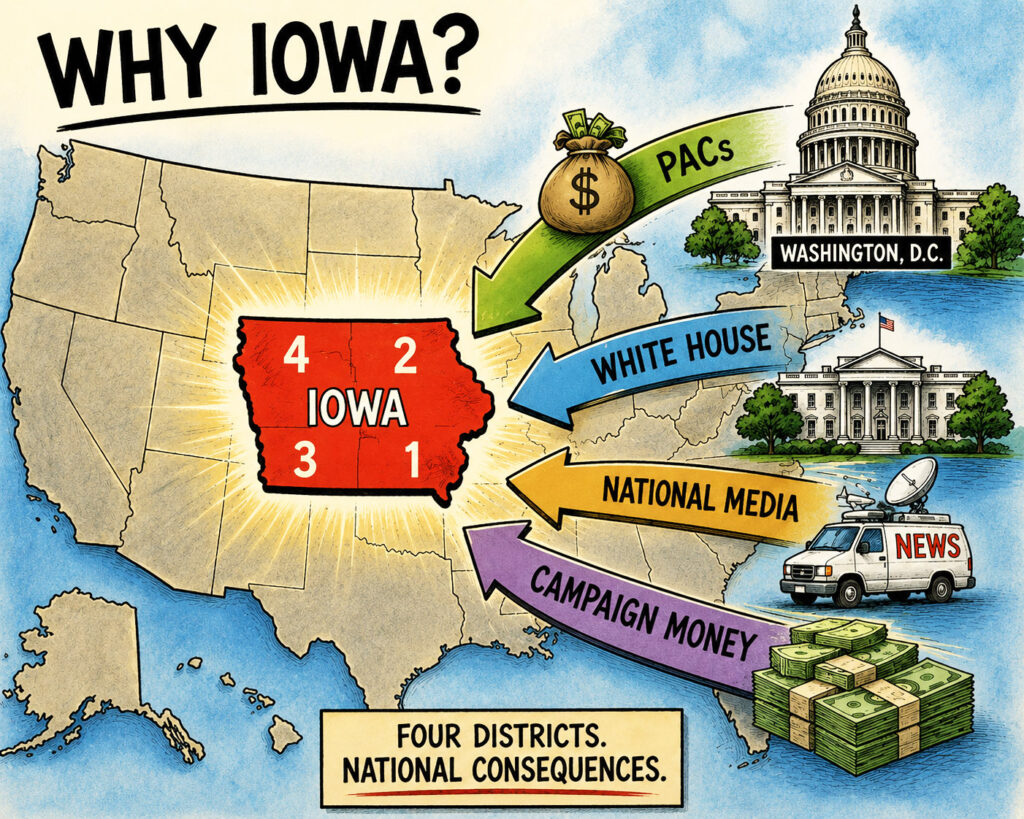
Today, Iowa’s governor’s race, U.S. Senate race, and two congressional districts are all attracting national attention. Election analysts view several of these contests as competitive enough to influence control of Congress and potentially shape the direction of both political parties heading into the 2028 presidential election.
When that happens, outside interest inevitably follows. National party committees. Political action committees. Independent expenditure groups. High-profile surrogates.
And now, apparently, members of the President’s Cabinet.
Why Libertarians Matter
The reported outreach also illustrates something campaigns have long understood. Close elections aren’t decided only by the two major-party nominees.
Third-party and independent candidates can influence campaign strategy, fundraising, messaging, and voter turnout. Even if they receive only a small percentage of the vote.
That doesn’t necessarily mean Libertarian candidates pull votes from one party more than another. Rick Stewart himself rejected that assumption, arguing that many Libertarian voters are dissatisfied with both Republicans and Democrats.
But the fact that national Republicans reportedly devoted time and attention to these candidates demonstrates they view every potential vote as important in what could be a closely divided Congress.
The Nationalization of Iowa Politics
One of the most noticeable changes in recent election cycles is how national Iowa politics has become. Many campaign issues now originate in Washington before reaching Iowa. Campaign funding comes from national organizations. Advertising is often produced by outside groups. And national political figures routinely visit, or intervene in, Iowa races.
As a result, Iowa elections increasingly become part of broader national political battles rather than discussions focused solely on Iowa priorities. That reality creates opportunities for candidates through increased attention and resources.
It also means Iowa voters are likely to experience more outside influence than ever before.
Looking Ahead
Whether or not this week’s controversy fades quickly, one thing appears clear. Iowa has become a genuine political battleground.
National parties believe control of Congress, and perhaps the direction of the country, could depend in part on what happens here.
That means Iowans should expect more campaign spending, more outside organizations, more national figures, and greater scrutiny of every competitive race.
For voters, the challenge remains the same as it has always been. Separating campaign strategy from governing, political messaging from public policy, and national narratives from Iowa’s own interests.
If this election has demonstrated anything so far, it is that Iowa is no longer simply watching national politics. National politics is watching Iowa.
J.W. Calder
Political Notes
Breaking With Trump, or Just His Poll Numbers?
Candidates show some dissent over the Iran war, as Grassley and Ernst vote against limiting Trump’s war powersIowa Republican candidates are changing their positions on the Iran war as Election Day approaches. That is news. Calling it a “break with Trump” may be...
Has the UI Center Lost Its Academic Legitimacy?
How Much Academic Legitimacy Does Iowa's Center for Intellectual Freedom Have Left?Eleven scholars recruited to help establish the Center have resigned. Their departure raises a bigger question about what made this politically created institution academic in the first...
Trump Lost His Lawsuit. But Did the Lawsuit Fail?
An Iowa judge threw out Donald Trump’s lawsuit against Gannett and pollster J. Ann Selzer. But after nearly two years of litigation, the case raises a larger question about what it means to “win.”President Donald Trump lost his lawsuit against Gannett (owner of the...
As Iowans Suffer, Grassley Turns His Focus to Transgender Sports
Iowa already prohibits transgender girls from competing in girls' sports. With farmers struggling with diesel prices and families confronting inflation and housing costs, why is Chuck Grassley making the issue a national priority now?Should we be concerned about his...
Would a Ban of Diesel Exports Actually Lower Prices? Likely Not.
It’s More Complicated Than Grassley BelievesSen. Chuck Grassley says the U.S. should stop exporting diesel to bring down prices for farmers and truckers. The oil industry says that could backfire. Its explanation deserves a closer look.Iowa farmers are heading into...