Reynolds Creates Medicaid Fraud Task Force as Iowa Reports One of Nation’s Lowest Improper Payment Rates
New panel aims to eliminate fraud, waste and abuse while state already performs well below national average
Gov. Kim Reynolds has created a new task force to combat Medicaid fraud, waste and abuse, launching an initiative that state officials say will strengthen oversight of one of Iowa’s largest public assistance programs. The Iowa Medicaid Fraud Elimination Task Force, established by executive order, held its first meeting on July 15 under the leadership of Attorney General Brenna Bird.
“Iowans deserve efficiency and accountability in all taxpayer-funded programs,” Bird told members. “We’re here to focus our collective resources and expertise on a single, vital goal, and that’s to eliminate Medicaid fraud, waste and abuse in Iowa.”
The task force will develop recommendations for improving Medicaid program integrity through greater coordination among state agencies, expanded use of technology and data analytics, enhanced provider oversight, and improved public reporting mechanisms. A final report is due to Gov. Reynolds by Oct. 29.
Iowa Already Performs Well Below National Average
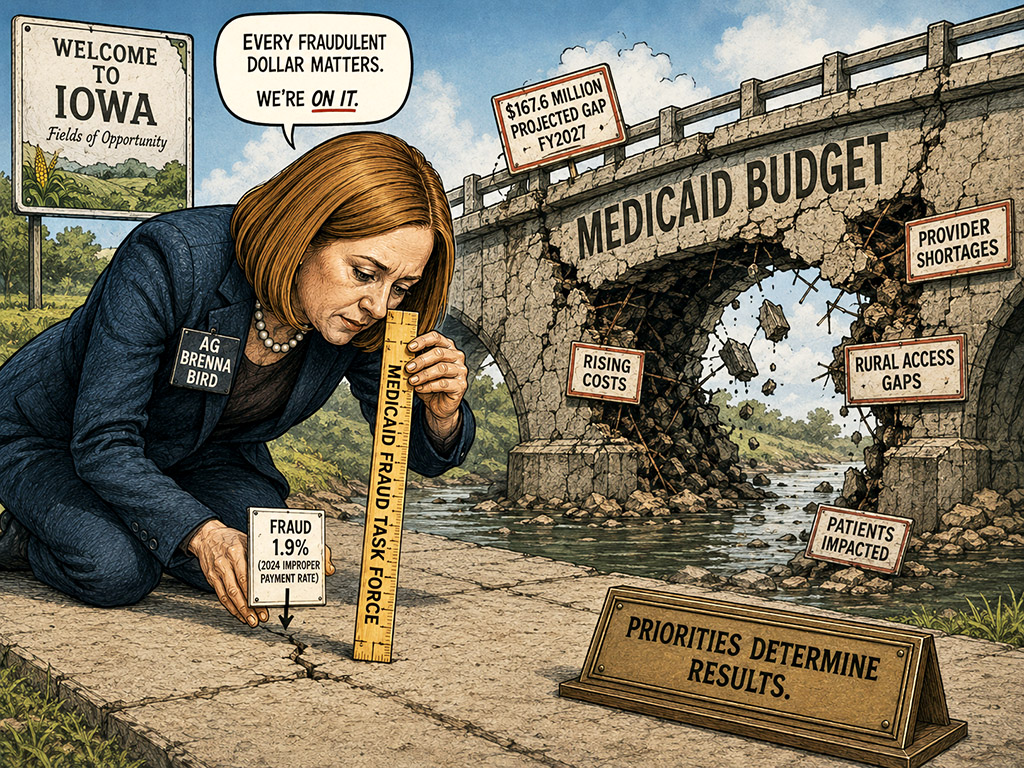
The initiative begins as Iowa already reports one of the nation’s lowest Medicaid improper payment rates. According to the state’s 2024 audit, Iowa’s improper payment rate stands at 1.9%, compared with a national average of approximately 6%. Federal officials also report that most improper payments result from administrative documentation issues rather than intentional fraud.
Bird emphasized that even a low fraud rate warrants continued enforcement. “There is no acceptable amount of Medicaid fraud,” she told reporters, adding that the state intends to pursue providers who improperly receive taxpayer funds through criminal prosecution or civil recovery when appropriate.
Part of Broader National Effort
The Iowa initiative mirrors broader federal efforts launched under the Trump administration to strengthen oversight of Medicaid and Medicare.
The Centers for Medicare & Medicaid Services has increased scrutiny of provider enrollment, payment integrity, and program oversight while Vice President JD Vance chairs a federal anti-fraud task force focused on public assistance programs.
Reynolds’ executive order directs the Iowa task force to align many of its recommendations with those federal initiatives.
Medicaid Budget Pressures Continue
The task force also begins its work as Iowa faces growing Medicaid budget challenges. State officials recently projected a $90.6 million Medicaid shortfall for the fiscal year ending June 30, and a projected $167.6 million gap for fiscal year 2027.
To address the current deficit, lawmakers approved a temporary increase in the health insurer tax, authorized an $89 million transfer from the state’s General Fund, and utilized money from the Taxpayer Relief Fund.
Working Groups Will Study Multiple Areas
Rather than focusing solely on criminal fraud investigations, the task force will organize four working groups examining federal coordination and Medicaid integrity, technology and data analytics, high-risk services and quality initiatives, managed care organization network management, and public awareness and fraud reporting.
The panel is expected to meet approximately once each month before submitting its recommendations this fall.
Why It Matters
Medicaid fraud is a legitimate concern for every state because taxpayer dollars should be spent on patient care rather than improper payments. At the same time, Iowa’s comparatively low improper payment rate raises broader questions about how government should prioritize oversight efforts.
If Iowa already performs significantly better than the national average, policymakers must determine what additional improvements are realistically achievable and how those improvements compare with other challenges facing the Medicaid program, including provider access, administrative efficiency, and long-term financial sustainability.
Our Take
Fighting fraud is not controversial. Every dollar lost to fraud, waste, or abuse is a dollar unavailable for legitimate patient care, and governments have an obligation to safeguard public resources.
The more interesting policy question is not whether Iowa should combat Medicaid fraud, but how government should prioritize its oversight efforts.
With an improper payment rate of just 1.9%, roughly one-third the national average, Iowa appears to have a comparatively strong record of program integrity. That does not mean additional improvements are impossible. It does mean success should be measured against clearly defined objectives rather than broad promises to eliminate fraud.
As the task force develops its recommendations, Iowans should ask several practical questions. What specific problems is the task force expected to solve? How much fraud is expected to be identified or prevented? What measurable improvements will define success? Are the anticipated benefits proportional to the resources devoted to the effort?
Good government is measured not simply by creating new task forces, but by producing measurable public value. The final report this fall should provide an opportunity to evaluate the initiative based on evidence rather than expectations.
Breaking With Trump, or Just His Poll Numbers?
Candidates show some dissent over the Iran war, as Grassley and Ernst vote against limiting Trump’s war powersIowa Republican candidates are changing their positions on the Iran war as Election Day approaches. That is news. Calling it a “break with Trump” may be...
Has the UI Center Lost Its Academic Legitimacy?
How Much Academic Legitimacy Does Iowa's Center for Intellectual Freedom Have Left?Eleven scholars recruited to help establish the Center have resigned. Their departure raises a bigger question about what made this politically created institution academic in the first...
Trump Lost His Lawsuit. But Did the Lawsuit Fail?
An Iowa judge threw out Donald Trump’s lawsuit against Gannett and pollster J. Ann Selzer. But after nearly two years of litigation, the case raises a larger question about what it means to “win.”President Donald Trump lost his lawsuit against Gannett (owner of the...
As Iowans Suffer, Grassley Turns His Focus to Transgender Sports
Iowa already prohibits transgender girls from competing in girls' sports. With farmers struggling with diesel prices and families confronting inflation and housing costs, why is Chuck Grassley making the issue a national priority now?Should we be concerned about his...
Would a Ban of Diesel Exports Actually Lower Prices? Likely Not.
It’s More Complicated Than Grassley BelievesSen. Chuck Grassley says the U.S. should stop exporting diesel to bring down prices for farmers and truckers. The oil industry says that could backfire. Its explanation deserves a closer look.Iowa farmers are heading into...