
Suspicions raised due to lack of details, timing of announcement
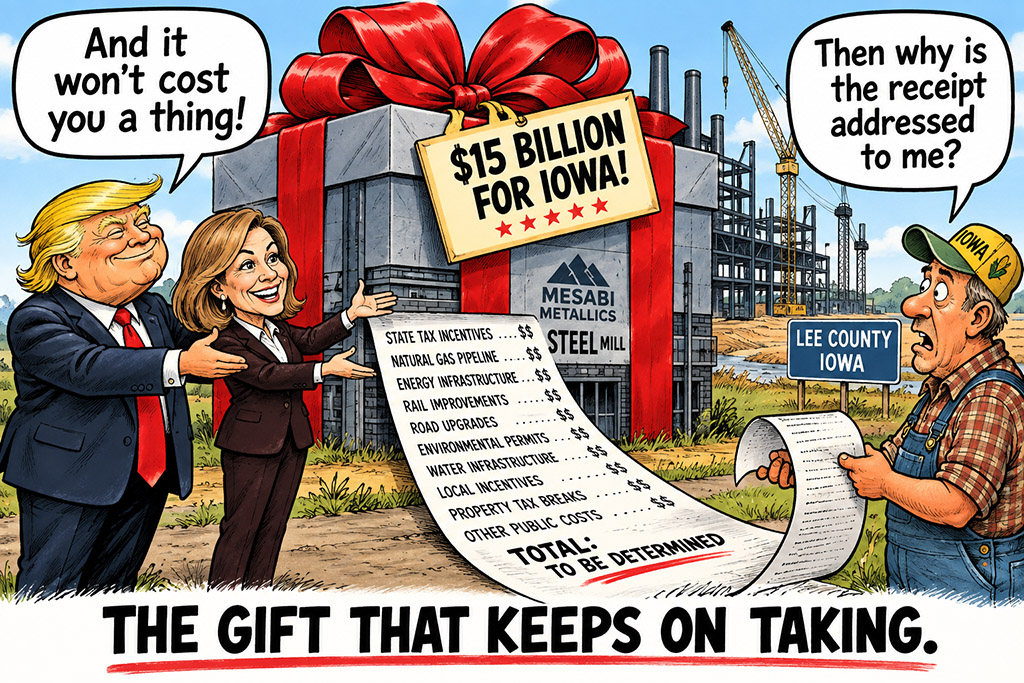
The massive project could bring thousands of jobs and make Iowa a major U.S. steel producer. But production isn’t expected until 2030, and important questions about financing, incentives, environmental impacts and the construction timeline remain unanswered.
President Donald Trump announced Monday that Mesabi Metallics plans to build a $15 billion steel mill in southeast Iowa, describing a project that, if completed as proposed, would represent one of the largest industrial investments in Iowa history.
The announcement came during an Oval Office event with company executives. The proposed plant is expected to employ about 1,750 workers when operational, with another 5,000 to 6,000 jobs associated with construction. First steel production is projected for 2030. Once fully built out, the plant is expected to produce as much as 10 million tons of steel annually, placing it among the largest steelmaking facilities in the United States.
Trump said construction would begin “immediately.” That gives Iowans an unusually clear benchmark against which to measure the project in the months ahead.
A Minnesota-to-Iowa Steel Operation
The company behind the proposal, Mesabi Metallics, is owned by India-based Essar Group and is developing a large iron ore mine and pellet operation near Nashwauk on Minnesota’s Mesabi Iron Range.
That operation officially began its startup this month and is expected to provide iron ore pellets for the proposed Iowa steel mill. Mesabi has hired more than 200 workers in Minnesota toward a planned workforce of about 350.
Mesabi’s history, however, demonstrates how long major industrial projects can take to move from announcement to production. Construction on the Minnesota project originally began under Essar Steel Minnesota in 2010. Essar Steel Minnesota later entered Chapter 11 bankruptcy, and Mesabi Metallics emerged from the reorganization in 2017 as successor to the project.
The project has since attracted billions of dollars in investment and is finally approaching commercial production. A recent SEC filing puts total expected investment through startup at approximately $2.4 billion and says initial production of direct-reduction-grade iron ore pellets is targeted for the fourth quarter of this year.
That history doesn’t mean the Iowa project won’t be built. It does illustrate the difference between announcing a massive industrial project and completing one.
Big Opportunity, Long Timeline
If the Iowa plant is completed as announced, the economic consequences for southeast Iowa could be substantial.
Thousands of construction jobs would arrive during development, followed by approximately 1,750 permanent positions. The project would also generate demand for suppliers, transportation, utilities and other businesses surrounding the plant.
But most of those long-term benefits are years away. The administration says first steel production is expected in 2030, meaning the facility would not begin producing steel until roughly four years after today’s announcement. Full buildout to the advertised 10-million-ton annual capacity could take longer.
That timeline is particularly relevant because the announcement comes just weeks before the November midterm elections. Reuters reported that the Trump administration is highlighting the project as part of its effort to promote domestic manufacturing ahead of those elections.
Whether the announcement ultimately becomes a political talking point or a transformative Iowa industrial project will depend less on what was said in the Oval Office Monday than on what happens next in southeast Iowa.
What About the Special Session?
The announcement also raises a new question about a possible special session of the Iowa Legislature.
Last week, lawmakers were told that a steel company was considering southeast Iowa and wanted lawmakers to approve an incentive package quickly to help it decide about locating it here. Monday’s announcement appears to move the project beyond that point: Trump and company executives publicly announced that the mill will be built in Iowa.
That does not necessarily mean state incentives are no longer part of the project. Mesabi may consider them part of the financial package necessary for construction to proceed.
But it changes the question. If Iowa has now been selected, lawmakers and taxpayers will need to know exactly what additional incentives the company is seeking, how much they will cost, what commitments Iowa receives in return and whether construction of the plant remains contingent upon their approval.
Environmental Questions Remain
A steel complex capable of producing up to 10 million tons annually would also be a major industrial and environmental development. Details about the Iowa plant’s environmental footprint have not yet been released, including expected water consumption, energy requirements, air emissions, wastewater discharges and transportation infrastructure. Those questions will become clearer as the company identifies the site and begins the environmental review and permitting processes.
Mesabi’s Minnesota operation provides some indication of the regulatory complexity involved in projects of this scale. The Minnesota Pollution Control Agency regulates its air emissions and industrial wastewater, and identifies dust from mining and material handling, combustion emissions from the pellet furnace and tailings-basin dust among the operation’s principal emission sources.
The Iowa steel mill will involve different processes and therefore different environmental impacts. Its proposed location near the Mississippi River makes questions involving water use, discharge, transportation and surrounding communities particularly important. Those impacts cannot yet be evaluated because the necessary project details have not been released.
The Announcement Is the Beginning
There are reasons to take Monday’s announcement seriously. Mesabi Metallics has a real mining and processing operation approaching production in Minnesota. Billions of dollars have already been invested there, and the company has substantial industrial backing through Essar Group.
There are equally good reasons to reserve judgment about what the Iowa announcement ultimately becomes. A $15 billion investment must be financed. Land must be acquired. State and local incentives must be negotiated. Environmental permits must be obtained. Electricity, water, natural gas, rail and potentially river transportation must be secured. Thousands of construction workers must actually arrive.
And a facility that does not expect to produce its first steel until 2030 will not deliver its promised long-term economic benefits anytime soon.
For southeast Iowa, the potential upside is enormous. For now, however, the $15 billion steel mill remains a promise. And the next test is Trump’s own assertion that construction is starting immediately.
That should be something Iowans can see.
The Hook: How Trump Benefits from False Claims
The Trump Tactic for Avoiding Questions about His Big LiesThe $15 billion Iowa steel mill may become everything Trump says it will. But his announcement illustrates a political technique Iowans have seen before: make the promise enormous, collect the political benefit...
Iowa Legislators at Odds Over the Iran War
Hinson Calls for End to Iran War as Grassley and Ernst Vote to Continue ItIowa Republican Rep. Ashley Hinson is now calling for an “immediate end” to the nearly seven-month Iran war, even as Iowa Republican Sens. Chuck Grassley and Joni Ernst voted Thursday against a...
Breaking With Trump, or Just His Poll Numbers?
Candidates show some dissent over the Iran war, as Grassley and Ernst vote against limiting Trump’s war powersIowa Republican candidates are changing their positions on the Iran war as Election Day approaches. That is news. Calling it a “break with Trump” may be...
As Iowans Suffer, Grassley Turns His Focus to Transgender Sports
Iowa already prohibits transgender girls from competing in girls' sports. With farmers struggling with diesel prices and families confronting inflation and housing costs, why is Chuck Grassley making the issue a national priority now?Should we be concerned about his...
Mortgage Rates Hit 7% as War Increases Housing Market Pressure
Higher energy prices, persistent inflation, and rising borrowing costs are making an already difficult housing market even harder for buyers.The New York Times reports that mortgage rates have climbed above 7% for the first time since January 2025, another economic...
The Company Miller-Meeks Keeps
The Company She Keeps: Who Is Miller-Meeks Bringing to Iowa?Mariannette Miller-Meeks brought Rick Scott and Markwayne Mullin to Iowa to help make the case for her reelection. Their backgrounds raise a reasonable question: What should voters make of the people a...
Iowa AG Filed Suit in Support of Mega Media Merger
Why Did Brenna Bird Try to Stop the Paramount-Warner Lawsuit?Iowa's attorney general called the challenge to the Paramount-Warner Bros. merger “politicized.” The states that brought the case said they were protecting competition, consumers and workers. Iowa Attorney...