
The Trump Tactic for Avoiding Questions about His Big Lies
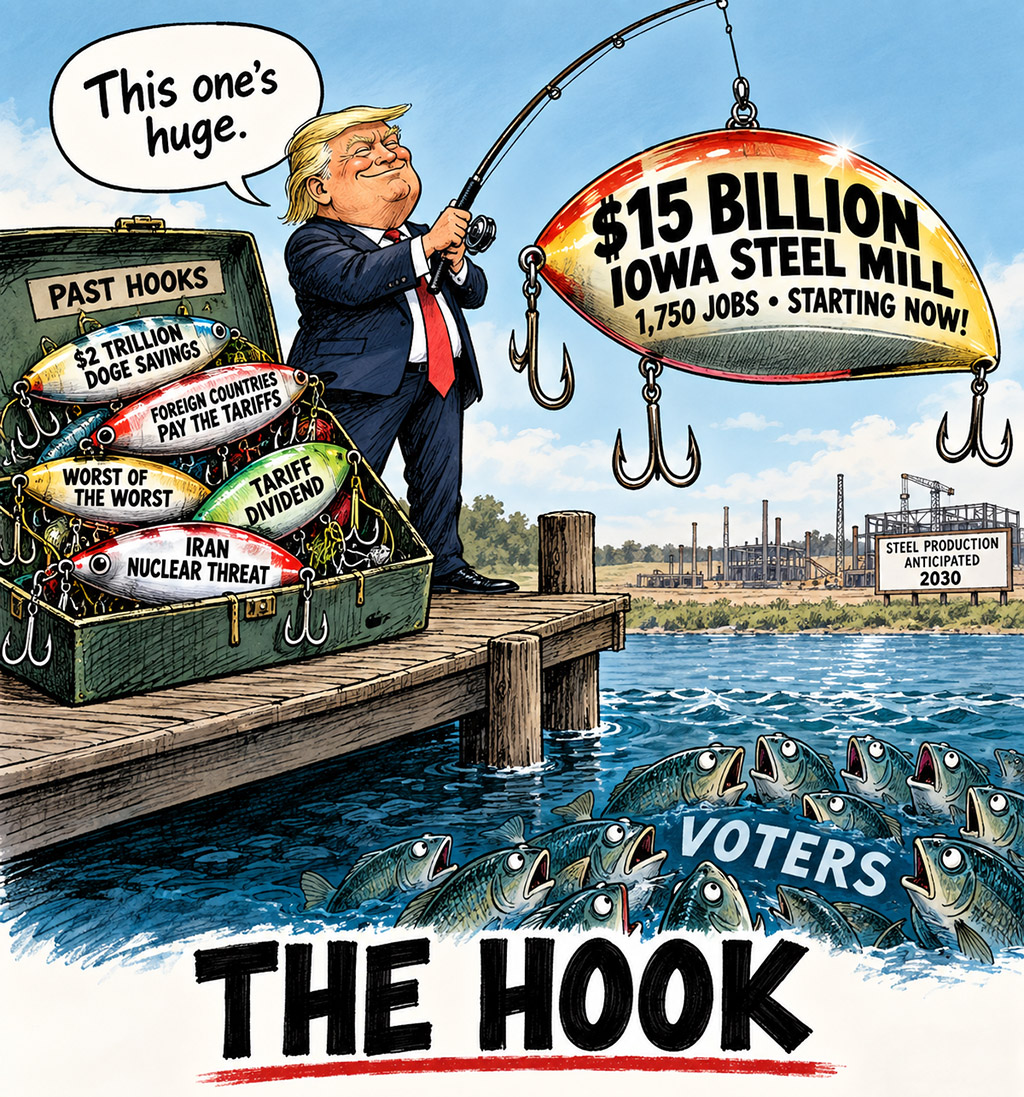
The $15 billion Iowa steel mill may become everything Trump says it will. But his announcement illustrates a political technique Iowans have seen before: make the promise enormous, collect the political benefit immediately, and leave the difficult details for later.
How Trump Gets the Benefit of a Promise Before He Has to Deliver It
The $15 billion Iowa steel mill may become everything Trump says it will. But his announcement illustrates a political technique Iowans have seen before: make the promise enormous, collect the political benefit immediately, and leave the difficult details for later. We hope Donald Trump is right. We hope that four years from now, a massive steel mill will be operating in Lee County, 1,750 Iowans have permanent jobs there, thousands more were employed building it, and southeast Iowa is benefiting from one of the largest industrial investments in state history.
But Donald Trump doesn’t have to wait four years to benefit from the steel mill, because he gets the political benefit today. That distinction is worth understanding because it illustrates a recurring feature of Trump’s political communication. Call it the hook.
Start with something people genuinely want or fear. Make the problem enormous. Offer an equally enormous solution. Describe the outcome with certainty. Then collect the political benefit of the promise long before anyone can determine whether the promise will actually be delivered. The Iowa steel mill may turn out exactly as advertised. But we’ve seen the hook before.
Give people something they want
The hook works because it begins with something real. People want safe communities. They want good jobs. They don’t want their government wasting money. They don’t want other countries taking advantage of the United States. They don’t want Iran to acquire a nuclear weapon. They don’t want a crushing national debt passed on to their children.
And southeast Iowa could certainly use thousands of well-paying manufacturing jobs. Those aren’t manufactured concerns. The simplification comes next, as complex problems become simple stories with enormous solutions.
Immigration wasn’t presented merely as a question of enforcing immigration law. The administration repeatedly told Americans it was targeting the “worst of the worst” criminals.
But as enforcement expanded, the population being arrested became much broader. An analysis of ICE data found that during Trump’s first three months in office, 21.9% of those arrested had neither criminal convictions nor pending charges. By the three months ending in mid-October 2025, that had risen to 40.5%. By January 2026, nearly 43% of ICE detainees had neither convictions nor pending charges.
The hook was memorable, but the reality was more complicated.
Then make the solution enormous
Consider DOGE. Americans have plenty of reason to want waste eliminated from the federal government. Elon Musk initially talked about cutting as much as $2 trillion in spending, later moving toward a $1 trillion target. Trump promoted the effort and even discussed using some of the anticipated savings to reduce the national debt.
Then reality arrived. By July 2026, DOGE’s Wall of Receipts claimed $110 billion in savings from contracts, grants and leases. The Government Accountability Office subsequently examined those claims and found that some estimates were incorrect or lacked supporting evidence.
GAO found, among other things, that 108 leases credited to DOGE were already being phased out before DOGE existed. DOGE also claimed $1.7 billion in savings from a Defense Health Agency contract that ultimately wasn’t terminated, reduced or defunded.
Actual savings from that claimed $1.7 billion cancellation? According to the nonpartisan Government Accountability Office: zero. The original promise – the hook – got the attention. Checking the receipts came much later.
Make a complicated problem sound simple
Trump has repeatedly described America’s trade relationships as other countries taking advantage of, or “ripping off,” the United States, usually because they sell a higher percentage of goods to the U.S. compared to what we sell that country. Not a ripoff.
The solution was tariffs. And the sales pitch was wonderfully simple: foreign countries would pay.
Except tariffs on imported products are collected from U.S. importers, not foreign governments. Foreign producers sometimes absorb part of the cost through lower prices, but economists have repeatedly found that at least some of the cost is passed along to American businesses and consumers.
Trump also promised that tariffs would dramatically reduce America’s trade deficit. The results have been considerably more complicated. The U.S. goods-and-services trade deficit actually increased in 2025, partly because importers rushed to bring products into the country before tariffs took effect. Through May 2026, the deficit was running below 2025 and 2024 levels. That is what real economic policy looks like. Multiple effects, tradeoffs and outcomes that don’t fit comfortably on a campaign sign.
The hook does.
And if one promise isn’t enough, add another
Tariffs provide an especially useful example because the promised benefits didn’t stop with trade. Trump has said tariff revenue could help reduce the national debt. He has also proposed using tariff revenue for other purposes, including dividend checks for Americans and increased defense spending. The same pot of money can only be spent once. FactCheck.org examined those promises in January and concluded that tariff revenue could cover only a fraction of everything Trump had proposed funding with it.
Then, at this month’s Republican midterm convention, Trump promised $5,000 dividend payments to every adult citizen if Republicans retained control of Congress and suggested tariff revenue could pay for them. Analysts calculated that the payments would cost roughly $1.2 trillion—more than six years of tariff revenue at the current collection rate. But again, the arithmetic comes after the promise.
The promise is the hook.
Fear works, too
The same technique can operate through fear rather than economic aspiration. When Trump made the case for the U.S.-Israeli military operation against Iran earlier this year, he described the objective as eliminating an imminent threat and repeatedly focused on preventing Iran from obtaining a nuclear weapon. Preventing Iranian nuclear proliferation has long been bipartisan U.S. policy. Iran’s enrichment activities also presented genuine proliferation concerns. But experts told FactCheck.org that available evidence did not establish the imminent nuclear threat Trump described.
The International Atomic Energy Agency had serious concerns about Iran’s highly enriched uranium, but arms-control specialists said there was a significant distinction between possessing enriched material and having a functioning nuclear weapon.
Again, reality required distinctions. But the hook did not.
Which brings us back to Iowa
Now consider Monday’s announcement of a $15 billion investment that could bring thousands of construction jobs and at least 1,750 permanent jobs. One of the largest steel mills in the country. And Trump said today during an Oval Office presser that construction begins immediately. Those are extraordinary claims. They were also announced just weeks before the midterm elections, with the proposed plant located in Republican Rep. Mariannette Miller-Meeks’ congressional district. But the plant isn’t expected to produce steel until 2030.
That creates the perfect conditions for the hook. The political benefit is immediate, and the economic payoff is delayed. Voters hear about $15 billion and thousands of jobs today. Whether the financing materializes, permits are issued, land is acquired, infrastructure is built, thousands of construction workers actually appear, and steel eventually rolls out of the plant won’t be known until later. Perhaps it all will. We hope it does. But hope isn’t verification.
Save the receipt
There is a useful critical-thinking lesson here that extends well beyond Donald Trump. When any politician offers an enormous solution to a complicated problem, don’t begin by asking whether you like the politician. Don’t even begin by asking whether you like the promise. Ask something more useful. What exactly is being promised? Then, write it down. What will happen? When will it happen? How much will it cost? Who pays? What measurable result should we expect? And when should we expect to see it?
Then, save the receipt. When the explanation changes six months later, go back to the original promise. When a $2 trillion savings target becomes something much smaller, remember the $2 trillion. When “the worst of the worst” becomes an enforcement system increasingly arresting people without criminal convictions or pending charges, remember the original description. When foreign countries are supposedly paying tariffs, ask who actually writes the check. And when the president says construction of a $15 billion Iowa steel mill starts immediately, mark the date: September 28, 2026. Then look for the construction.
The Hook only works if we forget
And remembering is one of the essential functions of an independent press. A president can move on from yesterday’s promise. A reporter can retrieve it. A politician can redefine what success was supposed to mean. A newspaper can compare the new definition with the old one. A claim can disappear from a speech, but it doesn’t disappear from the public record. That helps explain why an independent press is supposed to be adversarial rather than accommodating. Its job is not simply to report what a president says today. It is to remember what he said yesterday and then ask what happened.
That role takes on additional significance when the president attacks news organizations whose reporting he dislikes. Trump has recently barred CNN, MS NOW and Politico from the White House, describing their reporting as “fake news,” while the organizations contend that they are being punished because of the content of their journalism. The dispute is now before the courts.
Whatever the courts ultimately decide about access, the democratic principle is larger than a White House press pass. Power benefits when promises are forgotten. Journalism exists, in part, to make forgetting harder.
Trump’s political technique
Trump’s political skill isn’t simply making large promises. It is making the promise memorable while the details that eventually test it receive far less attention. That creates an enormous advantage for him. The announcement gets headlines. The superlative gets repeated. The promise becomes a talking point. Months or years later, the qualifications, revisions and disappointing numbers arrive one at a time.
By then, everyone has moved on to the next controversy. Or the next promise. Or the next hook.
The antidote isn’t cynicism. It isn’t assuming every Trump announcement is false, any more than we should assume every promise from any politician is false. It is memory. Remember what was originally promised. Separate the announcement from the accomplishment. And don’t give any politician credit for delivering something until they actually deliver it.
The Iowa steel mill gives us an unusually easy place to start. Trump says construction starts immediately. We hope he’s right. Now, let’s watch.
Trump Announces $15 Billion Steel Mill for Southeast Iowa
Suspicions raised due to lack of details, timing of announcementThe massive project could bring thousands of jobs and make Iowa a major U.S. steel producer. But production isn't expected until 2030, and important questions about financing, incentives, environmental...
Iowa Legislators at Odds Over the Iran War
Hinson Calls for End to Iran War as Grassley and Ernst Vote to Continue ItIowa Republican Rep. Ashley Hinson is now calling for an “immediate end” to the nearly seven-month Iran war, even as Iowa Republican Sens. Chuck Grassley and Joni Ernst voted Thursday against a...
Breaking With Trump, or Just His Poll Numbers?
Candidates show some dissent over the Iran war, as Grassley and Ernst vote against limiting Trump’s war powersIowa Republican candidates are changing their positions on the Iran war as Election Day approaches. That is news. Calling it a “break with Trump” may be...
As Iowans Suffer, Grassley Turns His Focus to Transgender Sports
Iowa already prohibits transgender girls from competing in girls' sports. With farmers struggling with diesel prices and families confronting inflation and housing costs, why is Chuck Grassley making the issue a national priority now?Should we be concerned about his...
Mortgage Rates Hit 7% as War Increases Housing Market Pressure
Higher energy prices, persistent inflation, and rising borrowing costs are making an already difficult housing market even harder for buyers.The New York Times reports that mortgage rates have climbed above 7% for the first time since January 2025, another economic...
The Company Miller-Meeks Keeps
The Company She Keeps: Who Is Miller-Meeks Bringing to Iowa?Mariannette Miller-Meeks brought Rick Scott and Markwayne Mullin to Iowa to help make the case for her reelection. Their backgrounds raise a reasonable question: What should voters make of the people a...
Iowa AG Filed Suit in Support of Mega Media Merger
Why Did Brenna Bird Try to Stop the Paramount-Warner Lawsuit?Iowa's attorney general called the challenge to the Paramount-Warner Bros. merger “politicized.” The states that brought the case said they were protecting competition, consumers and workers. Iowa Attorney...