
If Iowa’s $15 Billion Steel Mill Deal Is Done, Why the Special Session?
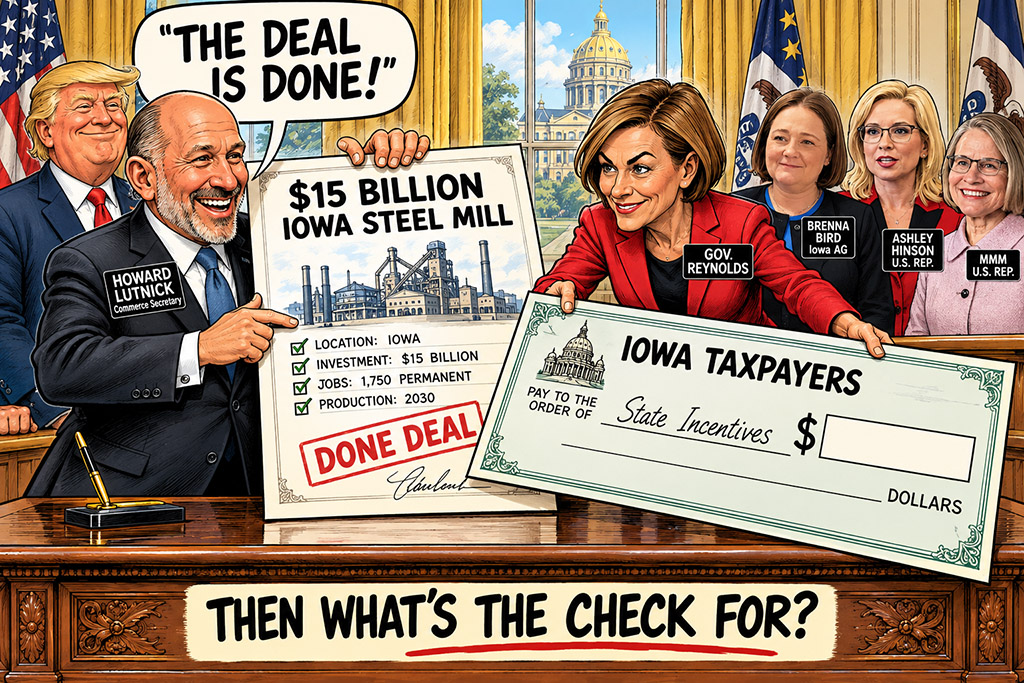
Trump’s commerce secretary says the $15 billion project doesn’t depend on state incentives. Gov. Kim Reynolds is calling lawmakers back to change Iowa’s incentive program anyway.
On Monday, President Donald Trump announced plans for a $15 billion steel mill in southeast Iowa, promising thousands of construction jobs and 1,750 permanent positions. The proposed Mesabi Metallics facility would be one of the largest industrial investments in Iowa history, with steel production expected to begin in 2030.
But an exchange during the White House announcement raises an important question about how much Iowa taxpayers may be asked to contribute. When reporters asked whether the project depended on state tax incentives, Commerce Secretary Howard Lutnick said it did not.
“I think this deal is done,” Lutnick said. “They’ve already worked it out. That’s why we’re all together with the president. The president doesn’t bring people together unless it’s a done deal.” White House officials also said the project was not dependent on local incentives.
Yet on Tuesday, Gov. Kim Reynolds called the Iowa Legislature into a special session for Friday, October 2, specifically to amend the state’s Major Economic Growth Attraction (MEGA) program to accommodate the steel mill.
If the company’s decision to build in Iowa is already final and doesn’t depend on state incentives, what exactly are lawmakers being asked to approve?
What is Iowa being asked to change?
MEGA is Iowa’s economic-development program for projects involving more than $1 billion in capital investment. It offers negotiated incentives that can include refundable investment tax credits, withholding tax credits for qualifying new jobs and refunds of sales taxes paid during construction.
According to Iowa Starting Line, the program currently allows a refundable investment tax credit of up to 5%. Applied to a $15 billion investment, that percentage would equal $750 million, although the actual eligible investment and any award would depend on the program’s rules and negotiated terms.
Corridor Business Journal reports that Reynolds claims that the unprecedented size of the steel mill requires adjustments to the program. Her office announced that Iowa and Mesabi Metallics have signed a memorandum of understanding outlining their partnership.
She characterized the proposed amendments as limited changes to an existing economic-development program. However, her announcement did not disclose the specific amendments or the financial terms of the agreement.
That leaves taxpayers unable to determine how much the project could cost the state or why the existing incentive program is insufficient.
Why the urgency?
The timing raises another question. The steel mill was publicly announced on September 28. The governor called a special legislative session the following morning, giving lawmakers just three days before they are scheduled to convene at 8:30 a.m. Friday. The project is not expected to produce its first steel until 2030. There may be legitimate financing, construction or contractual deadlines requiring immediate legislative action. But those reasons have not been publicly explained in sufficient detail.
If Lutnick is correct that the company has already committed to Iowa without needing state incentives, lawmakers should be able to establish what would happen if they declined to amend MEGA.
Would the company proceed anyway? Would construction be delayed? Or are there additional conditions that were not disclosed during the White House announcement?
Those are materially different possibilities, and they deserve clear answers before lawmakers vote.
What protections will taxpayers receive?
Both Democratic legislative leaders have expressed support for the prospect of new jobs while seeking more information about the proposed agreement.
Corridor Business Journal points out that House Minority Leader Brian Meyer said Democrats want to ensure that the project benefits Iowa workers and taxpayers. Senate Minority Leader Janice Weiner similarly called for a deliberative process and answers to outstanding questions.
The same questions should matter to every legislator, regardless of party. If Iowa provides substantial incentives, the agreement should specify what the state receives in return, when the company must meet its obligations and what happens if those obligations are not fulfilled.
The distinction between an announced investment and a completed industrial project is especially important when the promised economic benefits are several years away.
The deal may be done. The questions aren’t.
A $15 billion steel mill offering thousands of jobs represents a potentially significant opportunity for southeast Iowa. That opportunity deserves serious consideration, including appropriate public investment where the benefits justify the costs.
But an investment of this magnitude also warrants transparency about the state’s financial commitments. The Trump administration says the steel mill is coming to Iowa regardless of local incentives. Reynolds says lawmakers must urgently change the state’s incentive program to accommodate it.
Both statements could be accurate. A company can commit to a location while continuing to negotiate financial assistance. But if that is what happened, Iowans deserve to understand the difference between incentives necessary to secure the project and additional benefits being negotiated after the company has already committed.
Before Friday’s vote, lawmakers should make the proposed amendments, the memorandum of understanding and the expected public costs available for examination.
After all, according to Howard Lutnick, the deal is already done. So why is Iowa being asked to make another one?
Before Iowa Bets On a Steel Mill, First Think About Foxconn
The Proposed Iowa Steel Mill: Lessons from Wisconsin’s Foxconn FailureWisconsin's failed $10 billion manufacturing promise offers lessons as Iowa considers incentives for a proposed $15 billion steel mill.A Wisconsin reader's letter to the Des Moines Register this...
The $1.5 Billion Question: Why the Rush to Subsidize?
Reynolds’ Timing to Dedicate Taxpayer Funds for the Mesabi Steel Mill Is QuestionedTrump's commerce secretary says the deal is done. So why are Iowa lawmakers being called back to offer hundreds of millions more in tax incentives?Iowa's proposed $15 billion steel mill...
The Hook: How Trump Benefits from False Claims
The Trump Tactic for Avoiding Questions about His Big LiesThe $15 billion Iowa steel mill may become everything Trump says it will. But his announcement illustrates a political technique Iowans have seen before: make the promise enormous, collect the political benefit...
Trump Announces $15 Billion Steel Mill for Southeast Iowa
Suspicions raised due to lack of details, timing of announcementThe massive project could bring thousands of jobs and make Iowa a major U.S. steel producer. But production isn't expected until 2030, and important questions about financing, incentives, environmental...
Iowa Legislators at Odds Over the Iran War
Hinson Calls for End to Iran War as Grassley and Ernst Vote to Continue ItIowa Republican Rep. Ashley Hinson is now calling for an “immediate end” to the nearly seven-month Iran war, even as Iowa Republican Sens. Chuck Grassley and Joni Ernst voted Thursday against a...
Breaking With Trump, or Just His Poll Numbers?
Candidates show some dissent over the Iran war, as Grassley and Ernst vote against limiting Trump’s war powersIowa Republican candidates are changing their positions on the Iran war as Election Day approaches. That is news. Calling it a “break with Trump” may be...
As Iowans Suffer, Grassley Turns His Focus to Transgender Sports
Iowa already prohibits transgender girls from competing in girls' sports. With farmers struggling with diesel prices and families confronting inflation and housing costs, why is Chuck Grassley making the issue a national priority now?Should we be concerned about his...