
The Proposed Iowa Steel Mill: Lessons from Wisconsin’s Foxconn Failure
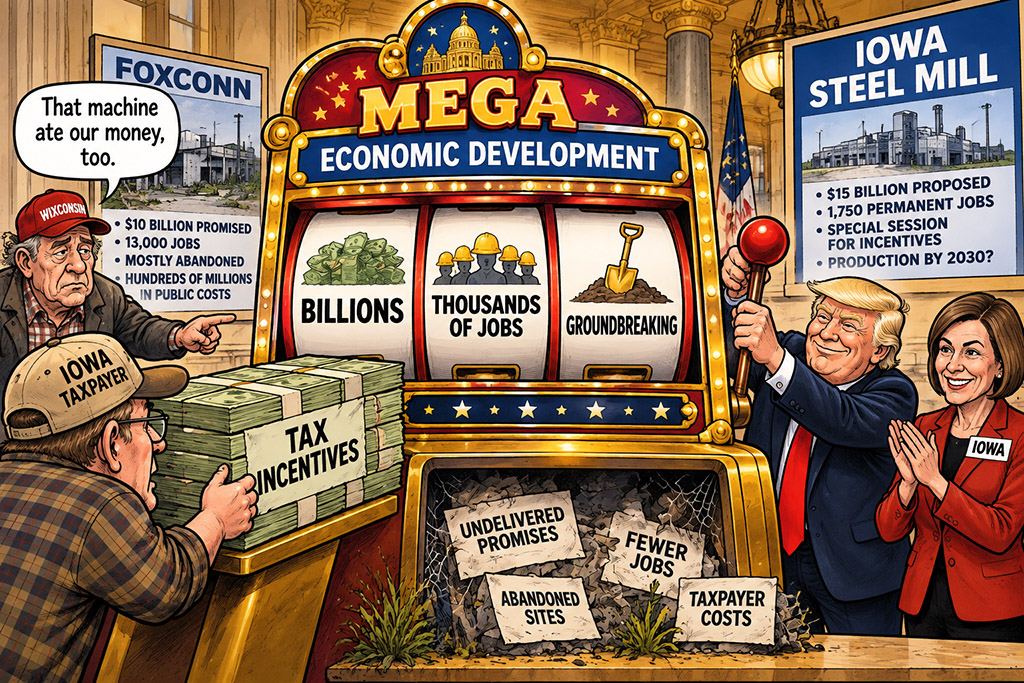
Wisconsin’s failed $10 billion manufacturing promise offers lessons as Iowa considers incentives for a proposed $15 billion steel mill.
A Wisconsin reader’s letter to the Des Moines Register this morning offers Iowans a timely reminder about Trump’s proposed $15 billion Iowa steel mill. As Wisconsin learned from a proposed Trump economic project there, a multibillion-dollar factory announcement, thousands of promised jobs and a presidential groundbreaking ceremony do not guarantee that a project will deliver.
In 2017, President Donald Trump and Wisconsin Governor Scott Walker celebrated plans for a $10 billion Foxconn manufacturing complex that was expected to create 13,000 jobs. Trump later described the project as the eighth wonder of the world. Four years later, the original project had largely collapsed. Foxconn renegotiated its agreement with Wisconsin, reducing its investment commitment to $672 million and its employment target to 1,454 jobs.
Now Iowa faces its own enormous manufacturing proposal: a $15 billion steel mill announced by Trump, with promises of at least 1,750 permanent jobs and thousands of construction positions. The projects are different. But Wisconsin’s experience raises questions Iowa should answer before committing substantial public resources.
Wisconsin’s Costly Lesson
Foxconn’s original agreement offered up to $2.85 billion in state tax credits, with additional local and infrastructure commitments bringing the potential public cost above $4 billion. When the company’s plans changed, Wisconsin renegotiated the agreement in 2021. The revised deal reduced potential state tax credits to $80 million and tied them to substantially lower investment and employment targets.
That renegotiation protected Wisconsin from paying the original state incentive package. But it could not undo the disruption experienced by residents whose properties were acquired or eliminate the substantial infrastructure spending already undertaken to accommodate the project.
The lesson is not that large manufacturing investments should be rejected. It is that taxpayers can incur substantial costs long before the promised factory begins producing anything.
Iowa’s Decision
Mesabi Metallics, owned by India’s Essar Group, proposes to build its steel mill in Lee County, using iron ore from its Minnesota operations. The company projects 1,750 permanent jobs, approximately 6,000 construction jobs and production beginning in 2030.
Governor Kim Reynolds has called a special legislative session for October 2 to amend Iowa’s Major Economic Growth Attraction (MEGA) program. The proposed changes would allow a refundable investment tax credit of up to 10% for a qualifying project, compared with the existing 5% maximum. On a fully qualifying $15 billion investment, that represents a potential $1.5 billion credit. Importantly, the proposed credit would not be paid until the facility enters service and at least half of the promised jobs have been created. That is a meaningful safeguard.
But Foxconn illustrates why lawmakers should examine the entire financial commitment, not just the conditions attached to one tax credit. Will Iowa or local governments be expected to finance roads, utilities, land acquisition or other infrastructure before the mill is operating? What happens if the company builds a smaller facility, delays production or creates substantially fewer jobs?
And if Commerce Secretary Howard Lutnick was correct when he said the steel mill deal was already done, why are additional state incentives necessary?
What Iowans Deserve to Know
Before committing public resources, Iowa officials should disclose the project’s financing arrangements, the full value of proposed state and local incentives, and the conditions that must be met before benefits are awarded.
They should also explain what happens if the project changes substantially after construction begins. Performance requirements, independent verification, enforceable repayment provisions and limits on advance public spending are particularly relevant lessons from Wisconsin.
A steel mill of the proposed scale could create significant employment and economic opportunities for southeastern Iowa. Mesabi’s existing Minnesota mining operations also distinguish its proposal from Foxconn’s original Wisconsin plan.
But neither those advantages nor a presidential announcement guarantees that the Iowa facility will be completed as proposed.
Wisconsin’s experience demonstrates why public officials need to distinguish projected economic benefits from enforceable commitments. And why taxpayers deserve to understand the financial risks before those commitments are made.
The question is not simply what Iowa stands to gain if the steel mill succeeds. It is what Iowans could lose if it doesn’t.
At a Glance
Wisconsin’s Foxconn Project
What was promised?
In 2017, Foxconn announced a $10 billion manufacturing complex in Wisconsin, promising 13,000 jobs.
What incentives were offered?
Up to $2.85 billion in state tax credits, plus substantial local infrastructure and development commitments.
What actually happened?
Foxconn abandoned its original manufacturing plans. In 2021, Wisconsin renegotiated the agreement, reducing the investment commitment to $672 million and the employment target to 1,454 jobs.
Did taxpayers pay the original incentives?
No. The renegotiated agreement substantially reduced state tax credits. However, local governments had already spent heavily on land acquisition and infrastructure.
What happened to residents?
Properties were acquired, including through eminent domain, and some residents lost their homes to make way for the development.
What’s the lesson for Iowa?
Taxpayer protections must cover more than promised jobs and conditional tax credits. Land acquisition, infrastructure spending and other public commitments can create substantial costs even when a project fails to materialize as planned.
The $1.5 Billion Question: Why the Rush to Subsidize?
Reynolds’ Timing to Dedicate Taxpayer Funds for the Mesabi Steel Mill Is QuestionedTrump's commerce secretary says the deal is done. So why are Iowa lawmakers being called back to offer hundreds of millions more in tax incentives?Iowa's proposed $15 billion steel mill...
The Hook: How Trump Benefits from False Claims
The Trump Tactic for Avoiding Questions about His Big LiesThe $15 billion Iowa steel mill may become everything Trump says it will. But his announcement illustrates a political technique Iowans have seen before: make the promise enormous, collect the political benefit...
Trump Announces $15 Billion Steel Mill for Southeast Iowa
Suspicions raised due to lack of details, timing of announcementThe massive project could bring thousands of jobs and make Iowa a major U.S. steel producer. But production isn't expected until 2030, and important questions about financing, incentives, environmental...
Iowa Legislators at Odds Over the Iran War
Hinson Calls for End to Iran War as Grassley and Ernst Vote to Continue ItIowa Republican Rep. Ashley Hinson is now calling for an “immediate end” to the nearly seven-month Iran war, even as Iowa Republican Sens. Chuck Grassley and Joni Ernst voted Thursday against a...
Breaking With Trump, or Just His Poll Numbers?
Candidates show some dissent over the Iran war, as Grassley and Ernst vote against limiting Trump’s war powersIowa Republican candidates are changing their positions on the Iran war as Election Day approaches. That is news. Calling it a “break with Trump” may be...
As Iowans Suffer, Grassley Turns His Focus to Transgender Sports
Iowa already prohibits transgender girls from competing in girls' sports. With farmers struggling with diesel prices and families confronting inflation and housing costs, why is Chuck Grassley making the issue a national priority now?Should we be concerned about his...
Mortgage Rates Hit 7% as War Increases Housing Market Pressure
Higher energy prices, persistent inflation, and rising borrowing costs are making an already difficult housing market even harder for buyers.The New York Times reports that mortgage rates have climbed above 7% for the first time since January 2025, another economic...