
The $1.1 Billion Budget Gap Tells Another Story
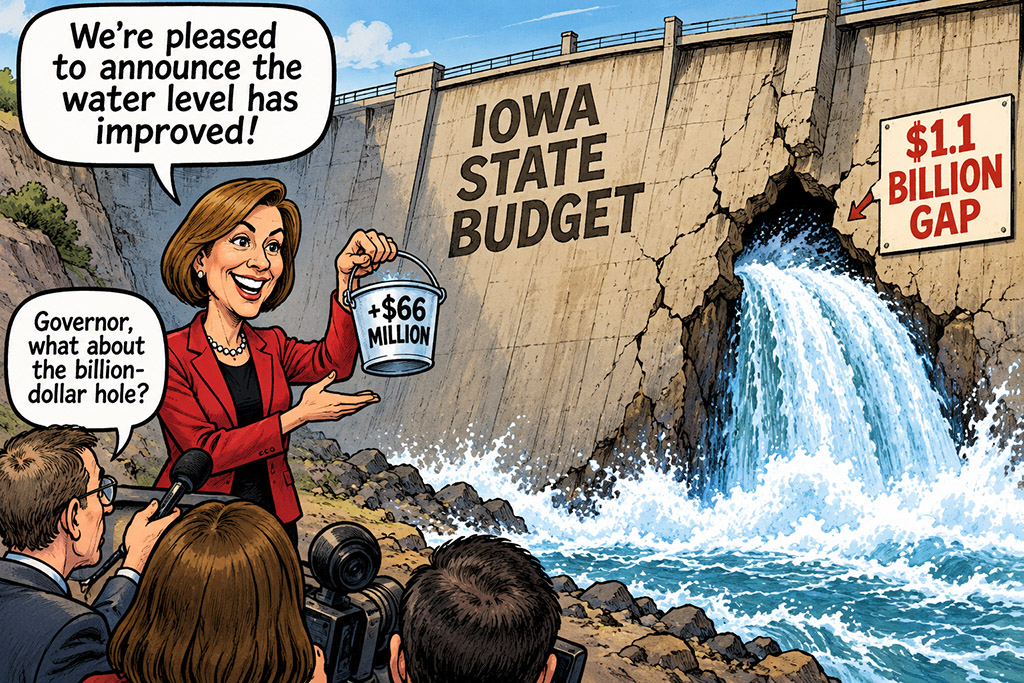
A modest increase in projected revenue does little to change Iowa’s underlying budget problem, or the economic growth Republicans are counting on to solve it.
Iowa’s fiscal outlook is improving. At least, that’s how Gov. Kim Reynolds characterized the latest revenue projections released Friday by the state’s Revenue Estimating Conference.
The three-member panel increased its estimate of fiscal year 2027 revenue by $66 million, bringing projected collections to $8.54 billion. That’s encouraging news. But it comes with a rather significant qualification: Iowa still expects to spend approximately $1.1 billion more than it collects this fiscal year.
Put another way, the improved forecast amounts to less than 1% of projected revenue and covers only about 6% of the state’s anticipated revenue-spending gap. So, how much has Iowa’s fiscal picture really improved?
A Budget Strategy Built on Future Growth
Iowa’s budget problem did not emerge unexpectedly. Republican lawmakers deliberately reduced state income taxes, culminating in a flat 3.8% individual income tax rate that took effect in 2025.
The resulting revenue reductions were anticipated. Rather than immediately reducing spending to match lower collections, lawmakers planned to draw on billions of dollars accumulated in the state’s Taxpayer Relief Fund and other available balances.
The strategy assumes that economic growth will eventually generate enough additional revenue to support ongoing spending without continued reliance on those reserves. That makes Iowa’s fiscal policy something of a race between two competing forces: the rate at which revenues grow and the rate at which the state consumes its accumulated savings. For now, the savings do much of the work.
The Numbers Behind the Optimism
The latest forecast projects revenue growth of 2.8% in fiscal year 2027 and another 3.4% in fiscal year 2028. Those increases follow three consecutive years of declining state revenue. In fiscal year 2026 alone, revenue fell approximately $635 million, or 7.1%.
Even with the projected recovery, fiscal year 2028 revenue of $8.83 billion would remain below the approximately $9.65 billion in spending approved for the current fiscal year. That comparison does not account for any additional spending increases lawmakers might approve in the meantime.
Nevertheless, Reynolds described the latest projections as evidence of a strong and stable financial outlook. Kraig Paulsen, the governor’s representative on the Revenue Estimating Conference, emphasized Iowa’s substantial cash reserves and expressed confidence that the Taxpayer Relief Fund would last until revenues catch up with spending.
That confidence may prove justified. But the projections do not yet establish when that crossover will occur.
Having Savings Is Not the Same as Balancing the Budget
Iowa does have substantial financial reserves. That is an important advantage, providing lawmakers with time to manage the effects of their tax reductions without immediately making equivalent spending cuts.
But reserves are finite. A household with $30,000 in savings and expenses consistently exceeding income may be financially secure today. Whether it remains secure depends on how quickly income increases, or expenses decrease, relative to the rate at which savings are depleted.
The same principle applies to state government. The distinction is between having enough cash to cover a shortfall and generating enough recurring revenue to support recurring obligations.
Republicans argue that their tax reductions will strengthen Iowa’s competitiveness and encourage economic growth. Critics question whether that growth will arrive quickly enough to prevent further depletion of the state’s reserves. Both positions ultimately depend on what happens to revenue, spending, and the economy over the next several years.
The Economic Wild Card
Iowa’s budget strategy also depends on economic conditions that state lawmakers cannot control. Inflation, borrowing costs, agricultural markets, fuel prices, federal trade policies, and broader economic uncertainty can all influence business activity and tax collections.
The Revenue Estimating Conference acknowledged several of those risks Friday. And while Iowa’s economy may experience the growth Republicans anticipate, a modest upward revision to one year’s revenue forecast is not evidence that the state’s longer-term fiscal challenge has been resolved.
The more important question is whether that growth can consistently outpace spending before the reserves intended to bridge the gap are substantially depleted.
What Happens if Growth Falls Short?
That is the question Iowa’s elected officials have yet to answer with a clear timetable. If revenue grows faster than anticipated, the state’s budget strategy could become sustainable without major spending reductions or tax increases.
If growth remains modest, however, lawmakers will eventually face more difficult choices: reduce spending, find additional revenue, or continue drawing down available balances. The latest revenue forecast offers some encouragement, but it does not eliminate those choices.
When the Revenue Estimating Conference meets again in December, Iowans should look beyond whether the revenue estimate has increased by another few million dollars. They should ask how much closer Iowa is to supporting its ongoing expenses with ongoing revenue.
Because an improving forecast is not necessarily an improving fiscal position. And hoping economic growth will eventually close a billion-dollar gap is not the same as demonstrating when, or how, that gap will close.
Sources
The draft draws on the October 16 Revenue Estimating Conference projections, Iowa Public Radio’s reporting on revenue trends and the forecasting panel’s deliberations, the governor’s statement, and the state’s published budget figures.
Energy Prices Push Inflation to 3.7% in September
Gasoline prices surge 34% over the past year as higher living costs continue to squeeze American householdsThe Federal Reserve is considering additional interest rate increases as American households face growing affordability challenges ahead of the midterm...
Lahn’s Running Mate Receives $540,000 Mystery Loan
The money is from an undisclosed LLC that had formed a week earlierA mysterious lender, a newly formed Illinois company, and a substantial private loan raise questions about the finances of Zach Lahn's running mate.Three weeks after Republican gubernatorial candidate...
Elon Musk’s Millions Are Helping Finance Iowa’s U.S. Senate Race
$31 million in Musk's super-PAC contributions have been spent to support the Ashley Hinton campaignTwo political organizations receiving $234 million from the billionaire since July have spent nearly $31 million supporting Ashley Hinson or opposing Josh Turek in...
Glyphosates Not Mentioned at Hinson Water Quality Event
Hinson Promises to Stand Up to Trump, but What About His Support for Monsanto's Roundup?After pledging to challenge Trump on policies harmful to Iowa, Hinson hosts a water-quality and cancer roundtable without addressing his administration's support for glyphosate.On...
Johnson Campaigns for Miller-Meeks Before GOP PAC Pulls Ads
Four Days After Johnson Campaigns for Miller-Meeks, GOP Congressional PAC Cuts FundingThe House speaker appeared with the Iowa Republican on Friday. By Tuesday, a major political organization aligned with his leadership was redirecting planned campaign spending...
Top Republican PACs Pull Funding from Miller-Meeks
Major Republican super PACs withdraw planned advertising support for Iowa Rep. Mariannette Miller-Meeks as they redirect funds to other House racesNational GOP groups redirect campaign spending to other House races, leaving Iowa's 1st District incumbent without...
Putin Calls, and Trump Obeys
After Trump's Call With Putin, Russia Gets Diesel Deal and Ukraine Gets DemandsAfter the call, Trump announced Russian fuel purchases, called for new Ukrainian leadership, and declared a ceasefire neither country had confirmed.Following an October 9 phone conversation...