
Middletown’s Toxic Countdown: How Did Iowa End Up With a Five-Ton Explosives Emergency?
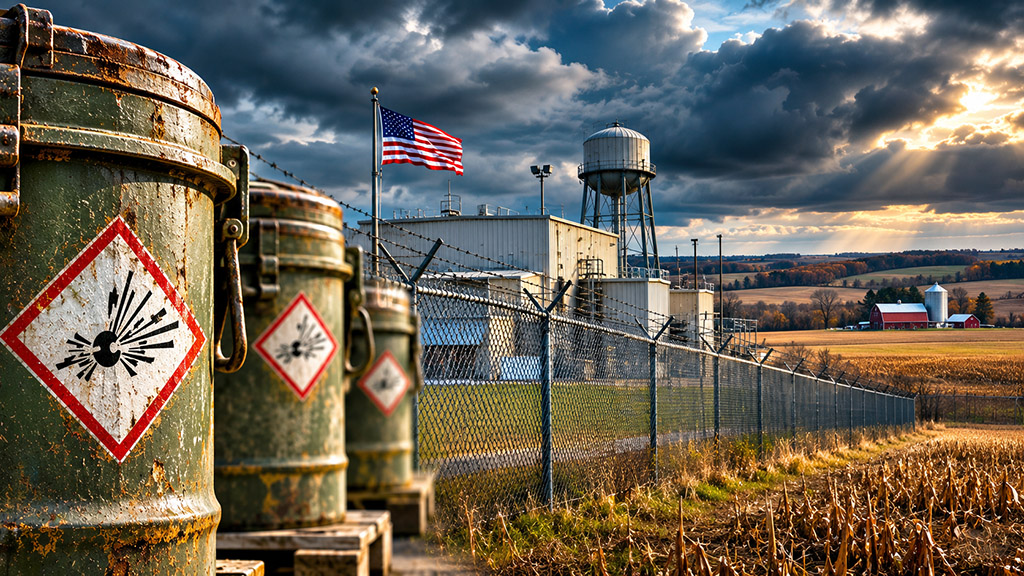
The nation’s lead azide stockpile was transferred to Iowa in 2009 despite evidence of deterioration. Seventeen years later, its planned destruction raises serious questions about military oversight, hazardous materials management, environmental protection and government accountability.
On the eve of Thanksgiving, southeastern Iowa residents are confronting an extraordinary public safety and environmental emergency that appears to have been decades in the making. The U.S. Army is preparing to conduct a controlled detonation of nearly five tons of deteriorated lead azide at the Iowa Army Ammunition Plant in Middletown on Wednesday, November 25. Federal officials maintain that the material has become so unstable that destroying it where it is stored presents less danger than attempting to move or otherwise dispose of it.
Residents in designated areas are being encouraged to temporarily relocate, while others have been advised to remain indoors during the operation. But beyond the immediate emergency lies a troubling revelation: the material represents the nation’s lead azide stockpile, transferred to Iowa in 2009 when signs of deterioration had already been observed. How did a known hazardous materials management concern evolve into a public safety and environmental emergency seventeen years later?
How Iowa Became the Repository for a National Hazard
The Middletown emergency is not simply the result of an aging inventory of explosives at a local ammunition plant. According to information provided by ATF Director Robert Cekada on November 24, and reported by KCRG and Radio Iowa, the nation’s lead azide stockpile was consolidated at the Iowa Army Ammunition Plant in 2009. Some of the material was already more than 60 years old, and authorities had observed evidence of deterioration.
The military transitioned away from using lead azide approximately two years later, citing difficulties associated with its storage and transportation. Yet the stockpile remained in Iowa for another 15 years. Earlier military research, dating to 2004, also addressed concerns about deteriorating lead azide at the Iowa facility, although it remains unclear whether that research involved the same material now awaiting destruction.
These revelations fundamentally change the context of the Middletown emergency. Iowa became the repository for a national stockpile of aging explosive material whose deterioration was already recognized. The immediate emergency may have been identified in 2026, but the underlying hazardous materials management problem was not new.
Seventeen Years of Storage and Oversight
KCRG reports that monthly inspections of the stored material were conducted. The existence of an inspection program, however, raises additional questions about its effectiveness and the actions taken in response to identified hazards.
- What risk assessments supported the decision to consolidate the national stockpile in Iowa in 2009?
- What corrective or preventive actions were taken when deterioration was identified?
- Why was the material retained after the military transitioned away from its use?
- What did subsequent inspections reveal about the condition of the stockpile?
- Were there established criteria for escalating concerns or initiating disposal?
- How were responsibilities divided between the Army and American Ordnance, the contractor operating the facility?
Evidence of deterioration in 2009 does not necessarily mean that the material was already in the critically unstable condition identified in 2026. Nevertheless, the reported history warrants examination of whether earlier intervention could have prevented the current emergency. The existence of an inspection program does not, by itself, demonstrate that the underlying risk was adequately controlled.
A Disposal Alternative That Was Abandoned
Among the most consequential developments is the revelation that the Army had considered an alternative to detonation. Documents reviewed by Iowa Public Radio indicate that American Ordnance contacted a specialist contractor in September 2025 regarding disposal of the material.
In March 2026, inspectors identified dangerous deterioration, and federal environmental regulators were notified.
The Army contracted with MuniRem Environmental, a company specializing in the treatment of explosive materials. According to documents reviewed by Iowa Public Radio, a technical panel initially supported chemical neutralization. Such treatment offered the potential environmental advantage of avoiding the dispersal of lead-containing particles associated with an explosion.
By May, however, the Army had selected controlled detonation, and the chemical treatment contract was subsequently canceled.
Army officials maintain that the condition of the material made handling it too dangerous to pursue chemical treatment safely.
That explanation addresses why the alternative was ultimately rejected. It does not resolve the question of whether chemical treatment or another disposal method might have been feasible had action been taken years earlier.
From an Explosives Emergency to a Public Health Concern
Destroying the explosive material does not eliminate the lead it contains. Federal authorities have implemented measures intended to reduce the release and dispersal of lead-containing dust. Environmental monitoring and sampling are also planned before, during and after the operation.
Nevertheless, residents, farmers and environmental organizations remain concerned about possible contamination of homes, agricultural land, livestock, water supplies and surrounding communities. Lead exposure is particularly concerning for young children and pregnant women. It can cause serious neurological and developmental effects, and no safe blood lead level in children has been identified.
The actual extent of any environmental contamination will not be known until monitoring and testing are conducted. Predicted exposure levels should not be confused with measured environmental outcomes. Similarly, the successful completion of the detonation should not be interpreted as confirmation that all environmental and public health risks have been eliminated.
Legal Challenges and Delayed Public Notification
The Iowa Environmental Council and Sierra Club challenged the emergency permit issued by the U.S. Environmental Protection Agency, raising concerns about the evaluation of alternatives, environmental safeguards and opportunities for public participation. A federal appeals court subsequently allowed the operation to proceed, removing an immediate legal obstacle to the planned detonation.
The ruling does not, however, resolve broader questions about the historical management of the stockpile. Iowa Public Radio reports that Gov. Kim Reynolds’ office learned of the planned detonation on November 16, despite federal agencies having been involved in addressing the deteriorating material for months.
For residents confronting temporary relocation decisions immediately before Thanksgiving, the timing of public notification is itself a significant concern. When did federal officials recognize that disposal could present risks to surrounding communities? What information was shared with state and local emergency management authorities? Could residents have been informed earlier? These questions deserve documented answers.
A National Responsibility, a Local Burden
The circumstances surrounding the Middletown emergency extend well beyond southeastern Iowa. The decision to consolidate the national stockpile in Iowa occurred in 2009. The military subsequently transitioned away from the material, while its storage, inspection and management continued across multiple presidential administrations. The resulting emergency therefore warrants examination as a matter of institutional responsibility, rather than simply the actions of current officials or the immediate decisions surrounding Wednesday’s detonation.
Federal authorities now face a difficult choice. Allowing increasingly unstable explosive material to remain in storage may present unacceptable risks, while its controlled destruction carries potential environmental and public health consequences. Accepting the necessity of the emergency response, however, does not require accepting the circumstances that made it necessary.
A comprehensive investigation must examine:
- The original decision to consolidate the national stockpile in Iowa.
- Historical inspection, maintenance and risk assessment records.
- Decisions concerning the retention and disposal of obsolete explosive materials.
- Federal oversight of facility operations and contractor performance.
- The evaluation and subsequent rejection of alternative disposal methods.
- Communication with state officials, local authorities and affected communities, and
- Responsibility for environmental testing, remediation and potential economic losses.
The investigation should also determine whether comparable hazardous legacy stockpiles exist at other military installations.
The Explosion Is Not the End of the Story
Wednesday’s planned detonation may eliminate the immediate explosive hazard at Middletown. It will not resolve the questions surrounding how that hazard developed, nor will it automatically eliminate its potential environmental consequences. Iowans deserve timely access to environmental monitoring results, transparent reporting of any detected contamination, independent verification where appropriate, clear cleanup commitments and information about assistance available to affected residents and agricultural operations. They also deserve a comprehensive accounting of the decisions made over the past seventeen years.
The immediate priority is protecting the public. The longer-term responsibility is determining how a known national hazardous materials management concern became an emergency for southeastern Iowa — and ensuring that it does not happen again. The national stockpile was transferred to Iowa. The responsibility for its management must remain national.
Sigourney Kinder Morgan Pipeline Explosion Seriously Injures One
Kinder Morgan Pipeline Explosion in Keokuk County, IowaA pipeline explosion in Keokuk County sends one person to the hospital as questions remain about the cause, circumstances and safety implications of the incident.The explosion, north of Sigourney on Monday...
A New Chapter for Iowa
The election is over, and now is the time for Iowans to work together in a time of healingElection night brought political change. Now comes an opportunity for Iowans to come together, restore trust, and chart a better future for our state.For months, Iowans have...
Dems Win Congress and Major Iowa Midterm Elections
Democrats capture both chambers of Congress, Iowa's governorship, U.S. Senate seat, attorney general's office, and three congressional districts. Republicans retain control of the Iowa Legislature.National Results Democrats won control of both the U.S. House of...
Iowa Farmers Union Endorses Josh Turek
Iowa Farmers Union pushes for Turek, the first federal candidate the group has endorsed in yearsBy Cami KoonsIowa Capital Dispatch Iowa Farmers Union has not endorsed federal candidates for at least 14 years, but is urging farmers to vote for Josh Turek in the race...
Joe Mitchell Names Trump “Man of the Century” at Sioux City Rally
Mitchell Goes "All In" for Trump at the October 22 Sioux City RallyJoe Mitchell presents Trump with a man of the century award. Human-directed AI-generated image.Iowa's 2nd District congressional candidate called Trump the greatest president in American history and...
Did Joni Ernst Have “Very Prosperous” Years in Washington?
Trump: Ernst Had “Very Prosperous Years” in Washington, and Other Remarks You May Have Missed at His Sioux City RallyTrump and Joni Ernst at the Sioux City political rally. Human-directed AI-generated image.At his October 22 rally in Sioux City, President Donald Trump...
Chuck Grassley’s Partisan Rhetoric Does Not Withstand Scrutiny
A Critical Thinking Exercise: Chuck Grassley's Recent Des Moines Register EditorialSelective facts, loaded language, unsupported predictions, and a billion-dollar omission reveal how political arguments can persuade without proving their conclusions.In his October 22...